




Do you find yourself constantly seeking validation from your partner, or quietly afraid that one day they'll leave you for someone better?
If those thoughts feel familiar, you may be living with low self-esteem in your relationship — and you are far from alone in it.
It is a deeply personal struggle, and a quiet one. It rarely announces itself. Instead, it builds invisible barriers between you and the closeness you are hoping for, coloring every interaction with a little doubt.
It is that nagging voice that whispers you are not good enough, not smart enough, or not attractive enough to truly deserve love.
When your sense of worth becomes tangled up in romantic validation, it sets off a cycle of insecurity that can slowly wear down even the strongest bond.
Learning to recognize that pattern is the first, gentlest step toward loosening its grip — and it matters for both your emotional well-being and the health of your relationship.
Self-worth isn't only about feeling good about yourself. It is the quiet foundation underneath healthy communication, trust, and real intimacy.
The moment you start noticing the signs of low self-esteem, you have already begun building the secure, loving relationship you deserve.
Understanding Low Self-Esteem in Romantic Relationships
Relationship insecurity rarely appears out of nowhere. It usually grows out of earlier experiences — childhood patterns, past relationships, or the quiet pressures of comparison — and shapes how you see yourself and whether you feel worthy of love.
Unlike the occasional moments of doubt everyone feels, chronic low self-esteem settles in and starts to color your daily interactions with your partner.
And the impact reaches further than just feeling bad about yourself. Emotional insecurity influences how you communicate, how you set boundaries, how you handle conflict, and how openly you express your needs.
It is a little like wearing tinted glasses: everything your partner says and does gets filtered through doubt and fear before it ever reaches you.
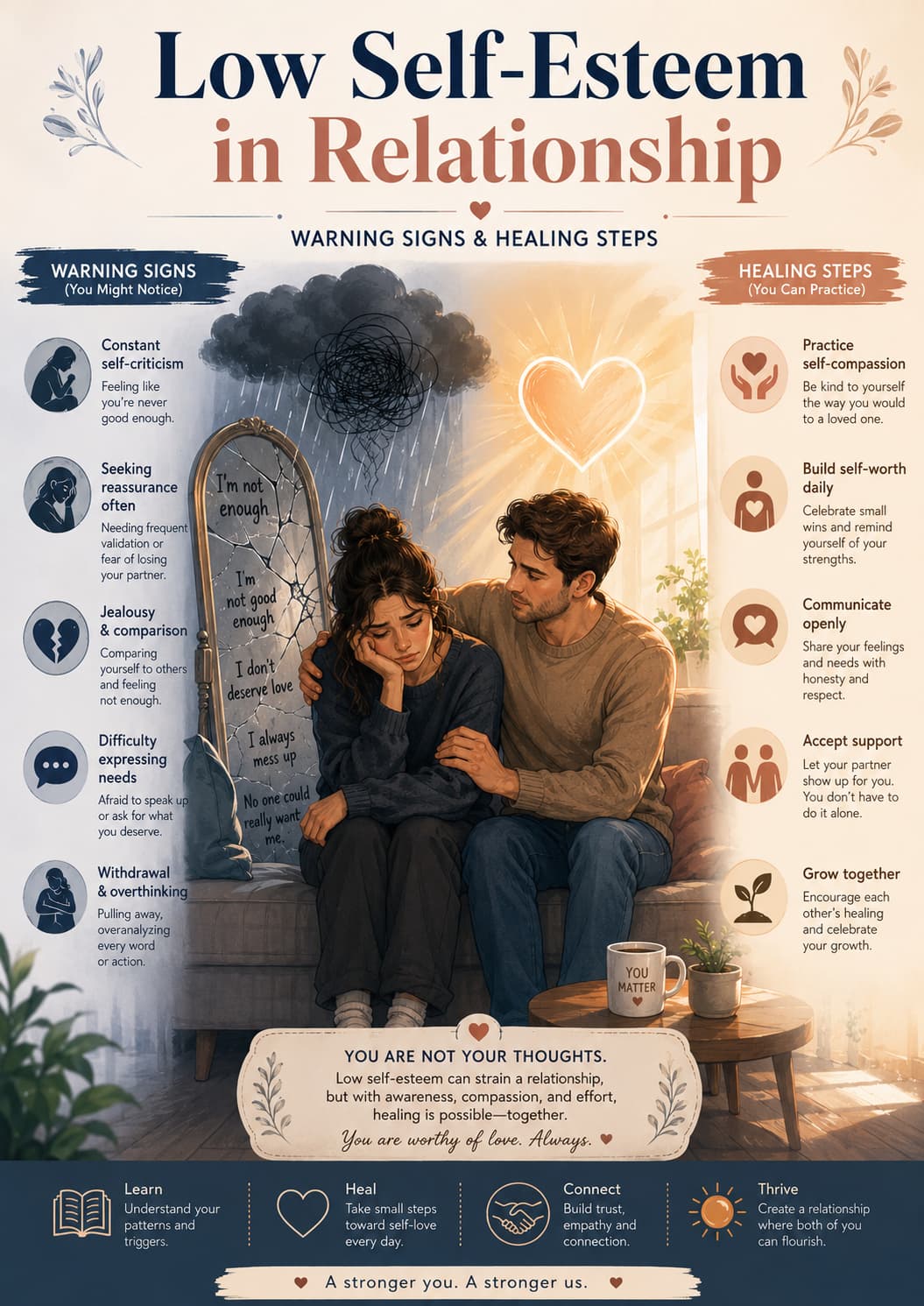
11 Signs of Low Self-Esteem in a Relationship
1. Constant Need for Reassurance

You find yourself asking your partner the same kinds of questions again and again — "Do you still love me?" or "Are you sure I look okay?"
A little reassurance is part of any healthy relationship. It becomes something to watch when you need constant validation just to feel secure.
Common Reassurance-Seeking Behaviors:
- Repeatedly asking if your partner is happy in the relationship
- Seeking confirmation about your appearance, intelligence, or worth
- Feeling anxious when your partner doesn't respond immediately to texts
- Interpreting normal mood changes as signs of rejection
Over time, this can quietly exhaust both of you. It also tends to feed itself — the more you reach for validation from outside, the more your own insecurity grows.
2. Difficulty Setting Boundaries
People-pleasing is one of the clearest signatures of low self-esteem. You might say yes to things you don't really want to do, avoid difficult conversations, and put your partner's comfort ahead of your own needs — almost without noticing it.
How Poor Boundaries Show Up:
- Agreeing to activities you dislike to avoid disappointment
- Difficulty saying no to requests that make you uncomfortable
- Avoiding discussions about your needs or preferences
- Feeling guilty when you express your opinions
Without healthy boundaries, a relationship slowly tips out of balance, and quiet resentment has room to build.
3. Fear of Abandonment or Rejection
This deep-seated fear shapes the way you trust and attach. You might catch yourself walking on eggshells, convinced that one wrong move will be the thing that makes your partner leave.
Signs of Abandonment Fear:
- Avoiding topics that might lead to conflict
- Staying in unhealthy situations rather than risking being alone
- Interpreting normal relationship challenges as threats to the relationship
- Feeling panic when your partner needs space or time alone
Sadly, this fear often becomes a self-fulfilling prophecy — the anxiety it creates is exactly what ends up pushing a partner away.
If this is something you recognize in yourself, our guide on how to feel secure in a relationship walks through gentle, practical ways to rebuild that sense of safety.
4. Overthinking and Catastrophizing
Overthinking pulls you into worst-case scenarios and makes you read trouble into perfectly innocent moments. You replay conversations long after they're over, searching for hidden meanings and signs of something wrong.
Overthinking Patterns Include:
- Analyzing every text message for tone and hidden meaning
- Assuming the worst when your partner seems distracted or quiet
- Creating elaborate scenarios about potential problems
- Losing sleep over minor relationship hiccups
This mental habit manufactures stress that was never really there, and it quietly robs you of the present moment with the person right in front of you.
5. Comparing Yourself to Your Partner's Exes or Others
Comparison and self-esteem don't mix well, and social media pours fuel on the fire. You might find yourself quietly scrolling through your partner's ex, or feeling smaller every time another couple's highlight reel appears on your screen.
The Comparison Trap Involves:
- Constantly measuring yourself against your partner's past relationships
- Feeling threatened by your partner's friendships with attractive people
- Believing you're not as good as the people in your partner's life
- Using social media as a tool for self-torture rather than connection
It helps to remember that social media almost never shows the full picture — not of anyone's life, and certainly not of anyone's relationship.
6. Struggling to Express Needs or Concerns
When you don't quite trust the value of your own feelings, speaking up becomes hard. You might find it difficult to say what you need or want, and easier to simply go quiet.
Communication Struggles Show Up As:
- Minimizing your feelings or concerns
- Avoiding conversations about relationship problems
- Feeling like your needs don't matter
- Expecting your partner to read your mind rather than communicating directly
Open communication is the lifeblood of a healthy relationship, but low self-esteem makes it feel risky and exposing — as if your needs aren't quite allowed to take up space.
7. Changing Your Personality to Please Your Partner
You might notice yourself reshaping your behavior, your interests, even your values to fit what you think your partner wants. This goes well beyond healthy compromise — it is the slow erosion of who you actually are.
Personality Changes Include:
- Pretending to like things you don't actually enjoy
- Changing your opinions to match your partner's
- Suppressing parts of your personality that you think might be "too much"
- Feeling like you don't know who you really are anymore
Every relationship asks for some flexibility. But holding on to your authentic self is what keeps the connection real — and what makes lasting happiness possible.
8. Hypersensitivity to Criticism or Feedback
When your self-esteem is low, even gentle feedback can land like a personal attack. You might react defensively to a small piece of constructive criticism, or shut down completely the moment your partner tries to raise a concern.
Hypersensitivity Manifests As:
- Taking constructive feedback as evidence that you're not good enough
- Becoming defensive or emotional when issues are raised
- Avoiding feedback altogether to protect your feelings
- Interpreting neutral comments as criticism
The trouble is that this makes it hard to grow together. Couples need to be able to talk honestly about what isn't working, and hypersensitivity quietly closes that door.
9. Jealousy and Possessiveness
Jealousy and possessiveness usually grow from the same insecure soil — a worry about your own worth and a quiet doubt about your partner's commitment. You might catch yourself monitoring their activities, feeling threatened by their friendships, or needing constant proof of their loyalty.
Possessive Behaviors Can Include:
- Checking your partner's phone or social media
- Feeling threatened by their friendships or work relationships
- Needing to know where they are at all times
- Feeling anxious when they spend time away from you
A flicker of jealousy now and then is human. But when it tips into possessiveness, it starts to erode the very trust the relationship needs to feel safe.
10. Sacrificing Your Own Happiness
You might find yourself placing your partner's needs ahead of your own again and again, even when it quietly costs you your own well-being. This is more than the give-and-take of a healthy relationship — it is the slow neglect of yourself.
Self-Sacrifice Patterns Include:
- Giving up your hobbies, friends, or interests for the relationship
- Ignoring your own emotional or physical needs
- Feeling guilty when you do things for yourself
- Believing that your happiness is less important than your partner's
A healthy relationship needs two whole people. Both partners have to keep tending to their own happiness for the love between them to stay alive.
11. Feeling Unworthy of Love or Affection
Perhaps the deepest sign of all is the quiet belief that you simply don't deserve love, care, or affection. That single belief can sabotage intimacy from the inside, making it almost impossible to fully receive the love your partner is offering.
Feeling Unworthy Shows Up As:
- Questioning why your partner chose you
- Waiting for them to realize you're not good enough
- Pushing away affection or compliments
- Believing that everyone else deserves love more than you do
Left unexamined, this belief becomes a wall between you and the closeness you long for.
How Low Self-Esteem Impacts Relationships
The effects of low self-confidence reach far beyond your own private feelings. When one or both partners are quietly struggling with self-worth, it changes the whole shape of the relationship.
Communication Breakdown
Communication strains when insecurity gets in the way of saying what you honestly feel and need. Instead of speaking plainly, partners drift into passive-aggressive hints, mind-reading, or simply avoiding the hard conversations altogether. If that sounds familiar, our guide on how to fix communication in a relationship covers practical ways to start talking openly again.
Trust Issues
Trust gets shaky when low self-esteem spills out as jealousy, possessiveness, or a constant hunger for reassurance. The steady sense of security a relationship runs on is hard to maintain when one partner can't yet trust their own worth.
Intimacy Challenges
Intimacy suffers when vulnerability starts to feel too dangerous. Real closeness asks you to be open and authentic, and low self-esteem makes exactly that feel exposing instead of safe.
It is hard to overstate how much self-worth shapes all of this. When you don't value yourself, it becomes genuinely difficult to believe that anyone else truly can — and so insecurity quietly breeds more insecurity, sometimes pushing away the very love you are reaching for.
Building Self-Esteem in Your Relationship
Recognition is the starting point, but real change takes intentional effort — and, for many people, some professional support along the way. Here are gentle, evidence-based strategies that can help.
Practice Self-Compassion
Try to treat yourself with the same kindness you would offer a good friend. When you stumble or face something hard, meet it with understanding instead of harsh self-criticism.
Challenge Negative Self-Talk
Notice the moments when your inner voice turns critical or catastrophic, and pause to ask: is this thought actually helpful, and is it based on facts or just on fear?
Set Healthy Boundaries
Start small, by saying no to things that don't sit right with your values or your well-being. Boundaries and self-esteem are closely linked — when you respect your own limits, you quietly teach others to respect them too.
Engage in Self-Care
Caring for yourself isn't selfish — it is what allows you to show up well for someone else. When you tend to your physical, emotional, and mental health, you become a steadier, more present partner.
Practice Gratitude
Gently turn your attention toward what is already going well in your life and your relationship. Gratitude has a quiet way of shifting focus from what feels missing to what is genuinely there.
Seek Professional Support
Therapy can offer tools and insight that are hard to reach on your own. A qualified therapist can help you understand where your insecurity took root, and walk with you toward healthier ways of coping.
Communicate Openly
When the moment feels right, share your struggles with your partner. Many people are surprised to find that being honest about their insecurities actually deepens the bond rather than weakening it.
Develop Your Individual Identity
Keep your friendships, hobbies, and interests alive outside the relationship. Two people who keep growing as individuals tend to grow closer as a couple — it is one of the quiet foundations of a long-lasting relationship.
When to Seek Professional Help
Self-help strategies can carry you a long way, but some situations genuinely call for professional support. It may be time to reach out if:
- Your insecurity is significantly impacting your daily life or relationship
- You're experiencing symptoms of depression or anxiety
- You have a history of trauma that affects your relationships
- Self-help strategies aren't providing relief
- Your partner is also struggling with similar issues
Couples therapy can be especially helpful when both partners are willing to grow. A skilled therapist offers tools for rebuilding trust and reshaping the communication patterns that have been holding you back.
FAQs - Low Self-Esteem in Relationship
Can low self-esteem ruin a relationship?
Left unaddressed, it certainly can do real damage. The constant need for reassurance, the jealousy, the strained communication, and the difficulty setting boundaries can settle into toxic patterns that slowly push a partner away. The hopeful part is that, with awareness and effort, those patterns can absolutely be changed.
How can I support a partner with low self-esteem?
Supporting a partner with low self-esteem takes patience, consistency, and clear boundaries of your own. Offer genuine compliments, be reliable and trustworthy, and encourage their growth — while gently avoiding the trap of enabling endless reassurance-seeking. And remember, kindly, that you can't fix your partner's self-esteem for them; that is work only they can do.
What are effective ways to improve self-worth?
Improving self-worth is a gradual process. It usually means challenging negative thought patterns, practicing self-compassion, setting and achieving small goals, caring for your physical and mental health, and often working alongside a therapist. It tends to go best when both partners are committed to growing together.
How long does it take to build self-esteem?
Building self-esteem is more of a lifelong journey than a destination. Some people notice real improvements within a few months of steady effort, while others need longer, especially when there are deeper wounds or past trauma involved. What matters most is persistence — and offering yourself plenty of compassion along the way.
Is it normal to have some insecurity in relationships?
Yes — the occasional wobble of insecurity is completely normal. The difference lies in frequency and intensity. A healthy relationship still holds room for vulnerability and the odd moment of doubt; those feelings just shouldn't dominate your days or quietly run your life.
How do I know if my low self-esteem is affecting my relationship?
A few honest signs: you constantly seek reassurance, feel jealous without real cause, struggle to voice your needs, or find yourself changing who you are to please your partner. If you recognize several of the patterns from this article showing up in your day-to-day interactions, it is very likely shaping your relationship and your overall happiness.
How can I stop comparing myself to others in my relationship?
Start by limiting your social media exposure, and practice gratitude for your own unique qualities. Focus on the private, real moments of your relationship rather than anyone's public highlight reel, remembering that people only ever show their best online. When a comparison thought arrives, you can gently challenge it — "is this helping me grow?" — and redirect that energy toward your own development and honest conversation with your partner.
What should I do when my partner criticizes me, and it triggers my insecurity?
Take a breath before you react. Ask for clarification about the specific behavior rather than hearing it as an attack on your character, and let your partner know how certain feedback lands for you. It helps to distinguish constructive feedback from harmful criticism, and to set boundaries around respectful communication. Quietly ask yourself whether the criticism comes from a place of love or of control — healthy relationships are built on supportive feedback, never on attacks on your worth.
Why do I have low self-esteem in relationships?
Low self-esteem in relationships often traces back to earlier experiences — childhood attachment patterns, previous relationship trauma, cultural pressures around beauty and success, or a family environment that didn't nurture a sense of worth. Understanding those roots, through self-reflection or therapy, lets you address the real cause rather than just the symptoms.
Do men also struggle with low self-esteem in relationships?
Absolutely — low self-esteem affects people of every gender. Men may simply express it differently: through emotional withdrawal, overworking, avoiding vulnerability, or becoming controlling. The underlying signs and solutions are largely the same, even if social expectations shape how it shows up on the surface.
What are specific signs of low self-esteem in women?
In women, low self-esteem often shows up as constant apologizing, downplaying achievements, seeking validation through appearance, comparing themselves to other women, struggling to accept compliments, people-pleasing to avoid conflict, and feeling guilty for taking time for themselves. Body image and social comparison can weigh especially heavily, thanks to the cultural pressures many women carry.
Conclusion
Recognizing the signs of low self-esteem in your relationship is the first step toward the loving, secure connection you truly deserve. These patterns can feel overwhelming, but they are not permanent — with awareness, effort, and often some professional support, you can grow the self-worth that healthy, fulfilling relationships are built on.
Your relationship with yourself quietly sets the tone for every other relationship in your life. When you learn to value, respect, and care for yourself, you create the space for others to do the same. This was never about becoming perfect. It is about becoming authentic, boundaried, and genuinely connected to your own worth.
The journey takes time, patience, and often the support of others — but it is worth every bit of it. As you build a healthier relationship with yourself, you don't just become happier as an individual; you become a better partner, friend, and family member too.
So please remember: you deserve love, respect, and happiness. You deserve a relationship where you can be your full, authentic self without fear of rejection or abandonment. The work you do on yourself today becomes the foundation for the love story you want to live tomorrow.
If you're ready to begin, choose just one area from this article to focus on this week. Whether it is setting a small boundary, challenging a single negative thought, or simply treating yourself with a little more compassion, small steps have a way of adding up to real change over time.