

Menu

Nobody warns you that the hardest part of marriage isn’t the big dramatic stuff. It’s the Tuesday nights. The ordinary moments where you choose each other again, or quietly don’t.
Most marriage advice skips right past that. You get the pretty quotes, the someday-you’ll-understand smiles, and the cookie-cutter tips that sound lovely until real life shows up at the door.
This isn’t that. What follows is honest. None of it is groundbreaking — some of it you’ve probably heard before. But there’s a wide gap between hearing something and actually living it, and that gap is where most of us get stuck. Love that lasts is built, not found. These are some of the bricks.

Somewhere along the way a lot of couples start keeping score, and once you’re keeping score you’ve already lost — both of you. The goal was never to be right. It was to get through the thing together and still like each other on the other side.
Next time you feel the argument tightening, try saying it out loud: we’re on the same team here. It sounds almost too simple. It works anyway.
This is the unromantic part nobody likes admitting. When you were dating, closeness happened on its own. Married, with jobs and kids and a mortgage, it mostly doesn’t. It waits for an opening that never comes.
So you make the opening. Fifteen minutes before bed with no phones. A standing Friday. Whatever fits your life. Putting connection on the calendar feels clinical right up until the week you skip it and feel the difference. (More on protecting that time in our guide to quality time in marriage.)
Your partner can’t read your mind, and resentment grows beautifully in the space between what you wanted and what you actually said. “I wish you’d help more” gives them nothing to do with. “Can you take the kids Tuesday and Thursday nights?” gives them something to say yes to.
Counselors teach a small formula for this: name the feeling, name the moment, name the ask. I feel stretched thin when bath time lands on me every night. I need you to take two of them. Awkward at first. Then it just becomes how you talk. (Our guide on how to fix communication in a relationship has more of these.)
Here’s a hard one for the fixers. When your partner comes to you upset, the instinct is to solve it. Often they don’t want it solved. They want to be heard by the one person whose opinion they actually care about.
You can just ask: do you want me to help, or do you want me to listen? It saves a remarkable number of pointless fights.
You flirted your way into this. There’s no rule that says it has to stop at the wedding. A text in the middle of a boring workday. Noticing the shirt. Catching their eye across a crowded room like you still can’t quite believe your luck.
It costs nothing and it keeps something alive that quietly dies in a lot of long marriages — the sense that you still choose this person, not just live with them.
The person you married at twenty-five is not the person you’ll be married to at forty-five. People grow. Their dreams shift. That’s not a betrayal of the deal — it is the deal.
The trick is to grow toward each other on purpose, and to treat your partner’s changes with curiosity instead of fear. “You’ve changed” can be an accusation. It can also just be true, and even a little wonderful.
If one of you snores like a chainsaw or kicks all night, and you’ve both been quietly exhausted for years, you’re allowed to sleep apart. No marriage was ever saved by lying awake resentful at 3 a.m.
Rest makes you kinder. Kindness makes the marriage. Do the math however works for your bodies, and skip the guilt.
The big betrayals get all the attention, but most marriages aren’t undone by one explosion. They’re worn down by a thousand small hurts nobody ever bothered to clear. The forgotten promise. The tone. The thing they always do.
You can’t store those up. You let them go in small batches, regularly, the way you’d empty a trash can before it overflows. Forgiveness in a marriage isn’t one grand gesture — it’s a maintenance habit. (We go deeper on this in apology and forgiveness in marriage.)
Don’t panic the first time the spark dims. It will. It comes back. Distance doesn’t mean the love is gone — usually it just means life got loud and the two of you stopped checking in. (When that drift goes unchecked for too long, it can harden into marriage burnout.)
A simple question, asked now and then: how are we doing, you and me? Not the kids, not the bills. You two. Most couples never ask it until something’s already broken.
When you find yourself genuinely furious about a sink full of plates, it’s worth pausing. The plates are rarely the point. Underneath is usually something quieter: I feel like I’m carrying this alone. I don’t feel seen. You don’t seem to notice what I do.
Get to that, and the dishes more or less sort themselves out.
The relationship researcher John Gottman spent decades watching couples and found that the ones who lasted shared roughly five positive moments for every negative one — a glance, a thank-you, a small kindness. The ratio holds up because nobody stays soft toward a person who only ever points out what’s wrong.
So say the good things you usually only think. The dinner was great. You handled that call well. I’m glad it’s you.
Instagram shows you the anniversary post, not the silence on the drive home. The surprise trip, not the argument that funded the guilt behind it. Every couple you envy is also, somewhere, doing the unglamorous work — or quietly falling apart while smiling for the camera.
Your marriage isn’t behind. It’s just yours, and it’s the only one you actually have to live in.
You don’t need a sitter and a tasting menu. You need each other’s full attention for an hour, which is harder to come by than money these days. A walk after dinner. Coffee in the car before the day starts. Thirty minutes with both phones in the other room.
The luxury isn’t the venue. It’s being properly looked at by the person you love.
You’re allowed to want a quiet hour with a book and no one needing anything from you. That’s not selfish and it’s not a sign that something’s wrong with the marriage. It’s how you refill so you have something left to give.
A person who never gets a moment to themselves slowly turns into someone they don’t like. Protect your peace. You’ll come back warmer for it.
This is the one that ends marriages while everyone insists things are fine. Unspoken frustration doesn’t disappear. It hardens, slowly, into distance — and by the time it finally comes out, it’s been collecting interest for years. (It’s one of the quieter forces behind the kind of slow drift our guide on how to avoid divorce is built around.)
Catch it early. Say the small annoyance while it’s still small and reasonable, before it becomes the thing you bring up in every fight for the next decade.
A lot of people only think about therapy when the marriage is already on fire, then treat going as an admission of failure. Flip it. Couples counseling is closer to a gym membership: you go to stay strong, not because you’ve collapsed.
Some of the steadiest couples you know have sat on a therapist’s couch on purpose, with nothing dramatic going on. That’s not weakness. That’s maintenance.
Bottling it up feels noble — you’re keeping the peace, not making a fuss. But silence doesn’t protect a marriage. It just quietly starves it, and leaves your partner confused about why you’ve gone cold. (Feeling safe enough to say the hard thing is part of feeling secure in a relationship.)
Give him the chance to show up for you. Say the thing, even when your voice shakes. People can only reach for you if they know where you’re standing.
Gary Chapman built a whole framework around this: some people feel loved through words, others through time, touch, help, or small gifts. What’s easy to forget is that it shifts. What landed for your partner ten years ago, in a different season of life, might not land now.
So don’t assume. Ask, every so often: what makes you feel most loved these days? The answer is allowed to surprise you.
Some seasons, one of you simply has to carry more — a new baby, an illness, a brutal stretch at work. Insisting on a perfect even split through all of it just turns the marriage into an accounting dispute.
Real partnership means trusting that it evens out over the long run, and being the one who carries more when it’s your turn, without keeping a ledger about it. (Our guide on the division of labor in marriage digs into how to keep it fair without scorekeeping.)
For the coffee. For taking the bins out. For going to work on a grey Monday for the hundredth time. The small thank-yous are easy to drop once you’ve gotten comfortable, and dropping them is exactly how comfort curdles into being taken for granted.
Gratitude, said out loud and often, is one of the cheapest and most powerful things you can do for a marriage.
No relationship stays strong on autopilot. The vows were one big yes; the marriage is a thousand small ones, said quietly, especially on the days you don’t feel like it. I’m choosing you today — even when today is hard, even when you’re tired, even when they left the cabinet open again.
That daily, unglamorous choice is the whole thing. Everything else is decoration.
The couples who feel close usually have little anchors woven through the week — coffee together before the house wakes up, a walk after dinner, Sunday morning with nowhere to be. Nothing fancy. Just yours.
Rituals give a marriage a rhythm to return to when life gets chaotic. They’re the small, repeated proof that you keep coming back to each other on purpose.
Everyone has an opinion about your relationship — your mother, your best friend, the group chat. Some of it is loving. Not all of it deserves a vote. The fastest way to weaken a marriage is to let too many outside voices into the room where you two are supposed to figure things out.
Sort it out privately. Present a united front. What happens between you stays between you, unless you both decide otherwise.
You’re going to mess up — both of you, regularly. What separates the couples who last isn’t fewer fights; it’s how quickly they find their way back. A softened tone mid-argument. A hand on a shoulder. A small I’m sorry, let me try that again.
Gottman called these “repair attempts,” and they matter more than the fight itself. A clumsy repair beats a perfect silence every time.
It’s strange, but you can share a bed with someone for twenty years and slowly stop being curious about them. You assume you already know. Mostly you know the old version.
Keep asking. What are they afraid of now? What do they want that they’ve never said out loud? Curiosity is what kept you up talking at the beginning, and it’s what keeps a marriage feeling alive long after the beginning is over.
Marriage was never about getting it perfect. It’s about showing up, owning it when you get it wrong, and choosing the same person again and again with your eyes open.
You don’t need all twenty-five of these at once. Pick the two or three that landed hardest — the ones that made you a little uncomfortable, probably — and live them for the next month. That’s enough. A strong marriage isn’t built in a weekend. It’s built the same way it’s always been built: one ordinary, intentional day at a time.
If it came down to one: stay emotionally safe with each other. Keep choosing connection over being right, and stay curious about who your partner is becoming. Everything else grows out of that.
Gently, and on purpose. Talk honestly about what makes each of you feel close — emotionally and physically — and then actually make room for it instead of waiting for it to happen on its own.
Yes, and it usually isn’t the end. Love is partly a feeling and partly a daily decision. When the feeling dims, the decision is what carries you back. Most couples drift and reconnect more than once.
Look underneath them. The small fight is almost always standing in for a bigger feeling — feeling unseen, unappreciated, or alone. Name the real thing and the little fights lose most of their fuel.
Sooner than you think you need to. Counseling works best as upkeep, before things feel broken — not as a last resort once the damage is deep.
A short, honest check-in once a week does more than most couples expect. You don’t have to wait for a crisis to ask how the two of you are doing.
Both of these come up by name in the tips above — and both are worth the shelf space:
As an Amazon Associate, EyesMata may earn from qualifying purchases — at no extra cost to you.
Divorce is one of the most painful decisions a couple can face. It doesn't only affect the two people in the marriage — it reaches children, extended family, and close friends, and the emotional, financial, and mental weight of it can stay with everyone for a long time.
But here's the truth that's easy to miss when you're hurting: in many cases, divorce is preventable. With honest effort, open communication, and a willingness to grow, couples can work through their hardest seasons and come out with a stronger bond. If you're wondering how to avoid divorce and save your marriage, you're not alone — and you're in the right place.
Emotional distance, constant arguing, money strain — these are painful, but they don't automatically mean the end. More often, they're signals. Your relationship is asking for attention, care, and effort, not handing down a verdict that it's over.
What follows is honest, practical guidance — grounded in research and real experience — for couples who want to reconnect. From rebuilding trust to restoring emotional and physical closeness, each step is something you can actually begin today. Let's walk through it together.
Before you can prevent divorce, it helps to understand what tends to cause it. You may have heard that half of all marriages end in divorce — but that figure is dated. More recent research shows the rate has actually been falling, with roughly 40% of first marriages ending in divorce today. The common reasons couples struggle are still worth knowing, because awareness is where prevention begins:
Recognizing these early warning signs gives couples the chance to act before the distance becomes permanent. Prevention almost always starts with honest awareness.
One of the most important things you can do to protect your marriage is to improve how the two of you communicate. Poor communication quietly feeds misunderstanding, resentment, and emotional distance.
Healthy communication doesn't mean you never argue. It means you argue with respect, and with the goal of understanding each other rather than winning.
Money is one of the most common pressure points in a marriage. Whether it's debt, an income gap, or different views on spending, financial stress can escalate fast when it's left unspoken.
Financial transparency builds trust. If money fights keep repeating, a financial counselor who works with couples can help you find neutral ground.
Every couple argues — what matters is how. Handled badly, conflict chips away at the relationship; handled well, it can actually deepen it. Unresolved fights are one of the biggest drivers of emotional withdrawal, and eventually, divorce.
When conflict is handled with respect, couples tend to feel more connected and more heard — which is exactly what lowers the risk of things falling apart.
A loss of emotional and physical closeness is one of the most common threads in marriages that end. Many couples don't blow up — they slowly drift, until they feel more like roommates than partners. Rebuilding that closeness, and a real sense of security with each other, is some of the most important work you can do.
When closeness fades, emotional distance follows. Tending to this connection is quietly one of the most protective things you can do for your marriage.
In the age of social media, it's easy to believe everyone else has a perfect relationship. That comparison breeds quiet dissatisfaction, jealousy, and resentment — none of which your marriage needs.
Your marriage doesn't have to look like anyone else's. It only has to work for the two of you.
A strong marriage is built by two emotionally healthy people. Many marriages strain simply because one or both partners are exhausted, anxious, or disconnected from their own needs.
You can't pour from an empty cup. Your own growth gives the relationship a steadier foundation to stand on.
Isolation is hard on a struggling marriage. When you're cut off from friends and family, every bit of pressure lands heavier on the two of you.
A community that values commitment can quietly strengthen your own resolve to keep working things out.
Therapy isn't only for couples on the edge of divorce. Plenty of healthy marriages check in with a counselor now and then just to stay emotionally aligned.
You don't have to wait until the damage runs deep. Even a few sessions with a licensed marriage therapist can shift things.
Couples who grow together tend to stay together. Shared dreams and goals help both partners feel like they're on the same team.
A shared vision keeps a marriage feeling alive and pointed forward, instead of stuck.
There will be seasons when love feels like hard work. Strong couples understand that commitment is a daily choice, not just a feeling that comes and goes.
Choosing each other — again and again — is, in the end, the real secret to avoiding divorce and building a partnership that lasts.
This article is for general information and support — it isn't a substitute for professional counseling. If your marriage involves abuse, addiction, or you ever feel unsafe, please reach out to a qualified professional right away. In the US, the National Domestic Violence Hotline is available at 1-800-799-7233.
No marriage is perfect, but most can be healed. Whether you're facing constant arguments, emotional distance, or a slow drift apart, you have the power to start making positive changes today — and you don't have to do it alone.
If you'd prefer a structured, step-by-step plan to work through together, some couples find a guided program like Mend the Marriage a useful starting point. Think of it as one tool among many — the real change still happens between the two of you, day by day.
One of the quietest threats to a marriage is plain exhaustion — the slow burnout that creeps in long before anyone says the word “divorce.” For a closer look at how it takes hold, and how to climb back out, read how to overcome marriage burnout.
The earliest signs usually include a breakdown in communication, growing emotional distance, frequent arguments, a fading physical connection, and quiet, building resentment. Noticing them early gives you the best chance to turn things around.
Yes — many marriages recover even after trust has been broken. It takes time, honesty, consistent action, and often the steady guidance of a counselor, and both partners have to genuinely want to rebuild. If you're working through betrayal specifically, our guide on marriage after betrayal walks through the recovery step by step.
For couples willing to put in the work, it can be very effective. It gives you a safe space to face deeper issues, communicate better, and learn how to handle conflict. According to the American Association for Marriage and Family Therapy, more than three-quarters of couples in marital or couples therapy report an improvement in their relationship.
Intimacy grows from emotional connection, trust, and a willingness to be open. Make time for each other, talk honestly about your needs, bring back small affection, and pay attention to how each of you most feels loved.
A date night every week or two is a good rhythm for staying connected. It doesn't need to be extravagant — what matters is uninterrupted time together.
Stay as calm as you can, listen more than you defend, and consider professional help. Try not to beg or blame — instead, focus on understanding their concerns and showing, through actions, that you're willing to work on things.
Yes — a few that couples return to again and again:
As an Amazon Associate, EyesMata may earn from qualifying purchases — at no extra cost to you.
Relationship podcasts and coaching programs can be helpful companions too.
Quality time in marriage isn’t about more hours together — it’s about making the minutes you already have actually count.
You’re halfway through the morning — a call on mute, lunchboxes half-packed — when your husband asks if you want to grab dinner tonight. Your first thought isn’t yes. It’s: when, exactly, would we fit that in?
If that’s familiar, you’re in good company. A lot of women love their partner deeply and still feel like there’s never quite enough time to tend to that love.
Here’s the part that surprises people, though: quality time in marriage isn’t really about clearing whole evenings or planning elaborate date nights.
It’s about making the small moments you already share actually count — even the two-minute ones.
This isn’t about adding to a schedule that’s already full. It’s about changing how you use the time that’s already there.

After decades of studying couples, relationship researcher Dr. John Gottman landed on something quietly reassuring: what predicts a strong marriage isn’t the sheer number of hours together, but the quality of attention partners give each other — the small, everyday moments when one person reaches out and the other turns toward them rather than away. Those tiny responses add up into a reserve of goodwill that carries a couple through harder stretches.
That same reserve is what helps a partner feel safe and secure over the long run. (If that’s something you’re working on, our guide on how to feel secure in a relationship goes deeper.)
The famous Harvard Grant Study, which followed people for more than eighty years, pointed in the same direction: close, warm relationships turned out to be among the strongest predictors of long-term wellbeing — more than money or status. And psychologist Dr. Barbara Fredrickson’s work suggests that brief shared moments of warmth and positive emotion, repeated often, gradually strengthen the bond between two people. None of this requires a free evening. It just requires presence.
Most couples get one thing wrong here: they assume quality time means a long, deep conversation every night, or a perfectly planned date. But quality isn’t about duration. It’s about intention and presence.
As a busy woman, you’re also up against some very real obstacles. The mental load means your mind is half on tomorrow’s meetings even when you’re sitting right next to your partner. There’s the guilt of feeling selfish for wanting focused time. There are mismatched energy cycles, and the constant low hum of phones and notifications. Left unattended over months and years, that slow disconnection is one of the quiet roads into marriage burnout — worth understanding early. The good news is that the antidote is small and doable.
Quality time happens when you:
A two-minute conversation where you’re fully present beats a two-hour dinner where you’re both distracted.
The strongest marriages usually aren’t built on grand gestures. They’re built on tiny, consistent rituals that quietly say, “I’m still choosing you.” The difference between a routine and a ritual is simply intention: taking out the bins becomes a ritual when you use the two minutes to check in. Making coffee becomes one when you actually look at each other while you do it. Warm, repeated moments like these are part of what helps couples feel calm and bonded rather than frazzled.
You don’t need new time — you need to repurpose what’s already on the schedule. The first few minutes of a shared commute can be the bridge from work mode to “us” mode. Folding laundry becomes bonding time when you talk while you do it. A ten-minute walk around the block counts when you’re focused on each other instead of your screens. Even a grocery run can become a mini-date with a silly game or a shared childhood memory.
Feeling truly seen by your partner does something powerful — even briefly. Giving someone your complete attention for a few minutes can land as warmly as a long hug. A few simple habits make it easier, especially when you’re tired:
You don’t need the perfect words. Often the most loving thing is simply being present with what they’re feeling, without rushing to fix it. If conversation tends to go sideways for the two of you, our guide on how to fix communication in a relationship breaks down the patterns.
Sometimes effort isn’t enough on its own — a few common snags get in the way.
Mismatched love languages. If your partner shows love through acts of service while you feel it through focused time, your efforts can quietly miss each other. Gary Chapman’s framework is a useful shorthand here: talk openly about what actually makes each of you feel loved, then combine languages — do a chore together while you talk, or hold hands during the conversation.
Conflict when you’re already stretched. When things flare, agree to come back to it within a day rather than forcing it while emotions run high; give each person a couple of uninterrupted minutes, then find one small step forward. And reconnect before you problem-solve — sometimes “I love you, we’ll figure this out” shifts everything. Our guide on apology and forgiveness in marriage goes deeper on repair.
Asking without guilt. If you need more connection, you’re allowed to say so. Try: “I love you, and I’ve been feeling a little disconnected. I don’t need long date nights — I’d love ten phone-free minutes together each evening. Could we try that for a week and see how it feels?”
You don’t need all of this at once. Pick a couple to start.
What quality time looks like shifts with life — and in the hardest seasons it matters most.
New parents can hold hands during a feed, swap one thing they appreciated about the other’s parenting, and trade five-minute breaks for each other. Empty nesters often need to rediscover each other outside the parenting role — fresh activities, honest conversations about current dreams, patience as you both adjust to more time together. And during career transitions or other stress, protect at least one consistent daily ritual even when everything else is chaos; support each other without trying to fix everything, and remember the season will pass.
Quality time in marriage isn’t about finding more hours or staging the perfect romantic gesture. It’s about bringing real presence to the moments you already have. The mindset shift is small but it changes everything: instead of “we don’t have time for us,” try “how do we make the time we do have mean more?”
Start small. Pick one habit from this guide and live it for a week. Notice how it feels, notice how your partner responds, and build from there. If you’d like more honest, real-life ideas in the same spirit, our 25 marriage advice tips is a good next read. Your marriage is worth this kind of attention — and so are you.
Giving your partner focused, undivided attention — even for a few minutes. It’s being fully present rather than multitasking: a phone-free coffee, a walk holding hands, a real conversation at dinner.
Don’t find new time — make existing time intentional. Turn off devices during meals, talk during the commute, and build brief but consistent daily rituals.
Start by learning how they prefer to connect — some show love through actions more than words. Have an open conversation about what makes each of you feel loved, start small, and be patient as you both adjust.
Yes — couples who keep regular, meaningful rituals tend to feel more bonded. The key is choosing ones that fit your life and feel authentic to you both, not copying anyone else’s.
Quality matters far more than quantity. Even five to ten minutes of focused, intentional connection a day can strengthen a marriage. Consistency and presence beat duration.
If you’d like a guided way to build small daily habits together, two stand out:
As an Amazon Associate, EyesMata may earn from qualifying purchases — at no extra cost to you.
• John Gottman, The Science of Trust (2011) — on emotional attunement and turning toward bids.
• George Vaillant, Triumphs of Experience: The Men of the Harvard Grant Study (2012). hup.harvard.edu
• Barbara Fredrickson, Love 2.0 (2013) — on positive shared moments and connection.
You're lying in bed next to the person you love most, and yet it feels like you're strangers. Earlier, what started as a simple conversation about weekend plans somehow turned into another argument — and you both ended up feeling misunderstood and worn out.
If that sounds familiar, you're far from alone. So many couples live this exact scene, more often than they'd like to admit.
Here's the part that's easy to miss: learning how to fix communication in a relationship usually isn't about talking more — most couples talk plenty. It's about changing how you talk, because some habits quietly push you apart even when you're trying to connect.
The encouraging part is that these are skills, not fixed traits. With a little patience and practice — and willingness from both of you — most couples can move from daily tension back to actually feeling like partners again. What follows is an honest, practical guide to getting there, one conversation at a time.
Communication issues rarely appear overnight. They usually build gradually, from a few common sources:
Catching these early makes them far easier to address:
The sooner you recognize these patterns, the easier they are to turn around.
A little understanding of what's happening in the mind and body makes these strategies click.
We're wired for connection. When we feel heard and understood, the brain releases oxytocin — the “bonding hormone” — which reinforces warmth and closeness. When we feel criticized or dismissed, the brain flips into fight-flight-freeze mode, and calm, rational conversation becomes almost impossible. That's why timing and tone matter so much.
Emotional intelligence — recognizing, understanding, and managing emotions — is central to communicating well. Partners with stronger emotional intelligence tend to be better at:
Your attachment style, shaped early in life, quietly influences how you communicate:
Knowing your default helps you catch it in the moment and choose a better response. If anxious or insecure patterns feel familiar, our guide on how to feel secure in a relationship digs into building that steadiness.
Drawing on decades of research, Dr. John Gottman identified a set of habits — the Four Horsemen — that strongly predict relationship trouble.
Active listening means fully engaging with your partner's message — words and body language both. The core pieces:
Example: “It sounds like you felt frustrated when I didn't reply to your text. Is that right? Help me understand what that was like for you.”
“I” statements share your feelings and needs without blaming, which lowers defensiveness and opens the door to real dialogue.
Structure: “I feel [emotion] when [situation], because [reason]. I need [specific request].”
For example:
Validation isn't agreeing with everything — it's acknowledging that your partner's experience makes sense from where they stand. A few phrases that help:
Healthy boundaries keep conversations safe for both of you:
Boundaries aren't walls — they're the guidelines that help you both feel safe and respected.
Developed by Marshall Rosenberg, Nonviolent Communication offers a simple structure for expressing needs and easing conflict:
Example: “When I see dishes in the sink after dinner (observation), I feel frustrated (feeling) because I need a calm, tidy space to relax (need). Would you be willing to clean up with me right after we eat? (request)”
(If chores are a recurring flashpoint, our guide on the division of labor in marriage tackles the fairness underneath.)
Built on decades of research, these habits steadily strengthen connection:
EFT, developed by Dr. Sue Johnson, focuses on the emotions underneath the conflict:
Spend 10–15 minutes a day sharing:
This small ritual builds intimacy and keeps little issues from growing. Couples who check in daily tend to report higher satisfaction.
For the important conversations, a little structure helps:
When you're tackling a specific issue:
Regular appreciation keeps the warmth flowing:
Partners from different backgrounds often communicate differently:
The way through: talk openly about your backgrounds, learn each other's norms, and find a middle ground that respects you both.
There can be broad differences in how people communicate, though individual variation matters far more than any generalization:
A note: avoid stereotyping — focus on your actual partner's preferences, not a category.
Modern relationships have to navigate the digital side too.
Where it helps: staying in touch through the day, sharing little moments, coordinating schedules.
Where it trips couples up: tone getting lost in text, screens crowding out face-to-face time, and social media stirring comparison or jealousy.
A few good habits: have the important talks in person, keep some phone-free times, and let technology add to your connection rather than replace it.
Mental health has a real effect on how we communicate:
Be patient on the hard days, learn about what your partner carries, and encourage professional support when it's needed. If betrayal is part of that history, our guide on marriage after betrayal covers rebuilding trust step by step.
Where you talk matters more than you'd think.
Choose the right spot: a private place without distractions, comfortable seating with eye contact, neutral ground for hard talks — and not the bedroom for serious conflict.
Cut the distractions: phones and TV off, a time when the kids are settled, comfortable lighting and temperature.
Psychological safety is what makes openness possible.
Build trust by: keeping confidences and promises, being willing to be vulnerable, responding with empathy over judgment, and following through.
Lower defensiveness by: opening with warmth or appreciation, keeping a gentle tone, owning your own part, and aiming for solutions instead of blame.
Busy schedules quietly sabotage good intentions.
Set regular times: a weekly relationship check-in, daily mini check-ins, a deeper monthly conversation, the occasional bigger review.
Protect that time: treat it like a real appointment, sort out childcare, switch off work devices, and build a small ritual that signals couple time has started.
Plenty of communication issues improve with practice, but it's worth reaching out for help when:
(If that last one is on your mind, our guide on how to avoid divorce walks through it honestly.)
Most couples notice some improvement within two to four weeks of consistent practice. Deeper, lasting change usually takes three to six months of steady effort from both partners.
You can't force change, but you can model healthy communication yourself — and that often invites your partner to meet you there. Lasting improvement is easier when you're both engaged, but your own steadiness still moves things.
Recurring fights usually point to a deeper need that isn't being met. Look beneath the surface topic for what each of you is really asking for.
Completely. Pausing when emotions run high is healthy — just agree on a specific time to come back to it, so it doesn't get left hanging.
Start small. Ease back in with low-stakes conversations and build up to the harder ones, rebuilding trust through consistent, respectful moments. A sincere apology, met with forgiveness, is often where that repair begins.
Improving communication is an ongoing practice, not a finish line. Be patient with yourself and your partner as you build new habits.
Setbacks are normal — they don't mean you've failed. What matters is that you keep at it together.
A few next steps:
If you'd like to go deeper, two that pair well with everything above:
As an Amazon Associate, EyesMata may earn from qualifying purchases — at no extra cost to you.
Disclaimer: This article offers general information about relationship communication and isn't a substitute for professional therapy or counseling. If you're experiencing relationship abuse, domestic violence, or a mental health crisis, please seek immediate professional help.
Finding the perfect words to express your love can be challenging, especially when you want to go beyond the ordinary. Spanish, with its lyrical beauty and deep cultural roots, offers a unique way to convey heartfelt emotions.
This guide presents 47 carefully curated Spanish love quotes for him, complete with English translations, usage tips, pronunciation guidance, and practical advice for making your messages truly memorable.
Whether you’re in a new relationship, celebrating an anniversary, or navigating a long-distance romance, you’ll find the right words here to deepen your connection.
If you’re in a hurry, here are some of the most beloved Spanish love quotes to use right away:
Spanish, like other romance languages, flows with rhythm and emotion. Its musicality makes even simple phrases sound poetic. Using Spanish love quotes adds depth and novelty to your expressions, helping you capture feelings that might feel too big for everyday words.
Research suggests that expressing love in a different language can strengthen emotional bonds. It requires both partners to pay closer attention to the meaning, making each message more intentional and memorable. Spanish love quotes can become your relationship’s “secret language,” fostering intimacy and creating lasting memories.
Taking the time to learn and use Spanish love quotes shows extraordinary care. It’s not just about the words—it’s about the effort you put into making your partner feel special and valued.
Different relationship stages call for different types of love quotes. Here’s how to choose the right ones:
Spanish is spoken across many countries, each with its own romantic traditions. While the quotes in this guide use standard Spanish, consider asking your partner about expressions unique to their heritage. This adds even more meaning and shows respect for their background.
Common Combinations:
Break longer quotes into segments and practice each part slowly before combining for a natural flow.
Q: Do Spanish love quotes really improve relationships?
A: They’re tools for communication, not magic solutions. When used sincerely, they can enhance connection, but trust and consistent care are essential for lasting love.
Q: Is it appropriate to use Spanish love quotes if I don’t speak Spanish?
A: Yes, when done respectfully. Always include translations and be genuine about your intentions.
Q: Will my partner think these quotes are cheesy?
A: Start with simpler, shorter quotes to gauge his response. Adjust based on his personality and feedback.
Q: Can I personalize these quotes?
A: Absolutely! Add his name, reference shared memories, or combine quotes to make them unique.
Spanish love quotes are rooted in a rich tradition of poetry and literature, from Lorca to Neruda. Using these expressions is a way to participate in a beautiful cultural heritage that values emotional honesty and artistry. Always approach with respect and curiosity, especially if your partner has Spanish-speaking roots.
People searching for Spanish love quotes often also look for:
Learning Resources:
Spanish love quotes offer a beautiful way to express feelings that sometimes feel too big for ordinary words. Whether you’re in a new relationship or rekindling romance in a long-term partnership, these expressions can add thoughtfulness and beauty to your communication. Remember:
Your relationship deserves honest, heartfelt communication. Use these Spanish love quotes as tools to express what’s in your heart, and always prioritize genuine connection over impressive words. Love is universal, but your way of expressing it should be authentically yours.
Finding and maintaining a healthy relationship can feel like navigating a minefield. One wrong step, and everything you've built together can start to crumble. Every couple faces challenges — but a handful of quiet, avoidable mistakes are the ones that most often make or break your connection with someone you love.
The truth is, most relationships don't fail because of dramatic betrayals or wildly incompatible personalities. More often, they unravel through small, seemingly harmless habits that pile up over time — slowly wearing away trust, intimacy, and mutual respect until there's little left to save.
Whether you're just starting to date someone new or you've been together for years, understanding these relationship mistakes to avoid can help you build a stronger, more resilient partnership. Let's walk through the seven most damaging patterns that could be quietly sabotaging your love life — and, more importantly, how to turn each one around.
Please note: the advice in this article is based on general psychological principles and relationship counseling concepts. While these insights help many couples, every relationship is unique. This is for educational purposes only and isn't a substitute for professional counseling. For serious or persistent problems, or any mental-health concerns, please reach out to a licensed therapist or relationship counselor who can offer guidance for your specific situation. Individual results vary, and no specific outcomes are guaranteed.
Before we dive into the specifics, it's worth understanding why this knowledge is so useful. Healthy relationships don't happen by accident. They take intentional effort, self-awareness, and the ability to recognize destructive patterns before they take root.
Relationship experts broadly agree that couples who actively work on their relationship skills tend to build stronger, more fulfilling partnerships. By spotting and addressing these common mistakes, you're not only protecting your current relationship — you're growing the emotional awareness that supports every relationship to come.
The mistake: assuming your partner can read your mind, or avoiding difficult conversations altogether.
A breakdown in communication is arguably the most destructive of these patterns. When couples stop talking openly and honestly, they create fertile ground for resentment, misunderstanding, and emotional distance.
Many people believe that if their partner truly loved them, they'd just know what they're thinking or feeling. That quiet assumption leads to frustration when needs go unmet and expectations go unspoken. Others simply avoid problems altogether, hoping they'll sort themselves out over time. They rarely do.
How to fix it:
One gentle habit helps more than people expect: aim for more warm, supportive conversations than problem-solving ones. When a relationship becomes nothing but logistics and friction, connection quietly drains away. Your partner isn't psychic — clear, compassionate communication is the foundation everything else rests on.
The mistake: disappearing completely into the relationship, or expecting your partner to meet every one of your needs.
One of the most devastating mistakes is slowly abandoning your individual identity to become half of a couple. It's natural to want to share a life and grow together — but merging completely can quietly breed an unhealthy dependence.
When you stop pursuing your own interests, friendships, and goals, you place an enormous weight on your partner to be everything to you. That's not fair to either of you, and it often ends in resentment and burnout.
How to keep a healthy sense of self:
Here's something many therapists notice: partners who hold on to a strong sense of self often feel more satisfied in their relationships, not less. It seems counterintuitive, but when you stay true to who you are, you bring more energy, curiosity, and growth into the partnership. Picture two trees growing side by side — stronger for their intertwined roots, but with their own separate canopies.
A healthy relationship is two whole people choosing to share their lives — not two halves trying to feel complete.
The mistake: overlooking concerning behavior because you're afraid of being alone, or because you believe you can change your partner.
Recognizing red flags early is one of the kindest things you can do for your long-term happiness and safety. Yet many people talk themselves out of obvious warning signs, hoping things will improve, or believing they can love someone into changing.
Common red flags include controlling behavior, emotional manipulation, disrespect toward others, unaddressed substance abuse, and an unwillingness to compromise. These patterns rarely improve on their own — and often escalate over time.
Warning signs worth taking seriously:
How to respond to them:
A simple gut check can help: notice how you feel in your body around your partner. A healthy relationship usually leaves you feeling more relaxed and more like yourself. If you consistently feel drained, anxious, or like you're walking on eggshells, that's worth paying attention to.
It also helps to look at patterns rather than single moments. A bad day might be stress; the same behavior again and again usually points to something deeper. And remember — you can't love someone into changing. People change when they decide to.
The mistake: letting the small gestures and everyday appreciation that once made your partner feel valued quietly fade away.
In new love, couples go out of their way to show affection and appreciation. As things grow comfortable, many people stop making the effort — and it's one of the most common mistakes that slowly erodes a romantic connection.
When you stop thanking your partner or making the little romantic gestures, they can start to feel unseen and taken for granted. Over time, that quiet ache turns into distance and resentment.
Ways to keep appreciation alive:
This kind of drift is easy to miss because it happens through many small moments of being overlooked rather than one big rupture. The antidote is just as small and steady: relationship research consistently finds that strong couples keep far more positive interactions than negative ones — not fake positivity, but real, everyday moments of connection, humor, and appreciation.
Simple practices to try:
The mistake: expecting perfection from your partner, or measuring your relationship against everyone else's.
Social media makes the comparison trap easier to fall into than ever. Other couples' highlight reels can make your own relationship feel like it's falling short — feeding quiet dissatisfaction over something perfectly normal.
Many of us also walk in with fairytale expectations of how love "should" feel. When reality doesn't match the fantasy, disappointment and conflict tend to follow.
Common unrealistic expectations:
It helps to remember a simple idea: your partner doesn't need to be perfect — they need to be compatible with you in the ways that matter most. That's not settling. It's focusing on real, core compatibility instead of expecting flawlessness everywhere.
A few honest questions to ask yourself:
The mistake: believing that never arguing means you have a healthy relationship.
Plenty of couples assume that never fighting is the mark of a perfect relationship. In reality, avoiding conflict is one of the most damaging patterns of all. When disagreements never get aired constructively, they don't disappear — they grow.
Healthy relationships bring together two people with different perspectives, needs, and preferences. Disagreement is inevitable, and when it's handled with care, it can actually deepen your bond — building understanding and solutions you reach together.
Signs of unhealthy conflict avoidance:
Here's the part that surprises people: couples who never address disagreements often end up weaker than those who handle conflict head-on. Avoidance doesn't remove the problem — it just lets pressure build until a small issue becomes a relationship-threatening blow-up.
One simple structure for healthier conflict is the FAIR approach:
The mistake: allowing physical and emotional closeness to quietly slip as the relationship goes on.
Intimacy is far more than physical attraction. It's the ongoing work of staying emotionally close, staying open, and continuing to understand and support each other.
For most couples, intimacy naturally dips when life gets busy with work, family, and everything else. But left unattended, that distance can leave you feeling lonely and disconnected even when you're side by side.
Kinds of intimacy worth tending:
Think of intimacy as something that needs regular investment. Every real conversation, shared laugh, and vulnerable moment strengthens your bond; every missed bid for connection or harsh word chips at it. Many couples struggle not because of a single betrayal, but because they slowly stopped tending that connection.
All through the day, partners make small bids for closeness — a comment about their day, a reach for a hug, sharing something they noticed. Strong couples tend to turn toward these bids most of the time; struggling couples often miss them. Catching those small moments matters more than any grand gesture.
Small ways to rebuild closeness:
Understanding these relationship mistakes is only the first step. Real, lasting change takes consistent effort from both partners. Here's how to start breaking the old patterns and build something stronger:
Before pointing at the relationship, take an honest look at your own behavior. Are any of these patterns yours? Self-awareness is where every bit of real growth begins.
Talk about these ideas with your partner. Share what you've noticed without blame, and ask for their view. A surprising number of problems start to ease simply by being brought into the open.
Couples therapy or relationship counseling can offer real tools and insight. You don't have to wait for a crisis — working with someone early can help you build a stronger foundation before cracks appear.
Old patterns don't shift overnight. Be patient with yourself and your partner as you build healthier habits together, one day at a time.
The most frequent relationship mistakes to avoid include poor communication, taking your partner for granted, avoiding conflict, neglecting your own growth, ignoring red flags, holding unrealistic expectations, and letting intimacy fade. These usually creep in gradually — which means awareness and steady effort can turn them around.
Rebuilding trust follows a steady, predictable pattern — and it's less about grand gestures than reliable, small actions over time. In short, it means genuinely understanding the impact of what happened, taking concrete steps to make amends, and then proving through consistent behavior that the change is real. It asks for patience from both partners. Our guide on how to rebuild trust in a relationship walks through the whole process step by step.
Trying to fix everything at once. It's overwhelming, and it often makes things worse. Pick one area — communication, emotional intimacy, or how you handle conflict — and focus there. Progress in one place tends to build momentum for the rest.
A useful question to ask is: "Would I want to be with someone who held the same standards for me that I hold for them?" If the honest answer is no, it may be worth revisiting. It also helps to separate core values — the things you genuinely can't compromise on — from preferences, the nice-to-haves that can stay flexible.
Healthy conflict stays on the specific issue, uses respectful language, looks for solutions, and ends with both people feeling heard. Unhealthy conflict slides into personal attacks, dragging up the past, refusing to listen, or using manipulation. The good news: these are skills, and they can be learned over time.
Keep pursuing your own interests, hold on to friendships outside the relationship, set personal goals, and encourage your partner to do the same. Healthy boundaries let both of you keep your own identity while building a shared life.
Building a strong relationship is an ongoing practice. A few resources worth turning to:
As an Amazon Associate, EyesMata may earn from qualifying purchases — at no extra cost to you.
Understanding these relationship mistakes is the first step toward the loving, lasting partnership you want. But knowledge alone won't change anything — action will.
Start small. Choose one area you'd like to improve, and commit to a single positive change this week. Maybe it's expressing more appreciation, having a conversation you've been putting off, or simply being fully present when you're together. Every small step counts.
The best relationships aren't perfect — they're the ones where both people keep choosing to grow together and to sidestep the patterns that quietly derail so many couples. Your story can be one of the good ones, as long as you're willing to do the work.
So — which one will you start with today? Your future self, and your partner, will thank you for it.
Do you ever feel like you and your partner are speaking different languages? You love each other deeply, yet somehow your conversations spiral into misunderstandings, hurt feelings, or uncomfortable silence. If this sounds familiar, you're not alone. Communication challenges affect nearly every couple at some point, but the good news is that effective communication is a skill you can learn and master together.
Whether you've been together for months or decades, improving how you communicate can transform your relationship from good to extraordinary. These 15 proven communication tips for couples aren't just theoretical advice—they're practical strategies backed by relationship experts and proven by countless couples who've strengthened their bonds through better communication.
In this comprehensive guide, you'll discover how to listen more effectively, express your needs without triggering defensiveness, navigate difficult conversations with grace, and build the emotional intimacy you've been craving. Ready to create the deeper connection you both deserve?
Effective communication is the foundation of every strong relationship. Research from the Gottman Institute shows that couples who communicate well are significantly more likely to stay together and report higher relationship satisfaction. When partners can express their thoughts, feelings, and needs clearly while truly hearing and understanding each other, they create a bond that can weather any storm.
Poor communication, on the other hand, is one of the leading causes of relationship breakdown. It leads to misunderstandings, resentment, emotional distance, and ultimately, the erosion of love and trust. But here's the encouraging truth: communication skills can be learned and improved at any stage of your relationship.
Before diving into specific techniques, it's essential to recognize that everyone has a unique communication style shaped by their upbringing, personality, and past experiences. Some people are direct communicators who say exactly what they mean, while others are more indirect and expect their partners to read between the lines.
Understanding these differences isn't about changing your partner—it's about adapting your approach to communicate more effectively with them. Pay attention to how your partner prefers to receive information, whether they need time to process before responding, and what communication patterns trigger positive or negative reactions.
Active listening is the cornerstone of effective couple communication. It means fully focusing on your partner when they're speaking, without planning your response or letting your mind wander.
How to Practice Active Listening:
Real-Life Example: Instead of half-listening while scrolling your phone, put the device down when your partner starts talking about their day. Show genuine interest in their experiences and feelings.
Pro Tip: Practice the 80/20 rule—listen 80% of the time and speak 20% of the time during important conversations.
"I" statements are a powerful tool for expressing your feelings without making your partner defensive. They focus on your experience rather than accusing or blaming your partner.
How to Use "I" Statements:
Real-Life Example: Instead of saying "You never help with housework," try "I feel overwhelmed when I handle all the household tasks alone. I would appreciate your help with the dishes after dinner."
Pro Tip: Practice reframing complaints in your head before speaking them aloud. This mental exercise helps you communicate more constructively.
Emotional safety is crucial for open communication. Both partners need to feel secure that they can express their thoughts and feelings without fear of judgment, criticism, or retaliation.
How to Create a Safe Space:
Real-Life Example: When your partner shares something they're struggling with, respond with curiosity and support rather than immediately offering solutions or criticism.
Pro Tip: Create a physical signal (like holding hands) that either partner can use to pause a conversation if emotions are getting too intense.
Understanding how your partner feels most loved and appreciated can dramatically improve your relationship communication. Dr. Gary Chapman's five love languages—words of affirmation, quality time, physical touch, acts of service, and receiving gifts—provide a framework for better connection.
How to Discover Love Languages:
Real-Life Example: If your partner's love language is quality time, they'll feel more connected when you put away your phone during dinner conversations than when you buy them expensive gifts.
Pro Tip: Remember that your love language might be different from your partner's. Communicate in their language, not just your own.
Regular relationship check-ins prevent small issues from becoming major problems. These scheduled conversations create a routine for addressing concerns, celebrating successes, and staying connected.
How to Conduct Check-ins:
Real-Life Example: Every Sunday evening, spend 30 minutes discussing the week ahead, any concerns, and what you appreciate about each other.
Pro Tip: Keep a shared journal where you can write down topics to discuss during your check-ins throughout the week.
Timing is everything in couple communication. Even the most well-intentioned message can fall flat if delivered at the wrong moment.
How to Choose the Right Time:
Real-Life Example: Instead of bringing up a concern the moment your partner walks through the door, give them time to decompress and then ask, "Would now be a good time to talk about something that's been on my mind?"
Pro Tip: If you're feeling urgent about a conversation, pause and ask yourself, "Is this truly urgent, or can it wait for a better moment?"
Emotional validation means acknowledging and accepting your partner's feelings, even when you don't agree with their perspective. It's one of the most powerful ways to build emotional intimacy.
How to Validate Feelings:
Real-Life Example: When your partner says they feel neglected, don't immediately defend yourself. Instead, say, "I can see that you're feeling disconnected from me. That must be really hard."
Pro Tip: You can validate feelings without agreeing with everything your partner says. Validation is about understanding, not necessarily agreeing.
Open-ended questions invite deeper conversation and show genuine interest in your partner's inner world. They move you beyond surface-level chat to meaningful connection.
Examples of Open-Ended Questions:
Real-Life Example: Instead of asking "Did you have a good day?" (which can be answered with yes or no), ask "What made today special for you?"
Pro Tip: Follow up on your partner's answers with more questions. Show that you're genuinely interested in their thoughts and experiences.
Emotional regulation means managing your own emotions during conversations, especially when topics become heated or sensitive. It's about responding rather than reacting.
How to Regulate Your Emotions:
Real-Life Example: If you feel anger rising during a discussion, say, "I need a few minutes to collect my thoughts. Can we pause and come back to this in 10 minutes?"
Pro Tip: Develop a personal toolkit of calming strategies—deep breathing, counting to ten, or briefly stepping outside—that you can use in the moment.
Daily appreciation creates a positive communication climate that makes it easier to navigate difficult conversations when they arise. It builds a foundation of goodwill and connection.
How to Express Appreciation:
Real-Life Example: "I really appreciate how patient you were with my mom on the phone tonight. Your kindness means so much to me."
Pro Tip: Keep an appreciation journal where you write down one thing you appreciate about your partner each day.
Early intervention prevents small irritations from becoming major relationship problems. It's much easier to address concerns when they're still manageable.
How to Address Issues Early:
Real-Life Example: If you notice your partner seems distant lately, address it early: "I've noticed we haven't been connecting as much lately. Is everything okay? How can we get back on track?"
Pro Tip: Remember that bringing up issues doesn't mean you're being negative—it means you care about the relationship's health.
Nonverbal communication—including body language, tone of voice, and facial expressions—often communicates more than words alone. Being mindful of these signals can dramatically improve your connection.
How to Improve Nonverbal Communication:
Real-Life Example: When apologizing, make sure your body language matches your words. Face your partner, make eye contact, and use a sincere tone rather than defensive posturing.
Pro Tip: Video record yourself having a conversation (with your partner's permission) to become more aware of your nonverbal habits.
Digital distractions can seriously impact relationship communication. Creating boundaries around technology use shows your partner that they have your full attention.
How to Create Tech-Free Zones:
Real-Life Example: Make dinner time a phone-free zone where you focus entirely on each other and meaningful conversation.
Pro Tip: Lead by example. Don't expect your partner to put away their phone if you're constantly checking yours.
Meaningful apologies repair relationship damage and show respect for your partner's feelings. A good apology acknowledges the impact of your actions and commits to change.
Components of a Meaningful Apology:
Real-Life Example: "I'm sorry I interrupted you repeatedly during our conversation last night. I know that made you feel unheard and frustrated. I was wrong to do that, and I'm committed to being a better listener. How can I show you that I value what you have to say?"
Pro Tip: Don't follow up an apology with "but" statements that minimize your responsibility.
Celebrating communication improvements reinforces positive changes and motivates continued growth. Acknowledge when you're both making progress in your relationship.
How to Celebrate Growth:
Real-Life Example: "I noticed how well we handled our disagreement about the budget last week. We both listened to each other and found a solution we're both happy with. I'm proud of how we're growing together."
Pro Tip: Keep a "wins" journal where you record communication successes, both big and small.
Even with the best intentions, couples face predictable communication obstacles. Here are solutions for the most common challenges:
When Your Partner Shuts Down: If your partner tends to withdraw during difficult conversations, respect their need for processing time while expressing your need for eventual resolution. Say something like, "I can see you need some space right now. When would be a good time to continue this conversation?"
When Conversations Escalate Quickly: Establish a code word or signal that either partner can use to pause heated discussions. Take a 20-minute break to cool down, then return to the conversation with calmer energy.
When You Have Different Communication Styles: Embrace the differences rather than trying to change each other. If one partner is more direct and the other is more indirect, find ways to bridge these styles through understanding and adaptation.
When Time is Limited: Quality matters more than quantity. Even five minutes of focused, distraction-free communication can be more valuable than an hour of half-hearted conversation.
While these communication tips for couples can dramatically improve your relationship, sometimes professional support is beneficial. Consider couples therapy or coaching if you're experiencing:
Remember, seeking help is a sign of strength and commitment to your relationship, not a sign of failure.
Improving relationship communication is a journey, not a destination. Start by choosing one or two tips that resonate most with you and your partner. Practice these consistently for a few weeks before adding new techniques.
Remember that change takes time, and you'll both make mistakes along the way. The key is to approach this growth with patience, compassion, and commitment to each other. Every small improvement in how you communicate creates ripple effects throughout your entire relationship.
Your Next Steps:
Effective communication truly is the heart of every thriving relationship. These 15 proven strategies provide you with a comprehensive toolkit for building deeper connection, resolving conflicts more effectively, and creating the loving partnership you both deserve.
Remember, the goal isn't perfect communication—it's better communication. Every conversation is an opportunity to strengthen your bond, understand each other more deeply, and build the trust and intimacy that makes love last.
Start with one tip today and notice the difference it makes. Your relationship is worth the effort, and you both deserve to feel truly heard, understood, and loved.
What communication tip will you try first? Share your experience and let's support each other in building stronger, more connected relationships.
Q: What if my partner isn't interested in improving our communication? A: Start by modeling the changes you want to see. Often, when one partner begins communicating more effectively, the other naturally follows. Focus on your own communication skills and gently invite your partner to join you in specific activities, like weekly check-ins.
Q: How long does it take to see improvements in relationship communication? A: Many couples notice small improvements within a few weeks of consistent practice. However, lasting change typically takes 2-3 months of regular effort. Be patient with yourselves and celebrate small victories along the way.
Q: What should I do if we keep having the same arguments repeatedly? A: Recurring arguments often indicate underlying unmet needs or unresolved issues. Try to identify the deeper concern beneath the surface argument. Consider using the "speaker-listener" technique where one person speaks while the other listens and reflects back what they heard.
Q: How can we communicate better when we're both stressed from work? A: Create a transition ritual when you come home from work—change clothes, take a few deep breaths, or spend 10 minutes unwinding separately before engaging in conversation. This helps you shift from work mode to relationship mode.
Q: Is it normal for communication to feel awkward when we first start using these techniques? A: Absolutely! Any new skill feels awkward at first. Give yourselves permission to be imperfect learners. The awkwardness will fade as these new communication patterns become more natural.
Disclaimer: This article is for general informational and educational purposes only. The content provided is not intended to be a substitute for professional counseling, therapy, or medical advice. Every relationship is unique, and what works for one couple may not work for another. If you're experiencing serious relationship difficulties, domestic violence, or mental health concerns, please seek help from qualified professionals such as licensed therapists, counselors, or your healthcare provider. The author and publisher are not responsible for any actions taken based on the information provided in this article.
Are you exhausted from the modern dating carousel? Tired of surface-level conversations that lead nowhere? You're not alone. A revolutionary shift is happening in today's dating world—intentional dating is replacing mindless swiping, and women everywhere are discovering how to build meaningful, lasting relationships through purpose-driven romance.
Intentional dating isn't just another dating trend; it's a complete mindset transformation that puts you in the driver's seat of your love life. Instead of hoping for the best with random matches, you'll learn to date with purpose, recognize green flags early, and attract partners who share your values and life vision.
This comprehensive guide will show you exactly how to master intentional dating, helping you move from frustrating dating experiences to the fulfilling relationship you deserve.
Intentional dating is a mindful approach to finding love that prioritizes compatibility, shared values, and long-term potential over casual encounters or superficial attractions. Unlike traditional dating, where you might go with the flow and see what happens, intentional dating involves:
Think of intentional dating as the difference between wandering through a maze blindfolded versus having a clear map to your destination. You're not just dating to date—you're dating to find your life partner.
The distinction between intentional dating and casual dating lies in approach and outcome:
Casual Dating:
Intentional Dating:
The dating landscape has dramatically evolved, and women are leading the charge toward more meaningful connections. Here's why intentional dating has become essential:
Recent studies reveal alarming trends in contemporary dating:
In today's dating landscape, successful relationships are built on shared values and life goals rather than surface-level attraction. Research consistently shows that spousal similarity in personal values predicts relationship satisfaction, with perceived-partner commitment, appreciation, and sexual satisfaction being top predictors of relationship quality. Women are prioritizing:
Intentional dating offers transformative advantages:
Emotional Benefits:
Practical Benefits:
Before diving into intentional dating, you need crystal-clear self-awareness. This foundation determines everything that follows.
Values Assessment Exercise:
Relationship Goals Clarity:
Online Dating Optimization:
Offline Dating Approaches:
Intentional dating thrives on deep, authentic communication. Move beyond small talk with these strategies:
First Date Conversation Starters:
Progressive Conversation Topics:
Boundaries are essential for intentional dating success. They protect your energy and ensure relationships develop healthily.
Essential Dating Boundaries:
Boundary Communication Scripts:
Intentional dating requires sharp awareness of warning signs that indicate incompatibility or unhealthy patterns.
Communication Red Flags:
Behavioral Red Flags:
Values Red Flags:
Digital Dating Red Flags:
Green flags indicate emotional maturity, compatibility, and relationship potential. These positive signs should guide your intentional dating decisions.
Communication Green Flags:
Character Green Flags:
Compatibility Green Flags:
Early Dating Green Flags:
Dating App Strategies:
Social Media Integration:
Self-Awareness Development:
Empathy and Connection Skills:
Authenticity Strategies:
Research shows that women who prioritize values alignment in dating consistently report higher relationship satisfaction. A typical successful intentional dating journey involves:
Phase 1: Self-Discovery
Phase 2: Strategic Dating
Phase 3: Relationship Building
Studies indicate that people who practice intentional dating typically experience:
According to relationship psychology research, successful intentional dating outcomes share common characteristics:
Solution Strategy:
Solution Strategy:
Solution Strategy:
Intentional dating aligns with proven psychological principles:
Values-Based Attraction: Research shows that shared values predict relationship satisfaction more accurately than initial chemistry or physical attraction. A comprehensive study of over 43 longitudinal couples datasets found that relationship-specific variables (including perceived-partner commitment and appreciation) predicted up to 45% of variance in relationship quality (PNAS, 2020).
Secure Attachment Development: Intentional dating practices promote secure attachment by encouraging clear communication, boundary respect, and emotional availability.
Cognitive Dissonance Reduction: By aligning dating behavior with relationship goals, intentional dating reduces the internal conflict that leads to dating dissatisfaction.
Studies consistently show that successful long-term relationships share these characteristics (BMC Psychology, 2020; Communications Psychology, 2025):
Intentional dating specifically targets these success factors from the beginning of the relationship.
Intentional dating means approaching romantic relationships with clear purpose, defined values, and specific goals. Instead of dating randomly and hoping for the best, you're strategic about partner selection, communication, and relationship development based on long-term compatibility and shared life vision.
Look for green flags like consistent communication, respect for boundaries, inclusion in future plans, introduction to important people, and alignment in relationship timeline discussions. Someone serious about intentional dating will demonstrate emotional availability and commitment to getting to know you deeply.
Key trends include the shift toward value-aligned dating, prioritizing emotional maturity over surface attraction, using technology strategically rather than mindlessly, focusing on personal growth within relationships, and choosing quality over quantity in dating experiences. According to The Knot's 2024 survey, online dating is now the most popular way to meet a spouse, with 27% of engaged respondents meeting their partner online.
Critical red flags include inconsistent communication, avoidance of serious conversations, disrespect for boundaries, negative talk about all ex-partners, reluctance to discuss the future, and pushing for physical intimacy before emotional connection is established.
Healthy boundaries involve clear communication about your needs, consistent enforcement of your limits, respect for your own time and energy, and willingness to walk away from situations that don't serve your well-being. Start by identifying your non-negotiables and communicating them kindly but firmly.
Intentional dating is a mindset and skill set that improves with practice. While some people meet compatible partners quickly, focus on personal growth and dating skill development rather than timeline pressure. Most people see improved dating experiences within 2-3 months of consistent practice.
Intentional dating isn't just a dating strategy—it's a life philosophy that puts you in control of your romantic destiny. By dating with purpose, setting clear boundaries, and focusing on genuine compatibility, you're not just finding love; you're building the foundation for the fulfilling, lasting relationship you deserve.
The modern dating world can feel overwhelming, but intentional dating provides the roadmap to navigate it successfully. You now have the tools to:
Remember, intentional dating is a practice, not a perfection. Each dating experience teaches you something valuable about yourself and what you're seeking in a partner. Trust the process, stay true to your values, and remain open to the beautiful relationship that's waiting for you.
Ready to transform your dating life? Start by completing the values assessment exercise in this guide. Your intentional dating journey begins with a single step toward clarity, purpose, and authentic love.
The love story you've always dreamed of isn't just possible—with intentional dating, it's inevitable.
Words have power — especially the right texts to make him miss you. A good message doesn't trap anyone or play games; it simply reminds him, warmly, that you're thinking of him and that what's between you is real.
Maybe you want to keep a spark alive in something new, reconnect with your boyfriend after a quiet stretch, or send one honest word to someone you used to love. Either way, the right text can stay with him long after the screen goes dark — not as a trick, but as a genuine echo of how you feel.
So this isn't a list of "magnetic triggers" to make him chase you. It's 101 honest, flirty, sweet, and heartfelt lines you can borrow and make your own. (Real attraction is built, not engineered.) The ones that land best are simply the ones that are true for you.
A good message lands in a quiet moment and stays there. A few reasons it works:
The key isn't pressure — it's feeling. A little curiosity, a little nostalgia, a little honest affection goes a long way. (Missing someone is rooted in how we're simply wired for connection, not in any clever tactic.)
Browse by mood, and tweak anything to fit your own voice — that's what makes a borrowed line feel real.
And if it's the mornings you most want to brighten, there's a whole separate collection of flirty good morning messages for him you can pull from too. For the harder conversations — the ones a text can't carry — a little honest communication does more than any single line ever could.
There's no formula here, and no game to win. Pick the lines that feel true to you, send them when you actually mean them, and let the rest unfold on its own. The most unforgettable text you can send is an honest one.
What kind of texts make a man miss you?
Texts that gently stir a memory, a little curiosity, or genuine warmth. Playful, nostalgic, or quietly romantic notes remind him of you and make him want to reconnect — no pressure required.
How often should I send them?
Less is more. Once a day or every few days keeps them meaningful, and a little space lets your messages stand out instead of feeling constant.
Can I use these to reconnect with an ex?
A light, honest message can gently reopen a door — but it can't force feelings, and it shouldn't try to. Start soft and sincere; if he responds warmly, you can go deeper. If he doesn't, that's honest information too, and worth respecting. If letting go is the harder part, building your own steady sense of security matters more than any text.
Do these work for long-distance relationships?
Very much so. Warm, flirty, heartfelt texts are one of the main ways you stay emotionally close when you can't be physically close. They keep the spark alive across the miles.
What should I avoid if I want him to miss me?
Over-texting, chasing, and needy messages. Don't pressure him for replies or keep asking whether he misses you. Aim for genuine warmth that draws him in — never a push.
Being the first kind voice in a man’s morning has its own quiet power. You put in a word before the to-do list and the traffic and the emails take over, and with a brief note he knows you have been thinking of him. It is not much, but then again, that is what true closeness is built on: small things done with sincerity.
We have put together a good 250 or so flirty good morning messages for him. They are all here in one place, divided up by mood and moment so you can pick what suits where you two are at. Whether you are brand new and still getting acquainted, or well into things and comfortable, or even miles apart and counting down, there is a line for it. We’ve got the sweet and the romantic, some that are playful or funny, and a few with a bit of boldness.
But let us be clear on one point. Here at EyesMata we don’t believe in using words as a way to “control” someone. You can’t engineer real attraction with a perfectly crafted text; you build it with care and honesty, and it takes time. A good morning message is just a gentle way of saying “you’re on my mind” and letting the rest of it happen.
So feel free to use these for ideas, but make them yours in the end. An honest text in your own voice will always have more impact than something you have lifted from a page. (It is a genuine gesture of care.) The whole lot is below.
Mornings are unguarded. His mind is still fresh, not yet crowded by the day. A kind, genuine message lands softly there and sets a warm tone he carries with him. You're not "programming" anything — you're simply showing up early and gently, and that's felt.
It's not about being the cutest or the cleverest. The messages that work share genuine care while letting a little warmth and attraction show. Men, like anyone, like feeling desired and appreciated — so a note that quietly says both "I see you" and "I'm drawn to you" tends to land well.
The key is balance: flirty enough to make him smile, never so over-the-top that it feels forced. Think of it as a little spice, not the whole meal.
Browse by mood. Personalise anything in [brackets] with your own details — that's where the magic really happens.
Timing shapes how a message lands. A rough guide:
More than the exact hour, what matters is sincerity. Send it when it feels natural to you — not on a schedule you have to force.
Keep it light and warm. Show interest without coming on too strong.
You can be more personal and playful now.
Remind him why you fell for each other in the first place.
In a world of generic "good morning" texts, a few small things make yours memorable:
Good signs your messages are welcome:
Signs to ease off and give him space:
If anxiety about his replies starts to take over, that's usually less about him and more about how secure you feel — and that's something you can gently work on.
Don't always send at the same time or in the same style. Now and then, surprise him with a voice note instead of text, a cute photo, an unexpected mid-morning message, or a longer, more heartfelt note.
Generic is forgettable; specific is unforgettable. Instead of "Good morning, handsome!" try: "Good morning! I keep thinking about how you laughed at that terrible joke yesterday — your sense of humour is one of my favourite things about you."
The messages that stay with him reference real things: future plans together, shared memories, and honest appreciation for who he actually is.
The goal was never to make anyone "addicted" or to play games. It's simpler and kinder than that: small, sincere gestures, repeated over time, build real warmth. A few things help them stay genuine rather than mechanical:
Relationship researchers — notably the Gottman Institute — talk about "emotional bids": small gestures that invite connection through the day. A good morning message is a perfect emotional bid. It starts the day with a positive association, shows intentional care, and quietly builds intimacy over time. A kind word early tends to set a warm tone — no manipulation required.
The most effective messages aren't copied from a list — they're authentic to you. To find your signature style, ask yourself: Are you naturally sweet and romantic? Do you lean toward humour? Are you more direct and confident? Do you prefer subtle hints or clear words? Then blend that with personal references to your relationship, a little forward-looking warmth, and your own playful confidence.
Lasting warmth doesn't come from finding one perfect text. It comes from a steady habit of small, honest connection. The principles that hold up over time:
How often should I send good morning messages?
Most days is lovely, but you don't have to send one every single morning. Send because you mean it, not to keep a streak going.
What if he doesn't respond right away?
Don't panic. He may be busy, driving, or simply still waking up. Give him space to respond naturally.
Should I message him while we're fighting?
A gentle, non-confrontational note can be a small olive branch — but don't pretend nothing happened. The real repair happens in an honest conversation, ideally about how you both communicate.
How do I know if I'm being too much?
Watch his responses. Warmth and engagement mean keep going; consistently short replies mean ease off a little.
What if he never messages first?
Some people just aren't natural initiators. Judge by his overall affection and how he treats you — not only by who texts first.
Good morning messages work because they meet real human needs — to feel desired, connected, appreciated, and chosen. When your words consistently offer that warmth, you become a bright spot in his day. Not through tricks — through being genuinely, warmly you.
The perfect message isn't a script — it's your real, confident, playful self coming through. Use these 250+ as inspiration, then add your own touch. Pick one tomorrow morning, send it when it feels right, and let the warmth do the rest.
How to Make Your Boyfriend Obsessed with You?
It is a question on the mind of most women. Not in some creepy, possessive fashion, but in the way that he can't help but think about you.
You want him to be the type who sees your name pop up on his phone and smiles at it, puts in a good word for you in front of his mates, and for all intents and purposes can't picture his world without you in it.
Then again, if you are here you are likely looking to put a little more depth into what you have with your boyfriend, to build that sort of magnetic pull that makes a relationship stand out. (Closely related: how to make him desire you in a way that's honest, not a game.)
And there is no need for any games or putting on an act. Psychology has some sound advice on how to get a man emotionally invested, and the truth is it is much simpler than you might think.
Let's be honest — most relationship advice about "making men obsessed" is either manipulative nonsense or so generic it's useless. "Be mysterious!" "Play hard to get!" But here's the truth: real attachment isn't built on tricks or games. It comes from understanding what people genuinely need and creating a real emotional connection. (If you've come across programs that promise a secret "trigger" to make him obsessed, it's worth reading our honest His Secret Obsession review before you buy in.)
First, let's be clear about what we mean by "obsession." The healthy kind looks like:
That's completely different from toxic obsession, which shows up as control, jealousy, and possessiveness. What we're after is the beautiful state where he's genuinely captivated by who you are — not where either of you loses yourselves.
Relationship researchers — including work from the Gottman Institute on emotional connection — point to a handful of things most people deeply want to feel in a relationship:
Understanding these core needs is the real foundation of lasting attraction — far more than any clever line or tactic.
When your boyfriend feels good around you — laughing together, feeling appreciated, sharing real moments — his mind naturally links those good feelings to you. Yes, warm moments release feel-good chemistry like dopamine, but the point isn't to "hack" his brain. It's simply that warmth is memorable. Be someone who's genuinely good to be around, and the rest follows on its own.
Relationships stay vibrant when they're not entirely predictable — but that has nothing to do with being hot-and-cold or playing games. It means letting your affection be spontaneous and varied: a surprise note one day, an unexpected little plan another, a warm message out of the blue. Genuine spontaneity keeps things feeling alive instead of mechanical.
We tend to unconsciously pick up the emotions of people we're close to. So your own state matters: when you're genuinely happy, confident, and engaged with your life, he tends to absorb some of that warmth and associate it with being around you. You don't have to perform it — just tend to your own happiness honestly.
There's a natural pull in getting to know someone over time. When you reveal yourself gradually — rather than handing over your entire life story at once — there's room for genuine curiosity to grow. This isn't about being secretive or playing coy; it's about being a whole person with your own inner world.
How to do it:
Example: Instead of immediately announcing your childhood dream of becoming a writer, let him stumble on your notebook of poetry. Let him ask, and let him slowly piece together this lovely part of who you are.
Many men are raised to bottle up their emotions, which makes a safe place to be vulnerable rare and precious. When you become that person — someone who listens without judgement and responds with empathy — you become irreplaceable. (Much of this comes down to how the two of you communicate.)
How to create emotional safety:
Why it matters: When a man feels truly safe with you, it builds a real sense of closeness and trust — the kind that's hard to find and easy to treasure.
People want to feel that they matter to the person they love — that their presence makes a difference. This isn't about acting helpless; it's about genuinely recognising and appreciating the ways he shows up for you.
Healthy ways to do this:
What it sounds like: "I really value your take on this — what would you do?" or "Thank you for helping me move that. I love how you always figure out a way to make things work."
Honest, specific appreciation is one of the warmest things you can offer. When you notice and name what you love about him, he feels seen — and that's a feeling people don't forget.
What makes appreciation land:
Examples:
Novelty and shared adventure create some of the strongest bonding moments. When you experience new things together, you build a store of positive memories that belong to the two of you.
Ideas:
Why it works: New experiences are vivid and memorable, so he's more likely to think of you when you're apart.
How you text can shape how present you feel in his day. The aim isn't a formula — it's messages that make him smile, laugh, or feel appreciated. (If you'd like ready-made ideas, there's a whole collection of flirty good morning messages — and some honest texts to make him miss you — to borrow from.)
What works:
Messages that land:
Few things are more attractive than a woman with her own life, goals, and interests. When you stay whole and fulfilled, you become someone he wants to be part of — not someone who needs him to feel complete.
How to keep your independence:
Why it deepens attraction: When you're genuinely happy on your own, that joy is contagious. He gets to be with someone who adds to his life rather than leans on him for hers.
A lot of connection happens beyond words — through your tone of voice, your warmth, and your body language. (You may have seen a famous statistic claiming most communication is non-verbal; that figure is widely misunderstood and comes from a very narrow study, so don't take the exact numbers to heart.) The honest version is simpler: how you say something, and the warmth behind it, often matters as much as the words.
Small things that speak volumes:
On touch: a hand on his arm, holding hands, a hug — small affectionate gestures build real physical closeness, and they often say more than words. (For more on what partners quietly appreciate, see 25 things men wish you knew.)
When you genuinely believe in him and his goals, you become an irreplaceable presence in his life. People are deeply moved by feeling supported and believed in by the person they love.
How to support him without losing yourself:
What it sounds like: "I know this project is stressing you out, but I've seen how talented you are. Whatever happens, I'm proud of how hard you're working."
It's natural: when we see the people we love respected and appreciated by others, our own appreciation deepens. This isn't a tactic — it's simply the quiet effect of living a life where you're valued.
What this looks like:
A little anticipation keeps a relationship exciting. When you have things to look forward to together, you're both reminded that there's more good ahead.
Ways to build anticipation:
Example: "I found this gorgeous hiking trail I think you'd love. Want to check it out this weekend?"
Sometimes the kindest thing you can do is give him a little space — not as a game, but as a healthy rhythm. Room apart lets you both miss each other and appreciate the time you share.
When a little space helps:
When you're not always on call, there's room to miss each other — and that makes the time together feel more precious for you both.
We're aiming for deep, healthy connection — so it matters to name the line where it tips into something harmful.
If you find yourself constantly analysing his every text, changing who you fundamentally are, feeling anxious when he's slow to reply, losing interest in your own life, or becoming possessive — it's time to step back and tend to your own well-being. (Building your own sense of security helps more than anything here.) The goal is to enhance your relationship, never to lose yourself in it.
Great texting isn't about rigid rules — it's about genuine connection while keeping your own life and interests. A few honest principles:
Voice notes convey emotion and personality in a way text can't — your tone, your laugh, your energy all come through. Use them when you're sharing something that made you laugh, expressing genuine affection, telling a story that's funnier out loud, or simply feeling happy and want him to hear it.
Used thoughtfully, photos create warmth: a beautiful moment from your day, something that reminded you of him, a glimpse of your life while you're apart, or a little anticipation for seeing each other.
If you're in a long-distance relationship, staying deeply connected just takes a little more creativity and intention.
Behaviours that read as needy:
How to avoid it:
Genuine: understanding how connection works and using it to build something real, while staying true to who you are.
Games: deliberately causing confusion, jealousy, or insecurity to get attention or control. That always backfires — and it's the opposite of what we're doing here.
Is it healthy to want your boyfriend to be obsessed with you?
Yes — when "obsessed" means deep emotional investment, genuine care, and consistently choosing the relationship. It becomes unhealthy when it involves control, possessiveness, or losing your individual identity.
How long does it take to see a difference?
Every relationship is different, so there's no fixed timeline — and chasing a deadline misses the point. What matters far more than speed is consistency. Small, genuine moments add up over time.
What's the difference between obsession and love?
Healthy obsession is intense attraction and emotional investment; love adds deeper commitment, acceptance, and partnership over time. The strongest relationships hold both.
Do these ideas work for long-distance relationships?
Absolutely. Emotional connection, warm communication, and keeping your own full life are if anything even more important across distance.
What if my boyfriend seems to be losing interest?
Start by reconnecting with your own interests and happiness. Then gently bring some novelty back in, work on how you communicate, and create good experiences together. A little healthy space can help too — but if something feels genuinely wrong, an honest conversation matters more than any technique.
Making your boyfriend "obsessed" with you isn't about manipulation or changing who you are. It's about understanding how connection works, creating genuine emotional closeness, and being the best version of yourself. When you combine confidence, emotional intelligence, and real care for his well-being, you create the kind of magnetic attraction that makes a relationship feel extraordinary.
The most powerful attraction comes from being someone who enhances his life while keeping your own identity and happiness intact. Build a connection that makes both of you better people, and you create the kind of devotion that grows into lasting love.
Use these ideas with integrity, look after your own well-being, and let the relationship deepen at its own honest pace. Start with just one or two that resonate most, and let the rest become natural over time. The goal isn't perfection — it's a deeper, more meaningful connection, built the real way.
Ever wonder what really goes on inside a man's mind? You're not alone. So many women quietly search for the same thing — the secret obsessions men wish you knew, the quiet feelings they carry but rarely say out loud. Beneath the calm, confident surface, most men hold emotions they guard carefully, even from the people they love most.
Here's something that surprises a lot of people: for many men, a romantic relationship isn't just one part of life — it's often their main source of emotional support. Research from the Pew Research Center has found that men are noticeably less likely than women to turn to friends or family when they need to talk, which means the closeness they share with a partner ends up carrying a great deal of weight.
Understanding these quieter, often unspoken needs won't give you power over anyone. What it gives you is something better — the ability to see your partner more clearly, and to meet him with patience instead of guesswork.
A gentle note before we begin. The patterns below are common, but they are not rules. As you read, keep in mind:
Some of this may not fit your partner at all, and that's exactly why nothing here replaces simply asking him about what he needs. Here'are - 25 Secret Obsessions Men Wish You Knew!
Before we get into the hidden needs men carry, it helps to understand why they stay hidden in the first place. A lot of it comes down to how boys are raised. From a young age, many are taught — directly or not — that showing vulnerability is a kind of weakness. That lesson doesn't disappear in adulthood; it just goes quiet.
There's also a loneliness most people never see. Men tend to have fewer close friends they can truly open up to, so the emotional weight a woman might spread across several friendships often lands on one person — her partner. And when a man can't find words for what he feels, those feelings don't vanish. They settle in quietly and start to shape how he behaves.
Maybe the deepest one of all: most men want to feel needed — not simply wanted, but truly essential to your life. So much of a man's sense of worth comes from believing he adds something real to the person he loves.
This goes far beyond fixing the sink or carrying the heavy bags. He wants to know he brings something to your world that no one else does.
Practical tip: Instead of a quick "thanks," try "I don't know what I'd do without you." Real appreciation lands far deeper than politeness.
There's a quiet wish in many men to be the one you turn to when things go wrong — the person who shows up, steadies the moment, and makes you feel safe.
When a man feels he's never allowed to step in — because you're fiercely independent, or simply used to handling everything alone — he can start to feel a little purposeless. This isn't a call to become helpless. It's an invitation to let him in sometimes.
Practical tip: Share something you're wrestling with and ask what he thinks, even when you already know how you'll handle it.
Many men quietly long to feel wanted — physically appreciated, not just accepted. This runs deeper than sex; it's about feeling attractive to the one person whose opinion matters most.
Men notice when affection cools. They wonder, often in silence, whether you still see them the way you used to — especially as they age, or when stress wears them down.
Practical tip: Reach for him in small, unplanned ways — a hand on his arm mid-conversation, an unexpected hug, a genuine compliment about how he looks.
One of the strongest, most unspoken needs a man carries is to feel respected — particularly in his decisions and judgment. For many, competence and self-worth are tightly knotted together.
When a man feels his judgment is constantly second-guessed or brushed aside, it cuts close to the bone. That's often what's really going on underneath arguments about small, almost trivial decisions — the real subject is respect.
Practical tip: Even when you disagree, lead with acknowledgment: "I can see why you'd think that — here's another angle." It changes the whole tone of a conversation.
A lot of men need uninterrupted time to sort through their thoughts and feelings. Where many women think out loud, many men prefer to work things through quietly, on their own, first.
It's easy to read this as withdrawal or coldness. Usually it's the opposite — he's retreating to think, not to shut you out, and he often comes back ready to talk.
Practical tip: When he goes quiet, try: "Do you need some time to think, or would it help to talk?" That small choice takes the pressure off.
Even as roles shift, most men still feel a heavy, private pressure around providing. This is often the engine behind overworking, career stress, and worry about the future.
Many men tie their worth to what they earn more than they'd ever admit. Even when a partner earns well, that pull to be the provider — or at least carry a real share — rarely fully lets go.
Practical tip: Acknowledge what he contributes, and talk about money as a team rather than letting him shoulder it alone.
Men often want to feel capable across the board — which is part of why so many won't ask for directions, admit they're lost, or accept help with something they feel they "should" be able to manage.
It traces back to that early lesson linking competence with manhood. When a man feels incompetent, it can feel like a threat to who he is.
Practical tip: Frame help as teamwork rather than rescue: "Want to figure this out together?" instead of "Let me do that for you."
Despite the stereotypes, your happiness sits close to the centre of his. When you're unhappy — especially if he believes he caused it — it weighs on him more than he shows.
This is often why men rush to fix a problem instead of simply listening. In his mind, your unhappiness can feel like his failure.
Practical tip: When you share something hard, say what you need: "I just want you to listen," or "What do you think I should do?" That small bit of clarity prevents a lot of mismatched moments.
Quietly, many men think about what they'll leave behind. Not fame or fortune, necessarily — just the hope of being remembered well by their children, their partner, and the people around them.
This sits behind a lot of midlife reflection, and the question underneath it: did my life mean something to the people I love?
Practical tip: Tell him, specifically, the difference he's made — in your life and in others'. Specific beats general every time.
Even deeply committed men want to keep a piece of themselves. It isn't a fear of commitment — it's a fear of disappearing into a role and forgetting who they were.
He needs a little room for his own interests and friendships, the same way you do.
Practical tip: Encourage his individual pursuits, and protect your own too. Healthy relationships are two whole people, not two halves.
Men quietly want to be trusted with the big stuff — real decisions, sensitive news, the things that matter. Being left out of those conversations can stir up a surprising amount of insecurity.
It's why some men react strongly to feeling "managed," or to decisions being made without them — even small ones.
Practical tip: Bring him into decisions, and ask for his take on things that affect you both.
As men get older, many grow quietly self-conscious about their bodies and their fitness. It's less about vanity than about vitality — feeling strong, attractive, and able to show up.
He notices the grey hairs, the extra weight, the small signs of time. Underneath is a worry about staying desirable and capable.
Practical tip: Make health something you pursue together, and notice his efforts rather than pointing out what's slipping.
Many men want to be the first person you reach for when life gets heavy — your main source of support, not one option among several.
When you consistently turn to friends, family, or professionals before him, it can quietly leave him feeling unneeded.
Practical tip: Let him be an early call when you're struggling, even if you gather other perspectives afterward.
Contrary to the stereotype, most men deeply want to understand you — your thoughts, your dreams, the things that worry you. They want to know what makes you you.
What gets in the way is usually communication. He may not know the right questions, or how to ask without feeling like he's prying.
Practical tip: Share your inner world freely. Tell him about your dreams, your fears, your random passing thoughts — without waiting to be asked.
Men want their efforts seen and celebrated by the person they love. It isn't ego — it's the simple wish to feel valued for what they pour themselves into.
When wins go unnoticed or get waved away, it can quietly read as "my hard work doesn't matter to you."
Practical tip: Celebrate his wins, big and small. Make a bit of a fuss. Let your pride in him show.
A lot of men carry private worry about confidence and performance — about pleasing their partner and staying desirable over the long haul.
These worries tend to grow with age, stress, or health changes, and most men sit with them in silence rather than say anything.
Practical tip: Talk openly about intimacy, and aim for connection over performance. A little reassurance goes a long way.
Many men quietly wonder whether they're interesting enough to hold your attention over the years — whether they've become predictable or dull.
For some, that fear is behind a sudden new hobby, a restless need for novelty, even unnecessary drama just to feel exciting again.
Practical tip: Show real interest in his thoughts and stories. Ask the follow-up question. Lean into the conversation.
However indifferent he may seem, being accepted by your family and friends matters to him. He wants to be seen as worthy of you, and capable of making you happy.
Criticism or coldness from the people you love can land harder on him than he'll ever let on.
Practical tip: Help build warm bridges between him and the people in your life. Stand up for him when it counts, and let others see his good side.
Men often carry a steady, low hum of worry about building a secure future — for themselves and the people they love. Money, career, the long game.
It can show up as anxiety about job security or big financial decisions, even when things are perfectly stable right now.
Practical tip: Step into future planning with him, and acknowledge the effort he puts into protecting what you're building. A few honest conversations about the future early on can ease a lot of that quiet pressure.
Against the stereotype again: many men genuinely want to be emotionally present and supportive, and quietly fear they're falling short of it.
Years of conditioning make emotional expression hard, but the wish to connect and show up for you is real.
Practical tip: Make it safe for him to open up, and appreciate his attempts even when his style isn't the same as yours.
Many men carry a strong instinct to protect the people they love — from harm, from worry, from hardship. It quietly shapes a lot of their reactions and choices.
When a man feels unable to protect, or feels his care being pushed away, it can stir real anxiety and a sense of falling short.
Practical tip: Read his protectiveness as care rather than control, and let him look out for you in ways that feel good to you both.
Men often wrestle with keeping their friendships alive while giving a relationship what it needs. They worry about drifting from friends, or being seen as the one who "disappeared" once he got into a relationship.
That quiet tug-of-war between loyalty to friends and devotion to a partner is more common than it looks.
Practical tip: Encourage his friendships, and now and then, join in. Take an interest in his friends and support those bonds.
When men do finally open up, what they want most is to be heard — not judged, not handed an instant solution, just understood.
This need grows sharper when earlier attempts to share were dismissed or misread.
Practical tip: Practise real listening when he opens up. Reflect back what you heard before you offer advice.
More and more men quietly wrestle with finding meaningful balance between work and life while still meeting the demands of career and money. Many struggle with a sense of purpose at work.
This often sharpens in midlife, when a man starts asking whether his career actually fits his values.
Practical tip: Support his search for work that means something, and look at ways to ease the balance together.
Perhaps the deepest wish of all: to feel chosen by you — not once, at the beginning or the altar, but again and again, day after day.
Men need that quiet, ongoing reassurance that you keep choosing them — through the flaws, the mistakes, and the ordinary wear of long-term love.
Practical tip: Tell him, regularly, why you choose him and what you love about the life you're building together. Small daily affirmations speak straight to this need.
Understanding these needs is only the beginning. The real change happens when you let that understanding shape how you show up, day to day.
One thing matters above all: use this to build genuine understanding, never to manage or steer your partner. A healthy relationship runs both ways — two people slowly learning each other's needs and choosing to meet them.
Start with awareness. Begin to see his behavior as the surface of a deeper need, rather than something to react to. That single shift changes a lot.
Respond with empathy. Once you understand the need underneath, you can meet it with compassion instead of frustration.
Make room for vulnerability. Men open up when they feel safe. Build a space where honesty isn't met with criticism, and you'll be surprised what surfaces.
Appreciate, out loud. So many of these needs come down to feeling valued. Regular, specific gratitude does quiet but powerful work.
Balance closeness with independence. The healthiest couples stay deeply connected while still being whole on their own — something that gets easier when you both feel secure from the inside.
Are these needs universal among all men?
These are common patterns, not rules. Culture, upbringing, and personality all shape how — and whether — they show up. Treat this as a lens for understanding, not a checklist to tick off.
How do I bring these things up without seeming manipulative?
Lead with real curiosity and care rather than strategy. Ask open questions, and share your own vulnerabilities too — openness tends to invite openness.
What if my partner doesn't seem to have these needs?
Some men have buried them so well they've lost touch with them; others simply express them differently. Watch for the quieter signs, and be patient as understanding grows between you.
Can understanding these needs really improve our communication?
Yes. When you can see the need beneath a behavior, you respond more kindly and more accurately — and that's often exactly where the real breakthroughs happen.
Knowing what your partner quietly longs for opens the door to something deeper — not because you're using it, but because you finally see him. These aren't weaknesses to take advantage of. They're ordinary human needs, the same kind you carry too, and they deserve care rather than judgment.
And it works both ways. The strongest relationships aren't built on one person decoding the other. They grow when two people feel safe enough to be fully known — flaws, fears, and all. So start small. Notice one thing this week. Say the kind word you'd normally keep to yourself. Over time, those small moments do far more than any clever tactic ever could.
One honest reminder to close on: no two men are the same, and nothing here replaces a real conversation with your partner about what he actually needs. Take this as a starting point — a way to understand him a little better — and let the rest unfold in your own words.
In today’s fast-paced, digital-first world, relationships can feel more fragile than ever. With so many distractions, shifting expectations, and emotional challenges, it’s no wonder many couples struggle to maintain a strong, lasting connection. But here’s the truth:
Love that lasts is not the loudest love. It is the gentle promise to keep choosing each other, even when life moves slowly and seasons change.
If you're searching for ways to make your relationship more resilient, joyful, and meaningful, you're not alone. Countless couples are looking for strategies to create a deep, sustainable bond that can weather life's storms and celebrate its triumphs.
This comprehensive guide explores the 10 most powerful, expert-recommended principles for building a long-lasting relationship—one that’s rooted in trust, love, respect, and mutual understanding.
Let’s dive in and discover how to build a relationship that not only lasts but thrives.
Love is more than a feeling—it’s a daily choice. It’s what brings two people together initially, but more importantly, it's what keeps them connected during challenges.
Remember: Lasting love isn’t passive. It’s active, intentional, and continually nurtured.

No relationship can last without mutual respect. Respect ensures that both partners feel seen, heard, and valued as individuals — the kind of emotional safety that helps you feel secure with each other.
Ask Yourself: “Do I treat my partner as I would want to be treated in their place?”
In a world full of filters and facades, honesty is a breath of fresh air. For a relationship to thrive, both partners need to feel safe enough to be vulnerable.
Quote to Live By: “Honesty may not always be easy, but it’s always necessary.”
Effective communication is the lifeblood of any relationship. When communication breaks down, everything else starts to unravel. (If yours needs repair, our guide on how to fix communication in a relationship walks through the how.)
Pro Tip: Schedule regular “relationship check-ins” where you talk openly about your emotional needs, goals, and concerns.
Healthy relationships are not about winning arguments—they’re about finding common ground.
Quote: “In love, sometimes you bend—not because you’re weak, but because you care.”
Trust is the invisible thread that holds relationships together. Without it, anxiety, suspicion, and emotional disconnection grow.
Rebuilding trust after betrayal is possible—but it takes time, patience, and sincere effort. Apologize, be accountable, and show through actions that you’ve changed. (Our step-by-step guide on rebuilding after betrayal goes deeper.)
Reminder: Trust isn’t given freely—it’s earned and protected over time.
A long-term relationship is more than romance—it’s friendship at its core. Your partner should be someone you enjoy life with, laugh with, and lean on.
Quote: “The best relationships start with friendship—and never stop being one.”
A relationship without fun becomes a routine. Laughter and playfulness are often underestimated but are vital to keeping love exciting and fresh.
Tip: Schedule “fun time” just like you would any important meeting.
Generosity in relationships isn’t about grand gestures—it’s about consistent giving, emotionally and physically.
Powerful Thought: Love is about giving more than you take—and doing so joyfully.
True love is not just about finding the right person—it’s about continuously choosing them, especially when things get tough.
Quote to Remember: “Commitment is showing up—again and again—because love is worth it.”
If you're curious about the psychology of emotional connection — why some couples bond deeply while others quietly drift — there are some thoughtful programs that explore it. One popular one looks at how small, genuine shifts in the way partners relate can deepen trust and commitment over time.
Learn more about it here. As with any guide, treat it as one perspective among many — the real work still happens between two people, honestly and day by day.
A long-lasting relationship isn’t defined by the absence of problems. It’s defined by two people who are committed to facing them together. Whether you’re in the early stages of love or years into your partnership, you have the power to nurture and grow a love that truly lasts.
By implementing these 10 principles with intention and care, your relationship can flourish for decades to come.
Your love story deserves to be lasting and legendary. Start building it today.
The key to a long-lasting relationship lies in a combination of trust, communication, respect, love, and commitment. Relationships thrive when both partners are emotionally available, support each other’s growth, and work together to overcome challenges.
To make your relationship last forever, focus on daily connection, honesty, emotional intimacy, and shared goals. Make time for each other, communicate openly, and never stop learning about your partner. Consistency and effort are the real secrets to lasting love.
The most common relationship destroyers are a lack of communication, dishonesty, disrespect, unresolved conflict, and emotional neglect. These lead to loss of trust, disconnection, and resentment over time. Addressing problems early can help prevent these issues.
A relationship without romantic love may survive for practical reasons, but it won’t truly thrive. Long-term happiness requires emotional connection, affection, and companionship. While love alone isn’t enough, it is a vital ingredient for meaningful intimacy.
Rebuilding a damaged relationship starts with honest conversations, taking responsibility, and restoring trust through consistent action. Both partners must be willing to forgive, grow, and commit to starting fresh. It’s a gradual process, but with effort, healing is possible.
You are here for a review of His Secret Obsession, so I will assume you are trying to decide if James Bauer’s program is a sound investment.
You have likely seen the rest of the reviews on the internet and put two and two together that they are penned by those with a commission to make from your purchase.
Not this one. We don’t have an affiliate link for it and we stand to gain nothing from you buying or not.
Consider what I have written below as a straight talk on the matter. It is a balanced account of where the program excels and where it doesn’t, and what it takes to build love that endures.
His Secret Obsession is a fully digital relationship program by James Bauer, a relationship coach and author.
It centers on a 217-page e-book and a couple of hours of accompanying video or audio, and it is sold as an instant-access download, typically through a ClickBank-style checkout with a 60-day money-back guarantee.
The whole program is built around one central idea Bauer calls the "Hero Instinct" — and it teaches a set of phrases, scripts, and signals (the "12-word text," "Glimpse Phrases," and so on) that are meant to make a man more attentive, affectionate, and committed.
So the real question isn't whether it's slickly packaged. It's whether that core idea holds up, and whether the approach is one you'd actually want to build a relationship on.
Let's be fair, because there is a genuine kernel of truth here. The Hero Instinct is essentially the idea that men want to feel needed, respected, and like they matter to their partner. That part is true — and it isn't unique to men.
Feeling valued and appreciated is a basic human need, and showing genuine appreciation does strengthen relationships. On that level, the program nudges women toward something healthy: noticing and affirming their partner.
Where honesty matters is the packaging. The "Hero Instinct" is Bauer's own term, presented as a kind of scientific discovery about male psychology.
In reality it is a popularized concept coined for the program, not an established, peer-reviewed psychological theory.
There is nothing wrong with a useful framing — but it's worth knowing you're being sold a brand-name idea, not a proven scientific law, especially when the marketing leans hard on words like "evolutionary" and "hardwired."
The trouble isn't the appreciation. It's the machinery built around it.
So much of the program is framed as secret phrases and signals designed to trigger a reaction — a "12-word text" to reignite his interest, lines to spark curiosity, nonverbal cues to send.
Once advice becomes a script you deploy to produce a feeling in someone, it has quietly crossed from understanding into tactics.
Tellingly, the program's own materials feel the need to insist "this isn't manipulation" — and when something has to keep reassuring you of that, it's usually worth a second look.
There's a second, quieter issue. A large part of the program is about the woman changing how she speaks and behaves in order to "keep" or "win" a man.
Read enough of that and it can start to chip at your sense of worth — as though love is something you have to earn through the right performance, rather than something you're already worthy of.
And underneath it all sits the deepest problem: a connection built on scripts is fragile. Decades of relationship research point the other way — the Gottman Institute's work consistently finds that genuine emotional connection and trust, not clever tactics, are what predict whether love lasts.
A relationship held together by secret phrases tends to wobble the moment the phrases stop working.
In fairness, not everyone who reads it will be harmed by it. If you tend to under-appreciate your partner, or you've fallen into criticism and forgotten to make him feel valued, the program's core message — show appreciation, let him feel needed — might genuinely nudge you somewhere kinder.
But be careful if you recognize yourself here:
If any of those sound familiar, the real work isn't learning what to text him. It's rebuilding how you feel secure from within — because that's the ground everything healthy grows from.
Here's the honest alternative to a list of secret phrases. Lasting desire and commitment grow from a handful of unglamorous things: genuine emotional connection, feeling safe with each other, honest communication, and two people who each value themselves. There's no trick — but there is a path, and it's one you can walk without pretending to be anyone other than yourself.
If you want to understand what men actually long for — honestly, without scripts — our guide to the real, unspoken needs men carry covers the same ground His Secret Obsession charges for, openly and free. And if you want to build the kind of pull that lasts, our guide on becoming genuinely magnetic to him walks through the psychology of healthy attraction.
For deeper, evidence-based reading, the work of the Gottmans is a trustworthy place to start, along with books like Attached (on attachment styles) and Hold Me Tight (on emotional connection). None of these promise a magic phrase — which is exactly why they're worth your time.
His Secret Obsession isn't a scam, and it isn't worthless — buried inside it is a real truth: men want to feel appreciated and needed. But that truth is wrapped in something we can't recommend building your love life on: secret scripts, instinct "triggers," and the quiet message that you must perform to be loved. Understand your partner deeply — yes, always. Perform for him to keep him — no.
If the appreciation message resonates with you, take that part and leave the rest. You don't need a 217-page program or a 12-word text to do the one thing that actually works: show up as your real self, value yourself, and build genuine connection. That's free, and it lasts.
Does His Secret Obsession actually work?
It depends what you mean by "work." Some women say it helped them feel more confident and show their partner more appreciation, which can genuinely improve a relationship. But there is no magic phrase that makes a man commit, and lasting change comes from real connection, not memorized lines.
Is the "Hero Instinct" real, proven science?
The underlying idea — that men value feeling needed and respected — has real support. But the "Hero Instinct" itself is Bauer's own branded concept, not an established term in peer-reviewed psychology. Treat it as a useful framing, not a scientific law.
Are the techniques manipulative?
Some edge that way. Showing your partner genuine appreciation isn't manipulation — it's just love. But using scripted phrases specifically designed to trigger a reaction in someone moves closer to it. The line is intent and authenticity: are you connecting, or performing?
Does it come with a guarantee?
The program advertises a 60-day money-back guarantee through its official checkout. As with any digital product, if you ever do buy something like this, check the current refund terms first and keep your purchase confirmation.
Real love isn't won with secret words, and you were never short of the right phrase — the marketing just told you that you were. Understanding the man you love is worth every bit of effort. Performing for him is not. Keep the appreciation, drop the scripts, and build something real instead.
This article contains affiliate links to two books we genuinely recommend. If you buy through them, EyesMata may earn a small commission at no extra cost to you — and we only ever link to things we truly believe in.
Have you ever found yourself lying awake at night, replaying every conversation and wondering if that special guy in your life actually likes you back?
You're definitely not alone.
Understanding the signs a guy likes you can feel like trying to crack a secret code, especially when mixed signals leave you more confused than ever.
The truth is, men often express interest differently than women expect. While some guys are bold and direct, others might be so subtle that their signs of attraction fly completely under the radar.
Whether he's naturally shy, worried about rejection, or simply doesn't know how to express his feelings, the signs a guy likes you are almost always there if you know what to look for.
In this comprehensive guide, we'll explore 27 scientifically-backed signs that reveal when a guy is genuinely interested in you.
From body language cues that psychologists swear by to communication patterns that relationship experts recognize, you'll learn to decode his behavior with confidence and clarity.
Stop second-guessing yourself and start recognizing the truth about his feelings. By the end of this article, you'll have the tools to determine whether he's just being friendly or if there's something deeper brewing beneath the surface.
Body language reveals more about attraction than words ever could. Research shows that up to 93% of communication is non-verbal, making physical cues incredibly reliable indicators of romantic interest. Here are the most telling signs a guy likes you through his body language:
When a guy likes you, his eyes will naturally gravitate toward you. This isn't just casual glancing – it's focused, meaningful eye contact that lasts longer than normal social interactions. You might catch him looking at you from across the room, or notice that he holds your gaze during conversations longer than he does with others.
Studies in social psychology show that prolonged eye contact releases oxytocin, the "bonding hormone," which explains why this behavior is such a strong indicator of romantic interest.
A genuine smile is one of the most reliable signs a guy likes you. Pay attention to whether his smile reaches his eyes (called a Duchenne smile by researchers). When a man is truly happy to see you, his entire face will light up – not just his mouth.
You'll notice this happens automatically when you enter a room or when you start talking to him. It's an involuntary response that's hard to fake.
Physical touch is a powerful indicator of romantic interest. When a guy likes you, he'll look for appropriate opportunities to create physical contact. This might include:
The key is that these touches feel natural and welcome, not forced or inappropriate.
Men who are attracted to someone will naturally move closer during conversations. If he's leaning in when you talk, positioning his body toward you, or finding reasons to be in your immediate vicinity, these are strong signs a guy likes you.
This behavior stems from our evolutionary desire to be physically close to people we're attracted to, even in social settings.
Mirroring is a subconscious behavior that happens when someone feels connected to you. If you notice him copying your gestures, posture, or even your speaking pace, it's a sign that he's unconsciously trying to build rapport and connection.
This might include crossing his arms when you do, leaning back when you lean back, or even picking up your favorite expressions or phrases.
When a guy likes you, he'll unconsciously adjust his posture to appear more attractive. This might mean:
These are all instinctive behaviors designed to make himself look more appealing in your presence.
How a guy communicates with you reveals volumes about his feelings. The way he talks, what he talks about, and how often he initiates contact are all crucial signs a guy likes you.
When a man is genuinely interested, he pays attention to details. If he remembers that you mentioned your sister's wedding next month, your favorite coffee order, or that funny story about your childhood pet, it shows he values what you say enough to store it in his memory.
This goes beyond just remembering big events – he'll recall small preferences, casual comments, and personal details that most people would forget.
A guy who likes you will find reasons to talk to you. Whether it's through text messages, phone calls, or approaching you in person, he'll consistently reach out first. This shows that you're on his mind and that he actively wants to maintain connection with you.
Pay attention to the frequency and timing of his communications. Does he text you good morning? Does he share random thoughts throughout the day? These are positive indicators.
Men who are romantically interested want to know the real you. Instead of sticking to surface-level small talk, he'll ask about your dreams, your childhood, your opinions on important topics, and your future goals.
This curiosity stems from a genuine desire to understand you on a deeper level, which is one of the clearest signs a guy likes you.
Creating unique nicknames is a way of establishing intimacy and connection. If he's given you a special name that he doesn't use for other people, it's his way of making your relationship feel unique and special.
These nicknames are usually affectionate and based on inside jokes, your personality traits, or something he finds endearing about you.
The way a guy texts, when he likes you, is distinctly different from casual communication. Look for these texting patterns:
Sincere compliments are a clear sign of romantic interest. When a guy likes you, he'll notice and comment on things beyond just your appearance. He might compliment your intelligence, your sense of humor, your kindness, or your unique perspective on things.
These compliments feel personal and specific rather than generic or superficial.
In today's digital age, social media behavior is a significant indicator of romantic interest. The signs a guy likes you online can be just as revealing as in-person interactions.
If he consistently likes your social media posts quickly after you share them, it suggests he has notifications turned on for your account or checks your profile regularly. This behavior indicates that he's paying close attention to your online activity.
Rather than just hitting the like button, he takes time to write thoughtful comments. These responses show he's actually paying attention to what you're sharing and wants to engage with you publicly.
Private messaging is more intimate than public interactions. If he's sliding into your DMs with memes, responding to your stories, or starting conversations through direct messages, it shows he wants one-on-one communication with you.
Including you in his social media content is a way of publicly acknowledging your importance in his life. This might be tagging you in funny posts, sharing photos you're in, or mentioning you in his stories.
A guy's behavior in social situations and around other people can reveal his true feelings. These signs a guy likes you become apparent when you observe how he acts in various contexts.
When a man is interested, he becomes naturally protective and helpful. He'll offer to carry heavy things, help you with problems, give you rides, or assist with tasks without being asked. This behavior stems from an instinctive desire to be useful and valued by someone he cares about.
Making you part of his future activities shows that he wants you in his life long-term. Whether it's inviting you to events, asking if you want to join him for activities, or including you in group plans, this behavior indicates serious interest.
This is one of the strongest signs a guy likes you seriously. When a man introduces you to his inner circle, he's essentially saying that you're important enough to be part of his world. Pay attention to how he introduces you and how his friends and family react – they might already know about you!
While excessive jealousy is unhealthy, mild jealousy can indicate romantic interest. If he seems a little uncomfortable when other guys flirt with you or pay you attention, it might be because he wishes he were the one receiving your focus.
This might manifest as asking questions about other guys in your life or appearing slightly less enthusiastic when you mention dating other people.
If he seems to show up in places where you frequently go, it might not be coincidence. Whether it's your favorite coffee shop, the gym you attend, or events you've mentioned you'll be at, his presence might be more intentional than it appears.
Paying attention to your routine and schedule shows genuine interest in your life. If he knows when you have important meetings, when you're free, or what your weekly schedule looks like, it indicates he's paying close attention to your daily life.
The most telling signs a guy likes you often involve emotional responses and subtle behavioral changes that reveal his inner feelings.
Nervousness around someone you're attracted to is completely normal. If you notice him fidgeting, stumbling over words, or seeming less confident than usual when you're around, it might be because your presence affects him emotionally.
Signs of nervousness might include:
When a guy opens up about personal struggles, fears, or insecurities, it's a sign he trusts you deeply. Men often guard their vulnerabilities carefully, so sharing these aspects of himself indicates that he sees you as someone special and trustworthy.
The desire to impress someone is a classic sign of romantic interest. This might involve:
When a guy genuinely cares about your wellbeing and happiness, it's a strong indicator of deep feelings. He'll check on you when you're having a bad day, celebrate your successes enthusiastically, and go out of his way to make you smile.
Including you in future plans or conversations about what's coming next suggests he sees you as part of his long-term picture. This might be as simple as mentioning a movie that's coming out that he thinks you'd enjoy together, or as significant as discussing future goals and seeing how you fit into them.
Understanding why signs a guy likes you can sometimes be unclear is crucial for accurate interpretation. Several factors can make male attraction signals confusing:
Not all men express interest the same way. Introverted guys might show subtler signs, while extroverted men might be more obvious. Some men are naturally flirtatious with everyone, making it harder to distinguish genuine interest from friendly behavior.
Many men hold back on showing clear interest because they're afraid of being rejected. This is especially true if he values your friendship and doesn't want to risk losing it by revealing romantic feelings.
Cultural background, upbringing, and social environment all influence how men express attraction. Some men are taught to be more reserved, while others are encouraged to be more direct.
Previous heartbreak or negative dating experiences can make men more cautious about showing interest. If he's been hurt before, he might be more guarded with his feelings.
Sometimes what appears to be mixed signals is actually just a man who's genuinely conflicted about his feelings or unsure about how to proceed.
If you're still uncertain about whether the signs a guy likes you are genuine, here are some strategies to gain clarity:
Your gut feeling is often more accurate than you think. If something feels off or if you sense that he's interested despite mixed signals, trust that instinct while remaining open to being wrong.
Genuine interest shows up consistently over time. One or two isolated incidents might not mean much, but patterns of behavior are much more reliable indicators.
Give him opportunities to show his interest more clearly. This might involve:
Sometimes the best approach is honest communication. If you're comfortable doing so, you can express your own interest and see how he responds, or simply ask him directly about his feelings.
Compare his behavior toward you with how he acts around other women. If he treats you significantly differently, it's a good sign that his feelings for you are unique.
While it's important to pay attention to signs, overanalyzing every interaction can drive you crazy. Focus on overall patterns rather than dissecting every single conversation or gesture.
Men who are hiding their feelings often show subtle signs through body language and behavior. Look for prolonged eye contact, nervousness around you, going out of his way to help you, and remembering details about your life. He might also show signs of jealousy when other men show interest in you or find excuses to spend time near you.
The most reliable signs include consistent communication, physical closeness, genuine curiosity about your life, introducing you to his friends and family, and making you a priority in his schedule. These behaviors require effort and intentionality that men typically only invest in women they truly care about.
Absolutely. Many men, especially those who are shy, inexperienced, or afraid of rejection, will keep their feelings hidden. They might show interest through subtle gestures, indirect compliments, and quiet support rather than obvious flirting or direct communication.
Pay attention to response time, message length, question-asking, and conversation initiation. A guy who likes you will typically respond relatively quickly, send thoughtful messages, ask questions to keep conversations going, and regularly initiate contact. He might also share personal details or send you things he thinks you'll find interesting.
The key difference is usually intensity and exclusivity. Friendly behavior is typically consistent across all interactions, while romantic interest involves treating you differently than he treats other people. Look for signs that his attention, effort, and behavior toward you are unique.
This varies greatly depending on personality, circumstances, and individual comfort levels. Some men show interest immediately, while others might take weeks or months to reveal their feelings. The signs a guy likes you often become clearer as he gets more comfortable around you.
Understanding the signs a guy likes you doesn't have to be an overwhelming mystery. By paying attention to body language, communication patterns, social behavior, and emotional indicators, you can gain valuable insight into his true feelings.
Remember that every person is unique, and not all men will show interest in the same ways. Some are bold and direct, while others are subtle and reserved. The key is looking for patterns of behavior rather than focusing on isolated incidents.
The most important thing is to trust yourself and your observations. If multiple signs point to genuine interest, there's a good chance he does like you. If you're seeing mixed signals or inconsistent behavior, it might be worth having an honest conversation or giving the situation more time to develop.
Don't let fear of rejection prevent you from recognizing genuine interest or pursuing potential relationships. The right person will appreciate your honesty and reciprocate your feelings. And if someone doesn't feel the same way, it's better to know clearly than to spend months wondering and hoping.
Moving forward, use these insights to build confidence in your romantic relationships. Trust your ability to read situations accurately, and don't be afraid to communicate openly about your feelings when the time feels right.
Remember, healthy relationships are built on mutual interest, clear communication, and genuine connection. When you find someone who consistently shows these signs that he genuinely likes you, you'll have a solid foundation for exploring a deeper relationship together.
The journey of understanding attraction and building meaningful connections is part of what makes dating exciting. Armed with these insights about the signs a guy likes you, you're better equipped to navigate these waters with confidence and clarity.
Trust the process, trust your instincts, and most importantly, trust that you deserve someone who shows clear, consistent interest in getting to know the amazing person you are.
This article is intended for educational and informational purposes only. The signs and advice presented are based on general observations and research in relationship psychology, but individual experiences may vary significantly.
Every person is unique - not all men will display these behaviors, and these signs should not be considered definitive proof of romantic interest. Personal judgment, direct communication, and individual circumstances should always be considered when interpreting someone's behavior.
This content does not constitute professional relationship counseling or psychological advice. For serious relationship concerns or personal issues, please consult with a qualified professional counselor or therapist.
The author and publisher are not responsible for any decisions or actions taken based on the information provided in this article. Always use your best judgment and prioritize your safety and well-being in all interpersonal relationships.
Are you searching for signs you're meant to be with your ex? This guide offers exactly what you need to know to quickly achieve clarity and emotional healing.
Breakups can be confusing. Sometimes, the end of a relationship isn't the end of the connection. If you find yourself questioning whether the bond you shared is truly over, you're not alone.
In many cases, emotional, spiritual, and psychological signs continue to point toward unfinished love.
This article will help you recognize if your story with your ex still has an unwritten chapter, and what steps you can take to rebuild a healthier, stronger relationship.
If you constantly think about your ex during mundane tasks or significant moments, it's more than just lingering nostalgia. Persistent thoughts often indicate emotional unfinished business.
According to clinical psychologist Dr. Cortney Warren, ruminating over an ex suggests unresolved feelings and a powerful emotional connection.
Examples include:
These experiences point to a connection that your heart hasn't released yet.
Unexpectedly running into your ex or seeing their name online can trigger intense physical and emotional reactions.
If your heart races, palms sweat, or you feel butterflies in your stomach, it signals that your emotional bond remains strong.
These reactions aren't just nerves. They reveal unresolved chemistry and deep emotional wiring that hasn't been undone.
Why Emotional Triggers Matter
Recognizing your physical responses can provide valuable insight into whether you still care deeply. Listening to these emotional cues helps you decide if a reconnection is worth pursuing.

Dreams often serve as messages from your subconscious. If your ex appears frequently in your dreams—especially in positive or meaningful scenarios—it may be a spiritual sign you're meant to reconnect.
Common dream experiences include:
Spiritual advisors often believe that dreams involving exes reflect unresolved soul contracts or unfinished spiritual lessons.
Many people report experiencing synchronicities after a breakup, suggesting deeper emotional or spiritual ties. Signs you're meant to be with your ex can show up as:
Paying attention to these signs can help you better understand your true emotions and intentions.
When dating someone new, it's natural to compare experiences. Yet if you consistently measure others against your ex and find them falling short, it's a strong indication that your ex still holds a special place in your heart.
Psychologists warn that comparisons often highlight what was unique about your previous relationship—something worth exploring.
If you reflect on your relationship and overwhelmingly focus on the positive moments rather than the conflicts, it suggests a bond worth revisiting.
Examples include:
Emotional memory tends to prioritize what truly matters to us.
Self-improvement after a breakup often reveals deeper emotions. If your motivation to grow—whether in fitness, career, or self-worth—is driven by a desire to be the best version of yourself for them, it signals that your emotional investment remains.
Research from the Journal of Positive Psychology shows that personal development sparked by love is a strong indicator of genuine emotional connection.
Feeling concern for your ex's well-being even after parting ways points to lingering affection. Whether it's worrying about their mental health or hoping they succeed in their dreams, genuine care is a hallmark of love that hasn't faded.
If both you and your ex make efforts to stay in touch through social media, occasional texts, or mutual friends, it suggests neither of you is ready to fully let go.
Simple gestures like liking each other's posts, sending birthday wishes, or checking in after major events show that the connection still exists.

Sometimes, separation is necessary for both individuals to mature. If you notice that you and your ex have grown emotionally, spiritually, and personally, the timing may now be right to reconnect in a healthier way.
Growth examples include:
Fantasizing about a shared future—whether traveling, living together, or building a family—reflects a subconscious desire for reconnection.
If these visions feel natural and joyful, rather than forced, it's a positive emotional sign that your love story may not be over.
Forgiveness is a critical step in moving forward. If you've genuinely forgiven past hurts—and also forgiven yourself for mistakes—your relationship may be ready for a second, stronger chapter.
Forgiveness clears emotional baggage, making space for healthy love to grow anew.
Feeling deep within that your ex is your soulmate, despite time, distance, or circumstances, is a powerful indicator that your connection transcends ordinary relationships.
Soulmate bonds don't dissolve easily. They often endure life's hardships, waiting for the right time to flourish again.
Recognizing the signs you're meant to be with your ex is the first step toward healing and clarity. If you identify with most of these signs, it's worth considering whether rekindling the relationship could lead to a stronger, more fulfilling partnership.
If you decide to reach out, do so with emotional maturity, clear communication, and a willingness to build something better. True love deserves a second chance—but only if both hearts are ready.
Take action today. Reflect, heal, and trust your heart's wisdom. Your best love story might still be waiting to be written.
Q1: Can signs from dreams truly indicate I'm meant to be with my ex? Yes. Dreams often reflect our subconscious desires and emotions. Frequent dreams involving your ex can signal unresolved emotional or spiritual bonds.
Q2: How can I differentiate between missing someone and still loving them? Missing someone is often about comfort or routine. Loving someone means you genuinely want the best for them, even if it challenges you.
Q3: Should I reach out if I notice these signs? If the breakup was respectful and feelings seem mutual, a sincere, non-pressure conversation can reopen communication lines.
Q4: What if my ex is dating someone else? Respect their current relationship. Focus on your growth and healing first. If the connection is meant to be, it will find a way back naturally.
Q5: Can emotional growth during separation improve our chances of lasting love? Absolutely. Emotional maturity developed separately often leads to stronger, more resilient relationships when reunited.
Read more here:
Do you find yourself constantly seeking validation from your partner, or quietly afraid that one day they'll leave you for someone better?
If those thoughts feel familiar, you may be living with low self-esteem in your relationship — and you are far from alone in it.
It is a deeply personal struggle, and a quiet one. It rarely announces itself. Instead, it builds invisible barriers between you and the closeness you are hoping for, coloring every interaction with a little doubt.
It is that nagging voice that whispers you are not good enough, not smart enough, or not attractive enough to truly deserve love.
When your sense of worth becomes tangled up in romantic validation, it sets off a cycle of insecurity that can slowly wear down even the strongest bond.
Learning to recognize that pattern is the first, gentlest step toward loosening its grip — and it matters for both your emotional well-being and the health of your relationship.
Self-worth isn't only about feeling good about yourself. It is the quiet foundation underneath healthy communication, trust, and real intimacy.
The moment you start noticing the signs of low self-esteem, you have already begun building the secure, loving relationship you deserve.
Relationship insecurity rarely appears out of nowhere. It usually grows out of earlier experiences — childhood patterns, past relationships, or the quiet pressures of comparison — and shapes how you see yourself and whether you feel worthy of love.
Unlike the occasional moments of doubt everyone feels, chronic low self-esteem settles in and starts to color your daily interactions with your partner.
And the impact reaches further than just feeling bad about yourself. Emotional insecurity influences how you communicate, how you set boundaries, how you handle conflict, and how openly you express your needs.
It is a little like wearing tinted glasses: everything your partner says and does gets filtered through doubt and fear before it ever reaches you.
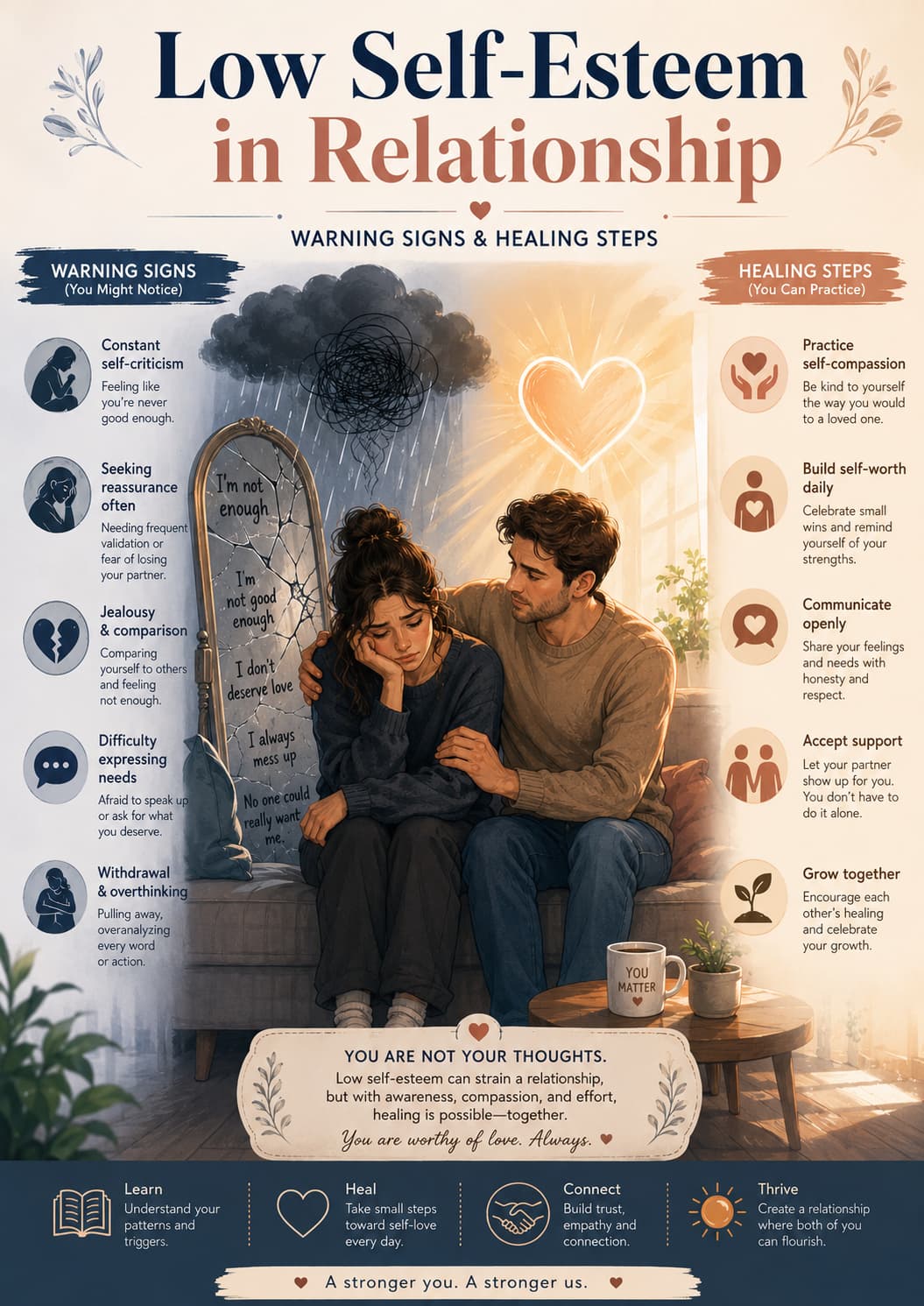

You find yourself asking your partner the same kinds of questions again and again — "Do you still love me?" or "Are you sure I look okay?"
A little reassurance is part of any healthy relationship. It becomes something to watch when you need constant validation just to feel secure.
Over time, this can quietly exhaust both of you. It also tends to feed itself — the more you reach for validation from outside, the more your own insecurity grows.
People-pleasing is one of the clearest signatures of low self-esteem. You might say yes to things you don't really want to do, avoid difficult conversations, and put your partner's comfort ahead of your own needs — almost without noticing it.
Without healthy boundaries, a relationship slowly tips out of balance, and quiet resentment has room to build.
This deep-seated fear shapes the way you trust and attach. You might catch yourself walking on eggshells, convinced that one wrong move will be the thing that makes your partner leave.
Sadly, this fear often becomes a self-fulfilling prophecy — the anxiety it creates is exactly what ends up pushing a partner away.
If this is something you recognize in yourself, our guide on how to feel secure in a relationship walks through gentle, practical ways to rebuild that sense of safety.
Overthinking pulls you into worst-case scenarios and makes you read trouble into perfectly innocent moments. You replay conversations long after they're over, searching for hidden meanings and signs of something wrong.
This mental habit manufactures stress that was never really there, and it quietly robs you of the present moment with the person right in front of you.
Comparison and self-esteem don't mix well, and social media pours fuel on the fire. You might find yourself quietly scrolling through your partner's ex, or feeling smaller every time another couple's highlight reel appears on your screen.
It helps to remember that social media almost never shows the full picture — not of anyone's life, and certainly not of anyone's relationship.
When you don't quite trust the value of your own feelings, speaking up becomes hard. You might find it difficult to say what you need or want, and easier to simply go quiet.
Open communication is the lifeblood of a healthy relationship, but low self-esteem makes it feel risky and exposing — as if your needs aren't quite allowed to take up space.
You might notice yourself reshaping your behavior, your interests, even your values to fit what you think your partner wants. This goes well beyond healthy compromise — it is the slow erosion of who you actually are.
Every relationship asks for some flexibility. But holding on to your authentic self is what keeps the connection real — and what makes lasting happiness possible.
When your self-esteem is low, even gentle feedback can land like a personal attack. You might react defensively to a small piece of constructive criticism, or shut down completely the moment your partner tries to raise a concern.
The trouble is that this makes it hard to grow together. Couples need to be able to talk honestly about what isn't working, and hypersensitivity quietly closes that door.
Jealousy and possessiveness usually grow from the same insecure soil — a worry about your own worth and a quiet doubt about your partner's commitment. You might catch yourself monitoring their activities, feeling threatened by their friendships, or needing constant proof of their loyalty.
A flicker of jealousy now and then is human. But when it tips into possessiveness, it starts to erode the very trust the relationship needs to feel safe.
You might find yourself placing your partner's needs ahead of your own again and again, even when it quietly costs you your own well-being. This is more than the give-and-take of a healthy relationship — it is the slow neglect of yourself.
A healthy relationship needs two whole people. Both partners have to keep tending to their own happiness for the love between them to stay alive.
Perhaps the deepest sign of all is the quiet belief that you simply don't deserve love, care, or affection. That single belief can sabotage intimacy from the inside, making it almost impossible to fully receive the love your partner is offering.
Left unexamined, this belief becomes a wall between you and the closeness you long for.
The effects of low self-confidence reach far beyond your own private feelings. When one or both partners are quietly struggling with self-worth, it changes the whole shape of the relationship.
Communication strains when insecurity gets in the way of saying what you honestly feel and need. Instead of speaking plainly, partners drift into passive-aggressive hints, mind-reading, or simply avoiding the hard conversations altogether. If that sounds familiar, our guide on how to fix communication in a relationship covers practical ways to start talking openly again.
Trust gets shaky when low self-esteem spills out as jealousy, possessiveness, or a constant hunger for reassurance. The steady sense of security a relationship runs on is hard to maintain when one partner can't yet trust their own worth.
Intimacy suffers when vulnerability starts to feel too dangerous. Real closeness asks you to be open and authentic, and low self-esteem makes exactly that feel exposing instead of safe.
It is hard to overstate how much self-worth shapes all of this. When you don't value yourself, it becomes genuinely difficult to believe that anyone else truly can — and so insecurity quietly breeds more insecurity, sometimes pushing away the very love you are reaching for.
Recognition is the starting point, but real change takes intentional effort — and, for many people, some professional support along the way. Here are gentle, evidence-based strategies that can help.
Try to treat yourself with the same kindness you would offer a good friend. When you stumble or face something hard, meet it with understanding instead of harsh self-criticism.
Notice the moments when your inner voice turns critical or catastrophic, and pause to ask: is this thought actually helpful, and is it based on facts or just on fear?
Start small, by saying no to things that don't sit right with your values or your well-being. Boundaries and self-esteem are closely linked — when you respect your own limits, you quietly teach others to respect them too.
Caring for yourself isn't selfish — it is what allows you to show up well for someone else. When you tend to your physical, emotional, and mental health, you become a steadier, more present partner.
Gently turn your attention toward what is already going well in your life and your relationship. Gratitude has a quiet way of shifting focus from what feels missing to what is genuinely there.
Therapy can offer tools and insight that are hard to reach on your own. A qualified therapist can help you understand where your insecurity took root, and walk with you toward healthier ways of coping.
When the moment feels right, share your struggles with your partner. Many people are surprised to find that being honest about their insecurities actually deepens the bond rather than weakening it.
Keep your friendships, hobbies, and interests alive outside the relationship. Two people who keep growing as individuals tend to grow closer as a couple — it is one of the quiet foundations of a long-lasting relationship.
Self-help strategies can carry you a long way, but some situations genuinely call for professional support. It may be time to reach out if:
Couples therapy can be especially helpful when both partners are willing to grow. A skilled therapist offers tools for rebuilding trust and reshaping the communication patterns that have been holding you back.
Left unaddressed, it certainly can do real damage. The constant need for reassurance, the jealousy, the strained communication, and the difficulty setting boundaries can settle into toxic patterns that slowly push a partner away. The hopeful part is that, with awareness and effort, those patterns can absolutely be changed.
Supporting a partner with low self-esteem takes patience, consistency, and clear boundaries of your own. Offer genuine compliments, be reliable and trustworthy, and encourage their growth — while gently avoiding the trap of enabling endless reassurance-seeking. And remember, kindly, that you can't fix your partner's self-esteem for them; that is work only they can do.
Improving self-worth is a gradual process. It usually means challenging negative thought patterns, practicing self-compassion, setting and achieving small goals, caring for your physical and mental health, and often working alongside a therapist. It tends to go best when both partners are committed to growing together.
Building self-esteem is more of a lifelong journey than a destination. Some people notice real improvements within a few months of steady effort, while others need longer, especially when there are deeper wounds or past trauma involved. What matters most is persistence — and offering yourself plenty of compassion along the way.
Yes — the occasional wobble of insecurity is completely normal. The difference lies in frequency and intensity. A healthy relationship still holds room for vulnerability and the odd moment of doubt; those feelings just shouldn't dominate your days or quietly run your life.
A few honest signs: you constantly seek reassurance, feel jealous without real cause, struggle to voice your needs, or find yourself changing who you are to please your partner. If you recognize several of the patterns from this article showing up in your day-to-day interactions, it is very likely shaping your relationship and your overall happiness.
Start by limiting your social media exposure, and practice gratitude for your own unique qualities. Focus on the private, real moments of your relationship rather than anyone's public highlight reel, remembering that people only ever show their best online. When a comparison thought arrives, you can gently challenge it — "is this helping me grow?" — and redirect that energy toward your own development and honest conversation with your partner.
Take a breath before you react. Ask for clarification about the specific behavior rather than hearing it as an attack on your character, and let your partner know how certain feedback lands for you. It helps to distinguish constructive feedback from harmful criticism, and to set boundaries around respectful communication. Quietly ask yourself whether the criticism comes from a place of love or of control — healthy relationships are built on supportive feedback, never on attacks on your worth.
Low self-esteem in relationships often traces back to earlier experiences — childhood attachment patterns, previous relationship trauma, cultural pressures around beauty and success, or a family environment that didn't nurture a sense of worth. Understanding those roots, through self-reflection or therapy, lets you address the real cause rather than just the symptoms.
Absolutely — low self-esteem affects people of every gender. Men may simply express it differently: through emotional withdrawal, overworking, avoiding vulnerability, or becoming controlling. The underlying signs and solutions are largely the same, even if social expectations shape how it shows up on the surface.
In women, low self-esteem often shows up as constant apologizing, downplaying achievements, seeking validation through appearance, comparing themselves to other women, struggling to accept compliments, people-pleasing to avoid conflict, and feeling guilty for taking time for themselves. Body image and social comparison can weigh especially heavily, thanks to the cultural pressures many women carry.
Recognizing the signs of low self-esteem in your relationship is the first step toward the loving, secure connection you truly deserve. These patterns can feel overwhelming, but they are not permanent — with awareness, effort, and often some professional support, you can grow the self-worth that healthy, fulfilling relationships are built on.
Your relationship with yourself quietly sets the tone for every other relationship in your life. When you learn to value, respect, and care for yourself, you create the space for others to do the same. This was never about becoming perfect. It is about becoming authentic, boundaried, and genuinely connected to your own worth.
The journey takes time, patience, and often the support of others — but it is worth every bit of it. As you build a healthier relationship with yourself, you don't just become happier as an individual; you become a better partner, friend, and family member too.
So please remember: you deserve love, respect, and happiness. You deserve a relationship where you can be your full, authentic self without fear of rejection or abandonment. The work you do on yourself today becomes the foundation for the love story you want to live tomorrow.
If you're ready to begin, choose just one area from this article to focus on this week. Whether it is setting a small boundary, challenging a single negative thought, or simply treating yourself with a little more compassion, small steps have a way of adding up to real change over time.
25 long-term goals for married couples — to keep growing together, not apart.
Marriage is a journey that takes intention, commitment, and a shared sense of where you’re headed. Setting long-term goals for married couples isn’t only about planning — it’s about building a roadmap for growing, and staying happy, together.
It’s easy to get lost in the day-to-day and slowly drift in different directions as the years pass.
The strongest marriages are built on shared understanding and a common purpose; when you set meaningful goals together, you create a foundation that can weather almost anything life throws at it.
These goals become anchors in the hard seasons and reasons to celebrate in the good ones. They quietly remind you why you chose each other — and what you’re building.
Below are 25 long-term goals for married couples, spread across money, family, emotional connection, personal growth, and shared adventure.
Whether you’re newlyweds or decades in, it’s never too early or too late to line up your visions. Often the conversation itself is what brings you closer.
In a strong marriage, love alone isn’t quite enough — growing in the same direction matters just as much.
Aligning your long-term goals helps you stay connected and resilient through whatever life brings. (That shared direction is also one of the quiet protections against slowly drifting apart; our guide on how to avoid divorce looks at that drift up close.)
Long-term goals reflect your shared dreams, your values, and the future you both want. That’s what gives a marriage a sense of purpose, rather than just momentum.

Long-term relationship goals are the intentional plans a couple makes to guide their journey together — around finances, parenting, emotional growth, or personal development.
Unlike short-term goals, they take years and ongoing commitment.
Think of them as your shared roadmap: a compass for navigating the relationship with purpose, trust, and teamwork.
Here’s a categorized list of 25 long-term goals you can actually act on.
1. Save for a Home or Dream Property
Plan to own a home together, or upgrade to one that fits your growing family.
2. Create a Long-Term Investment Strategy
Start investing in retirement plans, mutual funds, or other long-term vehicles.
3. Get Out of Debt Together
Make a plan to clear credit card debt, student loans, or car payments.
4. Build an Emergency Fund
Aim for six to twelve months of expenses as a financial cushion.
5. Plan for Your Children’s Education (if applicable)
Open a college fund or savings plan early.
6. Start or Grow Your Family
Talk about when and how you’d like to expand your family.
7. Align on Parenting Styles
Discuss discipline, education, and values before challenges arise. (Many of these are worth raising before marriage too.)
8. Create Family Traditions
Build rituals — Sunday dinners, holiday trips — that your children will carry with them.
9. Plan a Family Legacy Project
Write a book, start a small foundation, or build a family tree together.
10. Take Annual Family Vacations
Protect the quality time and the new experiences.
11. Have Regular Relationship Check-Ins
Talk about what’s working and what needs attention — weekly or monthly. (Our guide on quality time in marriage has simple ways to make those check-ins count.)
12. Attend Marriage Retreats or Counseling
Treat these as proactive tools to stay strong — not a last resort.
13. Celebrate Relationship Milestones
Anniversaries, first dates, and personal wins all deserve to be marked.
14. Read Relationship Books Together
Pick one book a quarter to spark growth and connection. (You’ll find honest, real-life ideas in our 25 marriage advice tips, too.)
15. Create a Safe Space for Vulnerability
Build emotional intimacy through honesty and real listening. (More on this in how to feel secure in a relationship.)
16. Support Each Other’s Dreams
Encourage career changes, further study, or creative projects.
17. Prioritize Physical and Mental Health
Work out together, or make space for individual therapy when it’s needed. (For the overwhelmed seasons, see marriage burnout.)
18. Practice Faith or Spirituality Together
Attend services, meditate, or study what aligns with your beliefs.
19. Volunteer as a Couple
Give back to your community and grow a shared sense of purpose.
20. Work on Emotional Intelligence
Improve communication, empathy, and conflict resolution together. (Our guide on how to fix communication in a relationship digs into the how.)
21. Travel the World Together
Make a couple’s bucket list of destinations and start ticking them off.
22. Build a Dream Home or Renovate
Design a space that reflects both your tastes and your needs.
23. Start a Business or Side Hustle Together
Turn shared passions into something that brings income and meaning.
24. Plan Your Ideal Retirement Life
Picture where you’ll live, what you’ll do, and how you want to feel.
25. Grow Old With Grace and Love
Support each other through aging with kindness, humor, and care.
A five-year horizon is a sweet spot — far enough to matter, close enough to feel real. A few examples:
Pro tip: break each five-year goal into annual and quarterly milestones. That’s what makes them trackable instead of just hopeful.
Want to stay on track? Run through this together:
Marriage isn’t a finish line — it’s the start of a shared journey. With the right long-term goals, you build a relationship rooted in love, respect, and a future you’re both reaching toward. So sit down together, dream a little bigger, and commit to building it as a team.
Start today: pick three goals from this list and make a simple plan with your partner to begin on them this week.
Strong ones include saving for a home, building a retirement plan, aligning on parenting, improving communication, and planning regular time away together. They help a couple grow emotionally, financially, and spiritually while reinforcing trust and unity.
Common five-year goals include paying off debt, starting a business, buying a home, having children, or travelling to specific places. They act as stepping stones toward bigger life ambitions and keep both partners aligned.
Weekly date nights, open communication, joint financial goals, supporting each other’s growth, and practicing gratitude. Small, repeated goals like these deepen connection over time.
They give a relationship direction, purpose, and structure. They help you plan ahead, manage expectations, and build a foundation on shared values and common dreams.
Start by sharing your individual values, priorities, and visions for the future. Find the common ground, then set specific, measurable goals across finances, family, health, and growth — and review your progress regularly.
Short-term goals are immediate actions that lift daily connection — a weekly date, a monthly check-in. Long-term goals take months or years and focus on building a future together, like buying a home or saving for retirement.
Yes. Shared goals encourage communication, accountability, and teamwork — and they help make sure you’re growing together rather than apart.
If you’d like a guided way to turn these goals into real conversations, two stand out:
As an Amazon Associate, EyesMata may earn from qualifying purchases — at no extra cost to you.
How to Rebuild Trust in a Relationship?
When trust shatters in your relationship, it can feel like standing in the wreckage of everything you believed was solid. Your world tilts, your heart races, and suddenly every shared memory gets filtered through this new, painful lens of betrayal.
But here's what most people don't realize: trust can be rebuilt — often stronger than before — if you understand the psychology behind why it breaks and follow a steady recovery process.
Research on betrayal recovery is genuinely hopeful. Many couples don't just survive a breach of trust; they rebuild into something more honest and resilient than what they had before, especially when they follow evidence-based steps instead of rushing.
This isn't about quick fixes or hollow promises. It's about understanding how trust repair actually works, and walking through it one deliberate step at a time.
When you discover a betrayal, your brain doesn't simply process it as relationship drama — it registers it as a survival threat. The amygdala, your brain's alarm system, floods you with stress hormones while quieting the prefrontal cortex you rely on for clear, logical thinking.
This is why betrayed partners often experience symptoms that resemble trauma: intrusive thoughts, hypervigilance, emotional numbness, and trouble concentrating. Your nervous system gets stuck in fight-or-flight, which makes calm, rational conversation nearly impossible.
Understanding this response matters, because it explains why advice like "just communicate better" tends to fall flat in the early days of recovery.
Most relationship advice assumes both partners are calm and rational. But when trust is broken, the betrayed partner's nervous system is dysregulated, while the betrayer often spirals into shame that triggers defensiveness.
Attempting deep conversations before settling these physical responses is like trying to negotiate during a fire alarm — the brain simply can't process complex emotional information while in survival mode. This is why couples who jump straight into marathon talking sessions often feel more disconnected and hopeless than before.
Mistake #1: Rushing the timeline. Society pressures couples to "get over it" quickly, but trust rebuilds on its own schedule, not on our impatience. Pushing for forgiveness before safety is established creates a fragile, fake reconciliation that crumbles under pressure.
Mistake #2: Focusing only on the betrayal. Many couples get stuck analyzing what happened instead of building what comes next. Understanding matters, but spending months dissecting the betrayal without creating new positive experiences keeps a relationship trapped in a loop of pain.
Mistake #3: Treating all trust breaks the same. A small lie about spending needs a different approach than discovering a years-long affair. Cookie-cutter methods fail because they don't address the specific wound each kind of betrayal creates.
Level 1 — Surface breaches. Small lies, broken promises, or minor deceptions that haven't fundamentally changed how you see your partner. These often heal within a few weeks of consistent, honest effort.
Level 2 — Moderate violations. Hidden activities, financial deception, or emotional affairs that create real doubt about your partner's character. Recovery usually takes a few months, and professional guidance helps.
Level 3 — Major betrayals. Physical affairs or large-scale deception that shatter your core beliefs about the relationship. Healing often takes many months to a year or more, usually with therapeutic support.
Level 4 — Systematic abuse. Patterns of manipulation, gaslighting, or abuse that call for immediate safety planning and, often, leaving the relationship. The focus here is individual healing and safety, not couple repair.
Ask yourself honestly:
If you answered "no" to more than two of these, individual therapy is a wise place to start before couples work.
Seek immediate professional support if you notice:
And if you're having thoughts of harming yourself, please reach out right now. In the US, you can call or text 988 (the Suicide & Crisis Lifeline) any time; elsewhere, your local crisis line can help. You don't have to carry this alone.
The first few days after discovery set the tone for the whole journey. What helps most:
For the betrayed partner:
For the partner who broke trust:
When both of you are ready for the first real talk (often several days after discovery), give it a structure.
Set the container: choose a private, distraction-free space; keep early conversations to about 45 minutes; agree on ground rules — no name-calling, no storming out, no defending.
The disclosure: the partner who broke trust shares plainly — "I did [specific action] on [timeframe]. I understand this hurt you by [impact]. I take full responsibility, with no excuses."
The response: the betrayed partner names their experience — "When this happened, I felt [emotion] because [impact on my sense of safety]. What I need right now is [specific request]."
When a conversation becomes overwhelming — racing heart, scrambled thinking — try a simple reset:
This stops the flooding that turns a productive conversation into a damaging fight.
Real accountability is different from a shame-soaked apology. It has four parts:
Post-betrayal transparency shouldn't feel like surveillance.
Early on (first few months): open access to phones, messages, and social media; clear schedules and whereabouts; no unexplained absences; regular check-ins about how each of you is feeling.
As trust returns: privacy gradually comes back based on demonstrated trustworthiness, not an arbitrary date. The betrayed partner should be able to ask for transparency without being called "controlling."
Trust rebuilds through consistent small actions, not grand gestures.
Many couples rush back to physical intimacy hoping it will restore connection, but that often backfires. Emotional safety has to come first.
New communication patterns: use "I feel" statements instead of "you always/never," practice listening without rushing to fix, and learn to validate emotions even when you don't agree. If talking still feels hard, our guide on how to communicate in a relationship walks through this in detail.
Step 1 — Surface sharing: daily experiences, preferences, and observations, with no emotional charge.
Step 2 — Emotional expression: feelings about current situations (not the betrayal itself).
Step 3 — Fears and hopes: concerns about the future and hopes for the relationship.
Step 4 — Deep vulnerability: childhood wounds, dreams, and the fears that quietly drive your behavior.
Affairs need a specialized approach: complete no-contact with the affair partner, full disclosure of the timeline and extent, and individual therapy to understand the vulnerability that led there. Over time, the work shifts to closing the relationship gaps that created that vulnerability and rebuilding physical closeness at the betrayed partner's pace. If this is your situation, our complete guide to healing your marriage after betrayal goes deeper into this path.
Financial infidelity can feel like a double betrayal — both the lying and the threat to your family's security. Start with full transparency about all accounts, debts, and obligations, temporary shared control of major decisions, and professional financial counseling if debt or gambling is involved. Trust returns through joint budgeting, a gradual return of independence, and regular financial check-ins.
Deception about personal history undermines the very sense of knowing your partner. Healing calls for complete disclosure, honest acknowledgment of how the lies affected the betrayed partner's sense of reality, and rebuilding intimacy on the basis of genuine knowledge of each other.
Each partner answers, briefly, every day:
Picture trust as an account that grows with deposits and shrinks with withdrawals.
Notice the daily balance, and talk through the patterns once a week.
Forgiveness is an internal process of releasing resentment, for your own peace. Reconciliation is the mutual work of rebuilding the relationship. You can forgive without reconciling — but you can't truly reconcile without forgiveness.
You may be moving toward forgiveness when thinking about the betrayal no longer spikes your stress, when you can see your partner as flawed rather than evil, when you want to release the anger because it's weighing you down, and when a hopeful future feels imaginable again.
You're likely ready when you've processed your emotions with support, your partner has shown consistent change over time, and you're choosing forgiveness for your own peace rather than to keep the peace. You're still processing — and that's completely okay — if waves of anger or sadness still overwhelm you, or if you'd be forgiving mainly to avoid conflict or under pressure from others.
Healthy forgiveness keeps its boundaries:
Forgiveness doesn't mean forgetting, excusing, or returning to exactly how things were before.
Once a month, talk through a few simple prompts: How connected have we felt this month? Where did we drift apart? Have there been moments where trust felt shaky, and what would strengthen it? What do we each want to work on, and how can we support each other's goals?
No relationship is fully affair-proof, but certain habits reduce the risk: regular conversations about how satisfied you each feel, honest discussions about attractions or temptations, and addressing problems before they create distance — while still supporting each other's individual friendships, interests, and growth.
Long-term accountability should feel supportive, not controlling. Both partners commit to transparency and growth — not only the one who broke trust. Schedule check-ins about connection and concerns before they become problems, and consider keeping occasional couples-therapy appointments for tune-ups rather than emergencies.
How long does it take to rebuild trust after cheating?
For major betrayals like affairs, rebuilding often takes a year or more, though many couples feel significantly better within about six months of consistent work. The timeline depends on the extent of the betrayal, both partners' commitment, professional support, and the strength of the relationship beforehand. Healing isn't linear — good days and setbacks are both normal.
Can trust be rebuilt after multiple betrayals?
It's much harder, but not impossible. Success depends on whether the betraying partner has addressed the underlying issues — addiction, unresolved trauma, and so on — that drove the pattern. If betrayals continue during recovery, the focus should shift to individual healing rather than couple repair.
What are the signs trust is being rebuilt?
You'll notice less anxiety about your partner's whereabouts, an ability to believe their explanations without constant verification, and spontaneous moments of connection and laughter returning. Physical closeness starts to feel safe rather than forced, and conversations about the future become possible again.
Should you stay together while rebuilding, or take a break?
Most experts suggest staying together during rebuilding unless there are safety concerns, since separation can heighten anxiety. A short, structured break can help if emotions are too intense for productive conversation — ideally decided from a calm place and with professional guidance, not in the heat of crisis.
How do you rebuild trust if your partner won't go to therapy?
You can still do real work on your own: set clear boundaries, seek individual therapy, and ask for specific behavioral changes regardless of their participation. Many reluctant partners become willing to attend once they see how seriously you're committed to your own healing and to what the relationship needs.
Rebuilding trust isn't about returning to how things were — it's about building something more honest and more resilient than what came before. The couples who manage it don't just recover from betrayal; they create relationships with deeper intimacy and stronger foundations than they thought possible.
This takes courage from both people: to face painful truths, to be vulnerable again, and to do the quiet daily work even when progress feels slow. If the breach has shaken the whole marriage, our guide on how to rebuild your marriage maps out the wider repair, and it can help to understand the leading cause of divorce so you can protect what you're rebuilding.
Your relationship's future isn't defined by its worst moment — it's shaped by the choices you make from here. Start with one small trust deposit today.
How to Communicate in a Relationship
How to Rebuild Your Marriage: A 5-Phase Guide
Marriage After Betrayal: A Complete Recovery Guide
7 Hard Truths Behind the Leading Cause of Divorce
The Yearners Dating Trend!
Dating apps changed how we meet — but somewhere along the way, they also quietly taught us to hide. Don't text first. Don't seem too keen.
Keep it cool, keep it casual, never let them see you care. For a long time, that was the unwritten rulebook of modern dating.
Lately, a quiet rebellion has set in. A growing wave of people — nicknamed yearners — are throwing that rulebook out. Instead of playing it cool, they say what they actually want: a real connection, honest conversation, something that lasts. And against all the old advice, it seems to be working.

The instinct to play it cool didn't appear out of nowhere — it grew out of how dating technology evolved:
Somewhere in that rush toward speed and endless options, detachment became a survival skill. When every match feels replaceable, caring out loud starts to feel risky. The yearner movement is, in many ways, a reaction to that fatigue — a quiet return to meaning.

A yearner is someone who leads with honesty in dating — expressing genuine feelings, intentions, and vulnerability from the first conversations, instead of pretending to be casual. They would rather risk seeming “too much” than drift through months of ambiguity.
Four traits tend to define the yearner approach:
You can hear the difference in the very first messages:
None of these is wrong, and casual dating is perfectly valid when both people want the same thing. (Our guide to soft dating explores that gentler middle ground.) The trouble only starts when one person is quietly yearning while the other is just browsing.
There's no trick to it. When you're upfront about what you want, two useful things happen. First, you filter faster — people looking for something different step aside early, which spares you months of guessing. Second, honesty invites honesty; when one person is brave enough to be real, the other often relaxes and meets them there. Clearer communication means fewer misunderstandings, quicker reads on compatibility, and a foundation built on trust rather than performance.
It also fits a wider cultural shift. A generation more fluent in mental-health language is simply less willing to play games that leave everyone anxious, and after the isolation of recent years, many people came away valuing genuine connection more. Authentic dating lowers the emotional labour of constant strategy — which is good for your wellbeing as much as your love life, and it rests on the same foundation as a long-lasting relationship: trust, honesty, and real safety with each other.
Being a yearner starts with your profile and shows up in how you communicate. To build a yearner-style profile:
And in conversation:
Here's the nuance that separates healthy yearning from self-sabotage: openness isn't the same as emotional flooding. Sharing your whole history or your deepest wounds in a first conversation isn't really vulnerability — it's a heavy thing to place on a near-stranger, and it usually pushes people away.
Keep your openness healthy by:
And watch for the signs you've tipped out of balance:
If any of those feel familiar, the work isn't to care less — it's to build a steadier sense of self first. Learning to feel secure on your own is what makes honest, open dating feel safe rather than scary.
Emotional honesty doesn't mean dropping every guard. A few simple habits keep openness safe:
Apps that reward detailed profiles and clear intentions — like Hinge, Bumble, or OkCupid — tend to suit this style better than pure swipe-for-speed apps, and many now offer prompts that make it easier to be upfront about what you want.
What is a yearner in dating?
Someone who dates with emotional honesty — expressing real intentions and feelings early, rather than acting casual to seem desirable. Yearners want a genuine connection and aren't afraid to say so.
Does dating this way actually work?
For many people, yes — mainly because honesty filters out mismatches quickly and builds trust sooner. It isn't a guarantee, but it spares you a great deal of guesswork and game-playing.
Isn't being a yearner just being desperate?
No. Desperation grasps; yearning is simply honest. The difference is timing and self-respect — you share what you want while still honouring your own pace and the other person's.
Is it safe to be so open with people online?
It can be, with boundaries. Be open about your feelings and intentions, but protect your personal information, take new connections slowly, and meet in public at first.
How do I write a yearner-style profile?
State your intentions clearly, share your real values, and say what you're genuinely seeking. Words like “meaningful,” “genuine,” and “authentic” help — and being specific beats generic phrases every time.
For years, dating advice rewarded whoever cared the least. The yearners are quietly proving the opposite: honesty isn't a weakness to hide — it's the very thing that makes real connection possible. Playing it cool might protect you from small disappointments, but it also keeps you from the thing you actually want.
This looks less like a passing fad and more like a lasting change in how people connect — built on a simple idea: that being real is more attractive than being unbothered. Love that lasts isn't found by accident; it's built, and it begins the moment you're brave enough to say what you mean. If you're curious how that honesty grows into something lasting, our look at how a friendship grows into forever love is a hopeful next read.
Soft Dating Guide: How Modern Women Create Authentic Relationships
How to Feel Secure in a Relationship: 15 Expert Tips
How to Build a Long-Lasting Relationship: 10 Proven Principles
Friends to Lovers: 17 Signs of a Lasting Love Story
Breaking up is never easy, but sometimes it's not the end of the story. If you're wondering how to get your ex back, you're not alone.
Millions of people search for ways to reconnect with their former partners every year, and while it's not always possible, there are genuine strategies that can help you rebuild that lost connection.
The truth is, getting your ex back isn't about manipulation or playing games. It's about understanding what went wrong, working on yourself, and creating the conditions for a healthier relationship.
Whether you're dealing with a recent breakup or trying to reconnect after months apart, this guide will walk you through the most effective approaches to winning back your ex's heart.
Before diving into how to get your ex back, it's crucial to understand why relationships fail in the first place. The most common reasons couples struggle tend to fall into a few familiar patterns:
Communication breakdown is one of the most common culprits. When partners stop truly listening to each other or expressing their needs clearly, emotional distance grows. (Our guide on how to fix communication in a relationship covers practical ways to rebuild it.)
Trust issues account for another significant portion of relationship failures. Whether it's infidelity, broken promises, or simply feeling like you can't rely on your partner, trust problems are difficult to overcome.
Different life goals become more apparent as relationships progress. What seemed like minor differences early on can become major incompatibilities over time.
Lack of emotional intimacy often develops gradually. Couples may stay together out of habit while the emotional connection slowly deteriorates. (Rebuilding that closeness usually starts with feeling safe again — see how to feel secure in a relationship.)
Understanding which of these factors contributed to your breakup is the first step in learning how to get your ex back successfully.
It's natural to want to reconcile with someone you loved deeply. Psychologists explain that this desire stems from several psychological factors:
Attachment theory suggests that humans are biologically wired to form strong emotional bonds. When these bonds are severed, we experience genuine distress and naturally seek to restore the connection.
Loss aversion is another powerful psychological principle. We tend to value something more highly once we've lost it. This explains why your ex might seem more appealing now than they did during the relationship.
Familiarity bias makes us prefer what we know. Your ex represents comfort and familiarity, even if the relationship had problems.
However, it's important to distinguish between healthy desire for reconciliation and unhealthy obsession. Healthy reconciliation focuses on creating a better relationship, while obsession centers on possession and control.
The first rule of how to get your ex back might surprise you: don't try to get them back immediately. This "no contact" period serves several crucial purposes:
Emotional healing happens during this time. You need to process your feelings about the breakup without the constant reminder of your ex's presence.
Perspective gain allows you to see the relationship more clearly. When you're not caught up in daily interactions, you can better understand what went wrong and what you want moving forward.
Attraction rebuilding actually increases when there's some distance. The saying "absence makes the heart grow fonder" has psychological truth to it.
Most relationship experts recommend a no-contact period of at least 30 days, though it may need to be longer for more serious relationships or traumatic breakups.
While you're giving your ex space, use this time for genuine self-improvement. This isn't about changing who you are to win someone back – it's about becoming the best version of yourself.
Address the issues that contributed to the breakup. If communication was a problem, consider taking a communication workshop or working with a therapist. If trust was an issue, examine your own trustworthiness and commitment patterns.
Develop new interests and hobbies. This serves multiple purposes: it makes you more interesting, gives you confidence, and shows that you're capable of growth and change.
Improve your physical and mental health. Exercise regularly, eat well, get enough sleep, and consider therapy if needed. When you feel good about yourself, it shows.
Strengthen other relationships in your life. Reconnect with friends and family. A strong support network makes you more emotionally stable and attractive as a partner.
Successful reconciliation requires brutal honesty about what went wrong. This means examining both your role and your ex's role in the relationship's demise.
Make a list of the problems in your relationship. Be specific about behaviors, patterns, and incidents that caused issues.
Take responsibility for your part without making excuses. This doesn't mean taking all the blame, but acknowledging where you could have done better.
Consider whether the core issues are fixable. Some problems, like fundamental incompatibilities in life goals or values, may be insurmountable.
Evaluate the relationship's overall health. Was it generally positive with some fixable issues, or were there deeper problems that made both of you unhappy?
After your no-contact period, you can begin reaching out, but this must be done strategically and respectfully.
Start small with a brief, friendly message. Don't pour out your feelings or immediately ask to get back together. A simple "Hope you're doing well" or sharing something that reminded you of them can be appropriate.
Be prepared for any response – or no response at all. Your ex might not be ready to communicate, and that's their right.
Keep initial conversations light and positive. Avoid bringing up the relationship or past problems in early interactions.
Show genuine interest in their life and well-being. Ask about their work, hobbies, or interests without being intrusive.
If your ex is open to communication, the next step in how to get your ex back is showing that you've genuinely changed and grown.
Actions speak louder than words. Don't just tell them you've changed – show them through your behavior and choices.
Be consistent in your new behaviors. Change that only lasts a few days or weeks won't convince anyone that you're truly different.
Address specific issues that caused problems in your relationship. If you were jealous, demonstrate trust. If you were neglectful, show attentiveness.
Avoid falling back into old patterns during your interactions. It's easy to slip back into familiar dynamics, but this will undermine your efforts.
Trust is often the biggest hurdle in getting back together. Rebuilding it requires patience, consistency, and genuine effort — especially when the breakup involved broken trust or betrayal. (Our guide to rebuilding after betrayal goes deeper on this.)
Be completely transparent about your actions and feelings. Hiding things or being secretive will only damage trust further.
Keep your promises, no matter how small. Reliability in little things builds confidence in bigger commitments.
Show empathy for the hurt you may have caused. Acknowledge their pain without becoming defensive.
Create new positive experiences together. As you spend time together, focus on making new memories rather than rehashing the past.
Learning how to get your ex back also means knowing what not to do. These common mistakes can sabotage your efforts:
Begging or pleading makes you appear desperate and pushes people away. Maintain your dignity throughout the process.
Trying to make them jealous by dating someone else or posting about your social life often backfires and can damage any chance of reconciliation.
Pressuring them for an immediate decision about getting back together. Healing and rebuilding take time.
Ignoring the reasons you broke up in the first place. If you don't address the core issues, you'll likely face the same problems again.
Stalking or harassment is never acceptable and can result in legal consequences. Respect their boundaries and space.
Not every relationship should be rekindled. Consider these factors when deciding if pursuing your ex is worth it:
The relationship was generally healthy with specific fixable issues rather than fundamental incompatibilities.
Both people are willing to work on the problems and make changes.
Trust can be rebuilt through consistent actions over time.
You're both in a better place emotionally and mentally than when you broke up.
The reasons for wanting to reconcile are healthy (love, compatibility, shared goals) rather than unhealthy (fear of being alone, stubbornness, control).
If you successfully get your ex back, the real work begins. Creating a stronger relationship requires:
Better communication skills. Learn to express your needs clearly and listen actively to your partner.
Established boundaries that protect both people's well-being and autonomy.
Regular relationship check-ins to address small issues before they become big problems.
Shared goals and values that align with both of your life directions.
Individual growth that continues even within the relationship.
(Many of these same habits are what keep a relationship off the rocks in the first place — our guide on how to avoid divorce walks through them.)
Sometimes, learning how to get your ex back requires professional guidance. Consider couples counseling or individual therapy when:
Communication problems persist despite your best efforts.
Trust issues are severe and challenging to overcome on one's own.
Underlying mental health issues contributed to the relationship problems.
Patterns of behavior keep repeating despite attempts to change.
A skilled therapist can provide tools and insights that aren't available through self-help alone.
Not every attempt to reconcile will be successful, and that's okay. If your ex doesn't want to get back together:
Respect their decision and refrain from continuing to pursue them.
Focus on your own healing and moving forward.
Learn from the experience to improve future relationships.
Maintain your dignity and avoid burning bridges with angry or hurtful behavior.
Consider this a growth opportunity rather than a failure.
Remember, understanding modern relationship patterns can help you recognize unhealthy behaviors — like an ex who disappears and then keeps contacting you unexpectedly, or someone who keeps you as a secret from their social circles. Recognizing these patterns can help you make better decisions about who deserves your energy.
Sometimes the process of trying to get your ex back leads to different but equally valuable outcomes:
Friendship might be possible if both people can move past romantic feelings.
Closure and understanding about why the relationship ended can help you heal.
Personal growth from the experience makes you a better partner for someone else.
Clarity about what you want in future relationships.
Regardless of whether you successfully get your ex back, the work you do on yourself during this process is valuable. You'll have:
Better communication skills for any relationship.
Increased self-awareness about your patterns and triggers.
Stronger emotional resilience from working through difficult feelings.
Clearer relationship goals and standards.
Improved ability to handle relationship challenges.
Q: How long should I wait before trying to get my ex back?
A: Most experts recommend at least 30 days of no contact. Feelings often linger well beyond that — for many people, months rather than days — so don't rush yourself. The right timeframe really depends on the relationship's length and complexity.
Q: What if my ex is already dating someone else?
A: Respect their new relationship and don't try to interfere. Focus on your own healing and growth. If reconciliation is truly meant to happen, it will only work once both of you are genuinely free and ready for it.
Q: Should I apologize for my mistakes in the relationship?
A: Yes, but only if you genuinely understand what you did wrong and are committed to changing. A sincere apology acknowledges hurt without making excuses and explains how you plan to do better. (Here's a gentle look at apology and forgiveness.)
Q: Is it possible to get an ex back after years apart?
A: While it's possible, timelines vary enormously — for some it's a matter of months, for others years. People change significantly over time, so in many ways you'd be starting a new relationship with two different people than you both were before.
Q: How do I know if I should stop trying to get my ex back?
A: Stop if they've clearly expressed they're not interested, if you're becoming obsessive or unhealthy, if they're in a serious relationship with someone else, or if pursuing them is preventing you from healing and moving forward.
Q: What are the signs that a breakup might not be permanent?
A: Key signs include: you're still in love with each other, you have mutual friends, you ask about each other through mutual friends, and there's ongoing communication or contact. According to a YouGov poll of over 22,000 Americans, 44% of people have gotten back together with an ex after a breakup.
Q: Can getting back together actually work long-term?
A: It can, when both people do the work. Success depends far more on addressing the original issues, a real willingness to change, and improved communication than on the calendar. A longer, steadier history before the split can help, but it's no guarantee on its own.
Q: How do I know if my ex still has feelings for me?
A: Signs include: they reach out during no contact periods, they respond positively to your messages, they're open to meeting in person, and they show interest in your life. However, be cautious not to misinterpret friendly behavior as romantic interest.
Q: What should I do if my ex won't talk to me at all?
A: If your ex has blocked you or refuses all contact, respect their boundaries and focus on your own healing. Sometimes people need extended time and space before they're ready to communicate again.
Q: Are there different strategies for getting back a boyfriend vs. a girlfriend?
A: The core principles — self-improvement, respect, patience, and genuine change — apply regardless of gender. People differ in how quickly they're ready to reach out, but that's about the individual, not a rule about men or women.
This article offers general guidance, not professional or psychological advice. Reconciliation isn't the right path for every situation — if your relationship involved abuse, manipulation, or controlling behavior, your safety and wellbeing matter more than getting back together. When in doubt, a licensed therapist can help you decide what's healthiest for you.
Learning how to get your ex back is ultimately about becoming a better person and partner. Whether you successfully reconcile or move on to someone new, the work you do on yourself during this process will benefit you for years to come.
Remember that healthy relationships require two willing participants. You can only control your own actions and growth – you can't force someone to love you or want to be with you. Focus on becoming the kind of person who deserves a loving, healthy relationship, and trust that the right person will recognize and appreciate that.
The journey of trying to get your ex back often teaches us more about ourselves than about relationships. Use this experience as an opportunity for growth, healing, and creating the foundation for lasting love – whether that's with your ex or someone new.
Reconciliation is more common than many people expect — in one YouGov poll of over 22,000 Americans, 44% said they had gotten back together with an ex after a breakup. Still, whether it lasts comes down to the same things: addressing the core issues that led to the breakup, and both partners' commitment to positive change.
Whether you're dealing with manipulative behavior patterns, navigating undefined relationship boundaries, or trying to avoid being kept as someone's secret, the self-awareness and emotional intelligence you develop through this process will serve you well in all your future romantic endeavors.
Ready to start your journey toward a healthier relationship? Take the first step today by focusing on your own growth and healing. Remember, the best relationships are built on a foundation of two whole, healthy individuals choosing to be together.
In a world where dating apps dominate romance and "hard launches" flood social media, a quieter revolution is taking place. Soft dating is changing how modern women approach relationships, offering a gentler, more authentic path to connection that prioritizes emotional safety over public declarations.
If you're exhausted by dating games, overwhelmed by pressure to define relationships too quickly, or simply craving something more meaningful, this gentle approach might be exactly what you need. This method isn't about being passive or unclear—it's about being intentional, authentic, and protective of your emotional well-being while building genuine connections.
Soft dating refers to a gentle, low-pressure approach to romantic relationships that emphasizes emotional connection and gradual trust-building over the immediate labeling or public announcement of a relationship. Unlike traditional dating patterns that often rush toward exclusivity or social media declarations, this method allows relationships to develop naturally at a comfortable pace for both partners.
This relationship approach emerged alongside the "soft launch" social media trend, where couples share subtle hints about their relationships without explicit announcements or tags. However, the practice extends far beyond social media behavior—it represents a fundamental shift in how women approach romantic connections.
The term gained traction as women began rejecting the pressure of the dating culture to immediately categorize relationships. Instead of rushing from first date to "official" status, this gentle approach creates space for an authentic connection to develop organically.
Traditional "hard launch" dating involves:
This gentler approach, by contrast, focuses on:
This subtle method often leads to stronger, more sustainable relationships because it's built on authentic compatibility rather than external expectations.
Today's women are increasingly drawn to this intentional dating style for several compelling reasons that reflect broader shifts in how we understand healthy relationships.
This gradual approach prioritizes emotional safety above all else. In an era where ghosting and breadcrumbing have become common, this method creates a protective buffer that allows genuine feelings to develop without fear of sudden abandonment or manipulation.
Women who practice this dating philosophy report feeling more emotionally secure because the relationship's foundation is built on consistent, reliable interaction, rather than grand gestures or public proclamations that might not reflect true commitment.
This dating style empowers women to set and maintain healthy boundaries from the beginning. Rather than being swept along by someone else's timeline or expectations, the gentle approach encourages women to:
Many women experience significant anxiety around modern dating's fast pace and high stakes. This intentional method alleviates this pressure by removing the urgency to make immediate decisions about relationship status or future plans.
This philosophy recognizes that meaningful connections take time to develop and that rushing often leads to poor decisions or relationships built on shaky foundations.
Understanding whether you're experiencing this gradual approach—either giving or receiving—can help you navigate these relationships more effectively.
This dating philosophy often involves "soft launching" relationships on social media, which includes:
These subtle cues allow couples to share their happiness without feeling pressured to make public declarations before they're ready.
The communication style in these gradual relationships typically features:
Consistent, meaningful contact without overwhelming frequency. Partners maintain regular communication that feels natural rather than obligatory.
Open, honest conversations about feelings and expectations without pressure to reach immediate conclusions about the relationship's future.
Respect for individual space and independence while building emotional intimacy. Both partners maintain their own lives while choosing to share experiences together.
Gradual revelation of personal information and deeper feelings as trust develops organically over time.
Mastering the art of intentional, gradual dating requires thoughtfulness and clear communication, despite its subtle nature.
Begin with honest self-reflection about what you're seeking. Are you looking for casual companionship, a potential long-term partnership, or simply exploring connections? Understanding your own intentions helps you communicate authentically without creating pressure.
When discussing your approach with potential partners, try phrases like:
The "talking stage"—that period between initial interest and official dating—is crucial in soft dating. Use this time to:
Build genuine connections through meaningful conversations about values, goals, and compatibility factors that matter to you.
Observe consistency in their communication and behavior. Soft dating doesn't mean accepting inconsistent or unreliable behavior—it means taking time to assess patterns.
Maintain your own life and interests while exploring this new connection. Don't abandon your friends, hobbies, or personal goals during this phase.
Trust your instincts about the person's character and intentions. The slower pace of soft dating gives you more time to notice red flags or compatibility issues.
Trust develops through consistent and authentic interactions over time. In soft dating, this means:
Following through on plans and commitments, even small ones. Reliability in little things builds confidence in bigger matters.
Being genuinely yourself rather than presenting a curated version designed to impress. Authentic connection requires authentic presentation.
Sharing vulnerabilities gradually as comfort and trust increase. This creates emotional intimacy without overwhelming either partner.
Respecting boundaries enthusiastically rather than pushing against them. This demonstrates genuine care for the other person's comfort and well-being.
Research and anecdotal evidence consistently indicate that soft dating approaches yield better relationship outcomes for women.
Women practicing soft dating report significantly lower dating-related anxiety. Without the pressure to immediately categorize relationships or make public announcements, they can focus on genuine compatibility and emotional connection.
This reduced stress enables better decision-making and more authentic self-presentation, resulting in relationships founded on genuine compatibility rather than anxiety-driven choices.
Soft dating's emphasis on gradual development creates stronger relationship foundations. When couples take time to build emotional intimacy before making public commitments, they often develop deeper understanding and more sustainable partnerships.
The slower pace allows both partners to:
The reflective nature of soft dating encourages women to develop better self-awareness about their relationship needs and patterns. This leads to:
A clearer understanding of personal values and non-negotiables in relationships.
Better ability to recognize and communicate boundaries effectively.
Increased confidence in relationship decision-making based on genuine compatibility rather than external pressure.
Greater emotional intelligence and the ability to navigate complex relationship dynamics.
Studies on modern dating patterns reveal compelling evidence supporting the effectiveness of gradual relationship development. Research conducted by relationship psychologists shows that couples who take more time during the initial stages of dating report significantly higher satisfaction rates and stronger emotional bonds⁶.
Key research findings include:
Women who practice intentional, slower-paced dating approaches demonstrate measurably lower stress levels during the relationship formation process. This reduced anxiety allows for better decision-making and more authentic self-presentation.
Relationship longevity studies indicate that partnerships built on gradual emotional development tend to show greater stability over time compared to relationships that progress rapidly to an official status.
Communication quality assessments reveal that couples who spend extended time in the "getting to know you" phase tend to develop superior conflict resolution skills and a deeper emotional understanding.
These research findings highlight how soft dating principles align with what psychological science tells us about healthy relationship formation, making this approach particularly valuable for women seeking meaningful, lasting connections.
While soft dating offers many benefits, it's important to acknowledge potential challenges and how to address them.
Clear communication remains essential even in subtle dating approaches. If someone misinterprets your soft dating style as disinterest or mixed signals, address this directly:
When your soft dating approach conflicts with someone who prefers faster progression:
Honor your own needs and boundaries while remaining open to compromise where appropriate.
Communicate clearly about your timeline and reasoning without apologizing for your preferences.
Assess compatibility in terms of relationship pacing—this is a legitimate factor in determining compatibility.
Consider whether the person respects your boundaries or consistently pushes against them.
Modern soft dating must navigate digital communication and social media platforms thoughtfully.
Soft launching on social media can be part of soft dating, but it shouldn't be the primary focus. Consider:
Quality over quantity in digital communication. Meaningful exchanges matter more than constant contact.
Maintain boundaries around response times and digital availability.
Use technology to facilitate in-person connection rather than substitute for it.
Be authentic in digital communication just as you would be in person.
The principles that make soft dating effective can strengthen long-term relationships as well.
Maintaining emotional safety remains important even as relationships become more established. This means:
Soft dating principles create sustainable relationship habits:
Several misconceptions can prevent women from effectively implementing soft dating approaches.
Soft dating is actually highly intentional and active. It requires clear communication, boundary setting, and conscious choice-making. The "soft" aspect refers to the gentle, pressure-free approach, not passive behavior.
Soft dating differs fundamentally from playing hard to get. While "playing hard to get" involves artificial barriers and mixed signals, soft dating emphasizes authentic communication and genuine interest expressed through respectful pacing.
Many serious, committed relationships begin with soft dating approaches. The gentle start often creates stronger foundations for long-term partnerships because they're built on genuine compatibility and mutual respect.
Q: What does "soft dating" actually mean? A: Soft dating refers to a gentle, low-pressure approach to romantic relationships that prioritizes emotional connection and gradual trust-building over immediate labels or public declarations.
Q: How is soft dating different from traditional dating? A: Unlike traditional dating, which may rush toward exclusivity or public announcements, soft dating allows both partners to move at their own pace, prioritizing comfort and authentic connection over external expectations.
Q: Is soft dating appropriate for women over 30? A: Absolutely! Women of all ages can benefit from soft dating, especially those seeking meaningful connections without pressure. Many women over 30 find this approach particularly valuable after previous relationship experiences.
Q: How do I know if I'm in a soft dating situation? A: Look for gradual relationship development, respect for boundaries, meaningful communication without pressure for labels, and focus on genuine compatibility over public displays or quick progression.
Q: Can soft dating lead to serious, committed relationships? A: Yes—many lasting, committed relationships begin with soft dating approaches. The strong foundation built through gradual development often leads to more stable long-term partnerships.
Q: How long should the soft dating phase last? A: There's no set timeline—it varies based on individual comfort levels and relationship development. Some couples transition to more defined relationships within weeks, while others take months. The key is following your own comfort level rather than external expectations.
Q: What if someone misinterprets my soft dating approach? A: Clear communication is essential. Explain that your approach reflects thoughtfulness rather than disinterest, and establish regular check-ins to ensure mutual understanding.
Ready to try soft dating? Start with these practical steps:
Reflect on your relationship goals and boundaries before engaging with potential partners.
Practice clear, gentle communication about your approach to dating and relationships.
Focus on building genuine connections rather than meeting external timelines or expectations.
Trust your instincts about pacing and compatibility while remaining open to authentic connection.
Maintain your individual life and interests while exploring new relationships.
Soft dating represents more than just a trend—it's a thoughtful approach to building meaningful relationships in an often chaotic dating landscape. By prioritizing emotional safety, authentic connection, and gradual development, this approach helps women create relationships that truly serve their needs and values.
The beauty of soft dating lies not in its subtlety for its own sake, but in how it creates space for genuine compatibility to emerge without external pressure or artificial timelines. When we give relationships room to develop naturally while maintaining clear boundaries and authentic communication, we often discover connections that are both deeper and more sustainable than those built on rushed decisions or public expectations.
Whether you're new to dating, returning after a break, or simply seeking a more intentional approach to relationships, soft dating offers valuable principles that can enhance your romantic life. Remember that choosing a gentle approach doesn't mean compromising your standards or accepting less than you deserve—it means being thoughtful about how you build toward what you truly want.
The modern dating world offers many options and approaches. Soft dating gives you the power to choose connection on your own terms, building relationships that honor both your heart and your wisdom. In a culture that often prioritizes speed over depth, choosing the soft dating path is both revolutionary and deeply practical.
Start where you are, with whatever relationship situation you're currently navigating. The principles of emotional safety, clear boundaries, and authentic communication can enhance any romantic interaction, whether you're just meeting someone new or deepening an existing connection.
Your approach to dating should serve your ultimate goal of finding meaningful, lasting love. Soft dating offers a path toward that goal that honors both your heart and your intelligence—gentle enough to feel safe, intentional enough to be effective, and authentic enough to build something real.
¹ Vogels, E. A. (2020). Dating and Relationships in the Digital Age. Pew Research Center. Retrieved from https://www.pewresearch.org/internet/2020/05/08/dating-and-relationships-in-the-digital-age/
² Holtzhausen, N., et al. (2020). Swipe-based dating applications use and its association with mental health outcomes: A cross-sectional study. BMC Psychology, 8(1), 22. doi:10.1186/s40359-020-0373-1
³ Bouffard, S., et al. (2021). Social media and romantic relationship: Excessive social media use leads to relationship conflicts, negative outcomes, and addiction via mediated pathways. Journal of Behavioral Addictions, 10(2), 364-375.
⁴ Finkel, E. J., & Eastwick, P. W. (2023). Modern Love: Scientific Insights from 21st Century Dating. Association for Psychological Science. Retrieved from https://www.psychologicalscience.org/observer/modern-love-scientific-insights-from-21st-century-dating
What to Do After a Breakup?
A breakup is one of the most draining things a person can go through. Whether the relationship lasted a few months or many years, the days afterward often feel like a tangle of grief, confusion, and plain exhaustion.
It's normal to feel overwhelmed, lost, or even a little numb at first. But healing is real — and it's something you build slowly, day by day. What you do in the weeks after a breakup quietly shapes how you recover, and how gently you find your way back to yourself.
This guide walks through ten honest steps to support that recovery: how to sit with the hard moments, process what you're feeling, rebuild your sense of self, and slowly find your footing again — on your own terms. (Still unsure whether you want to move on or try to reconcile? Our guide on how to get your ex back can help you weigh that — this one is for moving forward.)
None of it is complicated. Each step is simple, grounded, and something you can start today. If you're wondering what to do after a breakup to ease the pain and find some clarity, you're in the right place. Take it one step, and one day, at a time.
Breakups hurt, and pretending you're fine only delays the healing. The first thing to do after a breakup is to give yourself permission to feel it.
Whether you're angry, heartbroken, relieved, or simply confused — all of it is valid. Try not to suppress or shame what comes up.
Give yourself room to cry, to journal, to talk it through with a friend, or to spend a quiet day just reflecting. This isn't weakness; it's part of how people heal.
Pushing feelings down tends to stretch the sadness out, or let it surface later in harder ways. Let yourself grieve.
Writing down your thoughts each day for a week or two can help. It shows you your own patterns and triggers, and brings a little clarity over time. Healing starts with being honest — especially with yourself.

After a breakup, your body and mind crave a little stability. A gentle daily routine gives your days shape again. Start with the basics: regular sleep, proper meals, water, and some light movement.
A simple structure helps shift your focus from the pain to small, steady progress. Wake at a consistent time, give your day a few easy goals — a stretch, a walk, a few lines in a journal — and wind down screen-free at night.
Movement helps more than you'd expect. Even a short daily walk can lift your mood. Add small rituals too — skincare, getting properly dressed, making your bed. They quietly rebuild the feeling that you're worth showing up for.
One of the most important things after a breakup is putting some distance between you and your ex. It gives you space to think clearly and stops you reliving the same pain. No contact usually means no texts, no calls, no scrolling their profiles, and steering clear of "accidental" run-ins.
Unfollow, mute, or block if you need to — out of sight really does help with out of mind. This isn't about being cold; it's about protecting your peace. Let mutual friends know you need some space, and ask them to respect it.
If you share responsibilities — kids, pets, a business — keep communication limited, neutral, and scheduled. And if your ex keeps reaching out and it's keeping you stuck, this honest read can help: why your ex keeps contacting you. Boundaries aren't cruelty; they're self-respect.
A breakup can leave you feeling like you've lost a part of yourself. That's exactly why this is the time to pour back into you. Make a list of things you've always wanted to try, or come back to — solo travel, a cooking class, art, a new language.
Investing in yourself hands you back some control over your own story. Pair the physical (movement, eating well, rest) with the emotional (mindfulness, therapy, journaling). Small, reachable goals are enough — you don't need to overhaul your whole life overnight.
This is your time to come back to yourself. Recovery isn't only about forgetting someone; it's about slowly becoming someone you're proud of.
Reclaiming your own individuality matters. In a long relationship especially, it's easy for your identity to blur into your partner's. Afterward, gently turn your attention back to what makes you, you.
What did you love before the relationship? What matters most to you now? Rediscover old hobbies, and reconnect with the people who know you well. That steady sense of self is its own quiet work — our guide on how to feel secure in a relationship can help you rebuild it, for this season and the next.
Build new routines that are fully yours. Set fresh goals — personal, financial, or career. The more your focus turns inward, the sooner you'll feel steady on your own feet again.
Every relationship leaves something behind to learn from — the ones that work and the ones that don't. Looking honestly at what went wrong, and what went right, helps you carry the lessons forward instead of the patterns.
Ask yourself gently: What did this teach me about my needs? My triggers? My boundaries? This isn't about blaming yourself or your ex — it's about growth. And if communication was part of what frayed, our guide on how to fix communication in a relationship is worth keeping for next time.
Once you understand your own patterns, you can move forward with more clarity and gentler, healthier habits.
Healing also means sidestepping a few common traps. Rushing into a rebound, scrolling your ex's profiles, or reaching for alcohol to numb the ache tend to deepen the wound rather than soothe it.
Try not to disappear entirely, either. A little solitude heals; too much can tip into loneliness and overthinking. Stay gently connected to the people who lift you.
Above all, be kind to yourself. Progress isn't a straight line — some days will be heavier than others, and that's normal. Keep going at your own pace, without the shortcuts that cost you later.
If anxiety, low mood, or intrusive thoughts are hard to manage on your own, reaching out is a sign of strength, not weakness.
A good therapist can help you process the deeper feelings, soften harsh self-talk, and build steadier ways of coping. A few formats worth knowing:
You don't have to walk this alone. The right support can make the whole process feel less heavy.
And if the heaviness ever tips into something darker — if you're finding it hard to cope, or having thoughts of hurting yourself — please reach out right away. In the US, you can call or text 988 (the Suicide & Crisis Lifeline) any time, day or night; elsewhere, a local crisis line can do the same. Asking for help in those moments isn't weakness — it's one of the bravest, most loving things you can do for yourself.
A solid support system makes a real difference. Lean on friends, family, a support group, or a trusted community. Surround yourself with people who listen without judgment and remind you of your worth.
You might join a breakup-recovery group or a local wellness meetup. Use social media mindfully too — follow the accounts that steady you, and let go of the ones that don't.
If you'd like a little more structure, a few sessions with a counselor or a recovery group can give you a steady place to land while you find your feet again.
Your past doesn't define you. Every ending makes room for a beginning. Use this season to reconnect with your own hopes, set goals that actually mean something to you, and build a life that feels like yours.
There's no rush to find someone new. Heal first. Focus on becoming someone you're at peace with — and when love does come around again, you'll meet it with more wisdom, more self-worth, and a clearer heart.
Hold on to this: you are not broken. You are becoming.
Breakups are painful, but they often open the door to real change. What you do afterward matters — and you've already begun, simply by looking for support and reading this through.
Remember that healing isn't linear. There will be good days and harder ones, but each one brings you a little closer to a steadier, lighter version of yourself. Trust the process, lean on your people, and keep choosing your own growth.
When you meet your own pain with kindness, you grow stronger and more yourself. You deserve love, peace, and joy — and it begins with how you treat you.
If you're ready to keep going, here are a few honest reads to carry you forward:
Q1: How long does it take to heal after a breakup?
There's no universal timeline. It varies with the person and the relationship, but most people notice real emotional progress within a few weeks to a few months when they're using healthy ways to cope.
Q2: Is it okay to still miss my ex after months?
Yes — it's completely normal. Missing someone you shared a real connection with is human. Keep gently investing in your own growth, and the attachment softens with time.
Q3: Should I block my ex to move on?
If seeing their updates sets you back, muting or blocking is a healthy choice. Protecting your peace matters more than appearing polite.
Q4: How do I stop thinking about my ex all the time?
Replace the looping thoughts with things that fully absorb you — movement, learning, making something. Journaling helps too, by giving those thoughts somewhere to go.
Q5: Can a breakup be a blessing in disguise?
Often, yes. Many people rediscover who they are, what they love, and what they want after a breakup. With time, clarity, and self-kindness, this chapter can become a turning point.
If this guide helped, share it with someone going through a breakup too.
Build a stronger future together with the important premarital questions every couple should discuss before saying “I do.”
Marriage is one of the biggest commitments two people can make. It isn't only about love, attraction, or the excitement of planning a future together. It's also about values, communication, money, family, conflict, emotional support, and long-term life goals.
That's why knowing the right questions to ask before marriage matters so much. Honest conversations beforehand help couples understand each other more deeply, notice potential areas of tension, and build a stronger foundation for a lifelong commitment.
Many couples spend months planning the wedding and very little time preparing for the marriage itself. A beautiful ceremony lasts one day; a strong marriage is built over years. The right conversations now can save a lot of confusion, disappointment, and resentment later.
If you're seriously thinking about marriage, these are the essential topics worth talking through before you say yes.

Marriage joins more than two people in love. It joins two lives, two family backgrounds, two communication styles, and two sets of expectations.
That's why asking thoughtful questions before marriage isn't pessimistic — it's wise.
These conversations help couples:
The goal isn't to create fear. It's to create clarity.
When couples avoid the hard topics, they usually end up facing them later, under more pressure. Talking early gives both people a chance to be honest, realistic, and kind.
Shared values shape a marriage more than shared interests. You might love the same music, movies, and weekend plans, but marriage runs deeper than that. It asks whether you want the same kind of life.
Not everyone views marriage in the same way.
For one person it might mean lifelong commitment, no matter what. For another, an emotional partnership and shared goals, growing together through every season. Some see marriage through a spiritual lens; others through emotional, practical, or family-centered terms.
This question helps you see whether your definitions match. If they don't, it's far better to know early.
It sounds simple, but it often reveals a lot.
Are you both marrying because you feel emotionally ready, aligned, and committed? Or is the decision being nudged along by age, pressure, family expectations, loneliness, or fear of losing the relationship?
Healthy reasons usually involve trust, love, shared vision, and genuine readiness. Less healthy ones often involve urgency, pressure, or the hope that marriage will fix something unresolved.
Values shape how people live, spend, forgive, parent, and decide. Talk about what matters most to each of you — things like:
When couples share core values, the long-term decisions tend to come easier.
You can love someone and still picture very different futures.
Talk about the life you want. A quiet, home-centered life or a fast-paced city one? A career-driven path, or a future built around children and family? Do you value stability, adventure, flexibility, or tradition?
This one helps reveal whether your long-term vision feels naturally aligned.
Money can strain even strong relationships. You don't have to agree on every detail — but you do need honesty and a workable plan.
People bring different money mindsets into a relationship. One sees money as security; another as freedom. One is a saver; the other more spontaneous.
These patterns matter because they usually trace back to upbringing, past experiences, or quiet fears.
This conversation should be clear and honest. Talk through:
A healthy marriage shouldn't begin with hidden money issues.
There's no single right way to handle money in marriage, but there should be a shared approach. Talk about whether you want:
What matters is clarity, not assumptions.
Security means different things to different people. For one, a large emergency fund; for another, a steady income and manageable bills. If you don't define it together, you can end up with very different expectations around saving, spending, and lifestyle.
Few topics matter more than family expectations and future parenting decisions. These aren't small details — they can shape the whole direction of a couple's life.
This is one of the most important questions to ask before marriage. Talk openly about:
If one person clearly wants children and the other doesn't, that difference should never be brushed aside.
Even couples who agree on having children can have very different parenting expectations. Talk about:
These expectations shape daily life in a big way.
Marriage usually comes with family influence, subtle or direct. Talk about:
This matters especially when one partner comes from a very close-knit family and the other prefers more independence.
Beyond children, think about the atmosphere of the home you want to create. A calm, structured environment? A lively, social home? Strong traditions, or a private, peaceful routine?
These questions help move you from vague dreams into a shared reality.
Every couple has conflict. The question isn't whether it happens — it's how each of you responds when things get hard.
This is one of the most practical questions to ask before marriage. Ask yourselves:
Healthy couples don't avoid conflict forever — they learn to handle it without damaging trust. (Our guide on how to fix communication in a relationship breaks down exactly how.)
Misunderstandings often happen simply because people communicate differently. One person needs a calm tone and patience; another wants directness and clarity. Some feel heard through listening; others need reassurance before any problem-solving begins.
Knowing what makes each partner feel respected can improve communication right away.
A sincere apology means different things to different people. Talk about:
Repair is one of the most valuable skills a couple can build before marriage — our guide on apology and forgiveness in marriage goes deeper on how it actually works.
Stress changes people. Some withdraw, some get irritable, some need space, some need more closeness. When you understand each other's stress patterns, it's easier to support each other without taking everything personally.
Marriage often reveals how two people respond under pressure — better to talk about it now than guess later. (Left unmanaged over the long haul, chronic stress can even build into marriage burnout, which is worth understanding early.)
Long-term closeness rests on more than romance. It needs emotional safety, affection, honesty, and care.
People want support in different ways. One wants comfort and reassurance; another wants practical help. Some want advice; others just want to feel heard.
This question matters because so many couples care deeply about each other and still miss each other emotionally.
Physical intimacy can feel sensitive, but avoiding it doesn't make things easier. Talk honestly and respectfully about:
Healthy conversations here call for maturity, not shame.
Emotional safety is one of the strongest signs of long-term relationship health. Ask yourselves:
Without emotional safety, intimacy stays fragile; with it, trust deepens over time. If you'd like to build more of it, our guide on how to feel secure in a relationship is a good next read.
Marriage is built in everyday life, not just the big emotional moments. That's why the practical conversations matter.
Location shapes daily life more than many couples realize. Talk about:
Where you live shapes your lifestyle, finances, family access, and stress.
Unspoken assumptions often turn into resentment. Talk through:
A strong marriage doesn't mean doing everything the same way — it means sharing responsibility fairly and clearly. (Our guide on the division of labor in marriage has practical ways to keep it fair.)
Marriage brings constant decision-making. Talk about how you approach:
The healthiest marriages usually run on teamwork, not power struggles.
This question turns romance into reality. Do you want lots of time together or a more independent rhythm? How important are routines? What does quality time look like? How do you want to stay connected when life gets busy?
Daily life matters because marriage is built through repeated patterns, not occasional milestones.
Not every answer will feel perfect, and that's normal. What matters is whether both people are honest, respectful, and willing to work through the important differences.
Pay attention if:
Marriage shouldn't be used as a fix for problems that need attention first. (It rarely repairs what's already strained — our guide on how to avoid divorce explains why.)
Positive signs often include:
These don't mean a couple is perfect — they do suggest a healthier base for marriage.
One of the strongest foundations for marriage is genuine friendship.
Romantic love matters, but so does liking each other, respecting each other, and enjoying everyday life together. Friendship adds emotional safety, humor, companionship, and a quiet resilience that carries a marriage through the years.
That's why it's worth asking not only whether you're in love, but whether you truly work well as friends.
If your relationship has a strong friendship core, you may also enjoy our guide on Friendship to Forever Love Story, which explores why friendship can become one of the strongest foundations for lasting love.
The most important ones usually center on values, money, children, family boundaries, conflict, intimacy, and future goals — the topics that shape the day-to-day reality of married life.
Start these conversations well before engagement once the relationship is becoming serious. Waiting too long can make major differences harder to discuss calmly.
Love matters, but it doesn't automatically resolve major incompatibilities. Big differences around values, finances, children, and communication still need honest discussion.
Many couples benefit from it. Premarital counseling can surface blind spots, improve communication, and build healthier tools before marriage.
Some disagreements can be worked through with honest communication and compromise. Others may reveal a deeper mismatch worth serious reflection before marriage.
Yes. Friendship often strengthens marriage by adding trust, companionship, respect, and emotional safety — and it makes a relationship more resilient over time.
The best questions to ask before marriage aren't meant to make commitment feel less romantic. They're meant to make it stronger, wiser, and more honest.
A healthy marriage is built on more than love — it's built on communication, trust, emotional maturity, respect, and shared vision. The more openly you talk about real-life expectations beforehand, the better prepared you'll be for the future you want to build.
If these conversations feel serious, that's because marriage is. But they're also loving conversations. They quietly say, “I care enough about us to be honest now.”
And that honesty can become one of the strongest foundations for a lasting marriage.
If you'd like a guided way to work through these together, two stand out:
As an Amazon Associate, EyesMata may earn from qualifying purchases — at no extra cost to you.
Sarah sat on the edge of her bed at 2 a.m., her wedding photo glowing in the light of her phone. Her husband slept soundly beside her while she quietly typed three words into the search bar: leading cause of divorce.
Five years ago, she never imagined this would be her. If any part of that feeling is familiar to you, please know two things: you are not alone, and you are not powerless.
Roughly four in ten marriages end in separation. That number sounds frightening — but here is what most people never hear: understanding what quietly pulls couples apart is often the very thing that helps them stay together.
When you can name the threat, you can do something about it.
This guide walks through the seven hard truths that researchers consistently link to marriage breakdown — and, just as importantly, what you can actually do about each one before it becomes the end of your story.
This is written for women who are married or in a committed long-term relationship and feel a quiet worry about where things are heading. Maybe the closeness has faded, the arguments repeat, or you simply sense distance you can't explain.
Whether you're a working mother, a stay-at-home partner, or building a business, the patterns below are the same ones that threaten modern marriages — and the responses below are practical, not preachy.
Here is one sobering pattern: couples often wait years before reaching out for help — usually long after the strain has set in — and the longer they wait, the more those patterns harden into habits.
The encouraging part is that couples who notice the warning signs early, and find the courage to face them honestly, tend to recover far more easily. The truths that follow aren't here to scare you. They're here to give you a head start.
In a widely cited study published in Couple and Family Psychology: Research and Practice (Scott, Rhoades, Stanley, Allen & Markman, 2013), 75% of participants named a lack of commitment as a major reason their marriage ended — making it the most commonly cited factor of all.
But commitment isn't only about staying. It's about actively choosing your partner, again, on the ordinary days.
Commitment rarely collapses in one dramatic moment. It erodes in small, easy-to-miss ways: emotional unavailability during the conversations that matter, consistently putting individual goals ahead of shared ones, avoiding hard talks about the future, or making big decisions alone.
Often it traces back to a fear of being vulnerable — when someone has been hurt before, holding back can feel safer than fully investing.
Commitment grows back through intention, not grand gestures. Build shared goals that stretch beyond your individual ambitions — a trip you're saving for, a home project, a vision for the years ahead. Protect a small daily ritual of connection; even five uninterrupted minutes matters.
And don't wait for a crisis to seek the habits that keep love lasting — the strongest couples treat their relationship as something they build, not something they found.
Infidelity is the second most commonly cited reason marriages end, and it's far broader than most people assume. Today it includes emotional affairs, online relationships, financial secrecy, and the slow drift of "micro-cheating" — small choices that quietly cross a line.
Affairs rarely come out of nowhere. More often they grow in the gap left by unmet emotional needs, made easier by technology that keeps temptation a tap away. The point isn't to excuse betrayal — it's to recognize that emotional distance is usually the doorway.
Prevention starts with honesty: agree on clear boundaries together, protect your emotional intimacy with regular check-ins, and choose transparency over secrecy. If betrayal has already happened, healing is possible but slow — and it asks for genuine effort from both people. Our full guide on how to rebuild trust in a relationship walks through that process step by step.
Frequent, unresolved arguing ranks among the top reasons couples separate. But notice the word unresolved. Conflict itself isn't the problem — every healthy marriage has it. What predicts the ending is how the disagreements are handled.
Healthy conflict stays on the issue, listens to understand rather than to win, and takes a break when things get too hot. Unhealthy conflict slides into personal attacks, dredging up old wounds, the silent treatment, or throwing the word "divorce" into every fight.
Three habits change everything: speak in "I feel…" statements instead of "you always…" accusations; reflect back what you heard before you respond; and pause when emotions spike so you don't say the thing you can't take back.
If conflict with your partner feels like a loop you can't break, our guide on communicating with your husband offers research-backed techniques that lower the temperature.
Money troubles sit behind a large share of divorces — but the real issue is rarely the bank balance. It's the clash of values underneath: spender versus saver, security versus freedom, and the money stories we each carry from childhood without realizing it.
Hold a short, judgment-free "money meeting" once a month to review spending and upcoming decisions together. Build a joint budget that still leaves each of you a little personal freedom. Most of all, talk about your money stories — the fears and hopes you each grew up with. That conversation builds empathy faster than any spreadsheet.
When couples describe drifting apart, they're often describing lost intimacy — and it's far more than the physical kind. Emotional, intellectual, and even playful, recreational closeness all fade when busy schedules, unresolved resentment, and screens quietly take their place.
Intimacy returns through small, repeated effort: protect regular time together without children or phones; keep up non-sexual affection — holding hands, a real hello and goodbye; and share the texture of your day, not just the logistics. Our guide on quality time in marriage is full of micro-habits that rebuild connection even on the busiest days.
If you look closely, almost every other truth on this list grows from this one. The warning signs are familiar: avoiding hard conversations, talking over each other, assuming you already know what your partner thinks, or quietly shutting down when things get tense.
Better communication is a skill, not a personality trait. Listen to understand rather than to reply. Voice appreciation regularly — it builds the goodwill that carries you through the harder talks.
Save important conversations for when you're both rested, not exhausted at the end of the day. And learn your partner's style: some people think out loud, others need quiet before they can speak.
Modern culture sells a quiet lie: that a good marriage shouldn't require work, that your partner should read your mind, and that real love stays effortless forever.
When reality doesn't match that script, the disappointment can feel like proof something is wrong — when it's actually proof you're human.
Healthy expectations make room for the truth: both of you will grow and change, and that's a gift, not a threat. Love is both a feeling and a daily choice. Conflict, handled with care, is normal.
And keeping your own friendships and interests doesn't weaken a marriage — it keeps it alive. Many of the patterns that quietly damage relationships are avoidable once you can name them; our guide to the relationship mistakes worth avoiding is a useful companion here.
Now that you can name the seven truths, you hold something powerful: the ability to act early, while change is still easy. Prevention is almost always gentler than repair.
Start small. Choose the one area that needs the most attention right now and be honest with yourself about it. Bring your partner in — share what you've learned and ask to work on it together.
Set goals you can actually measure ("a fifteen-minute check-in three evenings a week" beats "communicate better"), and notice the small wins along the way.
If things have already gone further than that, you still have real options. Our guides on how to avoid divorce and how to rebuild your marriage after a crisis are written for exactly this moment.
Reaching out for help is a sign of strength, not failure — and it's especially worth it when conflicts escalate quickly despite your best efforts, when trust has been broken, or when you feel stuck in a pattern you simply can't break alone. A trained marriage counselor has tools that can move you forward far faster than going it alone.
A few trusted books that deepen this work:
As an Amazon Associate, EyesMata may earn from qualifying purchases — at no extra cost to you.
Understanding the leading cause of divorce is only the beginning. Real change comes from one honest conversation, one small habit, repeated. Every strong marriage moves through hard seasons — the difference is simply a willingness to face them together rather than apart.
Your story isn't finished. It's still being written. So choose one truth from this list, talk to your partner about it this week, and take the first small step. Your future self will thank you for it.
This article is for educational purposes only and is not a substitute for professional counseling, therapy, or medical advice. Every marriage is unique, and serious difficulties — including domestic violence, substance abuse, mental-health struggles, or thoughts of self-harm — deserve immediate help from a qualified professional.
If you need support now:
Not every love story is set in motion by fireworks. Ours might start with a friend.
The sort who has you figured out: your stress habits, your peculiar brand of humor, the side of you that comes out after a long and messy week.
And then, without much fanfare, there is a shift. You find the old familiarity of friendship turning into something else entirely.
That is the heart of a friends to lovers story. The movies are fond of their dramatic first encounters and instant chemistry, but life has a way of being more gradual.
For a lot of couples, what endures doesn’t come from a sudden spark so much as it does from trust and a shared past.
It is the quiet understanding that the one who already feels like home is the one you want to make a future with.
Don’t get me wrong, it is not an easy road for everyone. Yet if romance and friendship can be combined in a healthy fashion, you have a partnership built on real compatibility and affection to boot.
We have put together 17 reasons why this works so well, along with some candid signs to look out for.

There is a certain uncertainty to the start of most romances. You are guarded about what you put out there and what you keep to yourself.
But when it is a relationship born of friendship, that kind of pressure has a way of dissipating.
You don’t have to go out of your way to make an impression on one another; you are working with something genuine already in place.
There is nothing more difficult in the early stages of dating than to get a read on who a person really is. But once a friendship has made the transition to love, you are left with far less of a mystery.
You have been privy to the unvarnished truth of them by then, not just the put-together facade. You know their habits and moods, their quirks and flaws. So when romance does develop, it is grounded in what is there rather than some fantasy; the connection feels all the more solid for it.
You can’t have a healthy relationship without trust, and it is something that tends to be earned over time. When a friendship evolves into love, for instance, you will find that trust has already been established.
Chances are this person has been there for you in difficult moments, has been the one to keep your confidences and has shown they can be relied on. All of that puts to rest any of the insecurities you might otherwise have in a new romance — and that kind of established trust is the same bedrock every long-lasting relationship is built on.
You could call laughter a bonus, but it is really the emotional glue. Any relationship built on friendship will have its share of inside jokes and tried-and-true methods for taking the edge off after years together.
When you are in the thick of conflict or some hard times, that kind of shared humor is worth its weight in gold. Couples who can have a good laugh with one another tend to hold on to each other better when life puts on the pressure.
It can take months for a couple to figure out the right way to be there for one another.
One partner might want to hear some words of reassurance, while the other would prefer you give him or her space, or perhaps just offer a quiet presence and physical comfort.
But if your love has its roots in friendship, you will have picked up on those needs already.
There is an emotional intimacy to it that makes looking after each other come more naturally and with better effect.
There is a certain lack of friction to a friends to lovers tale once it turns serious.
Your family and friends will be familiar with the one you are with, your social circles have likely been mingling for some time.
In a way you are not bringing a stranger into your orbit so much as you are building on what is already there with someone who is part of your world.
When times are good and life is entertaining, anyone can put on a compatible front. But you only see the truth of it when things get hard, or in the face of conflict and letdowns.
There is usually a history to the ones where friendship has given way to romance. You have had time to find out if they are the type to be there when it counts, how they handle themselves under pressure and so on.
A strong friendship often creates something many couples take years to build: emotional safety. When you feel safe with someone, love has room to grow without constant fear or self-protection.
The emotional walls are often lower from the start. You may already feel comfortable being honest about your fears, admitting when you feel insecure, or showing the parts of yourself you usually hide.
That safety supports deeper intimacy. You're not spending all your energy trying to seem perfect — you're learning what it feels like to be fully known and still cared for. (If insecurity is something you struggle with, our guide on how to feel secure in a relationship may help.)
Every healthy relationship faces disagreements. The difference here is that conflict may feel less catastrophic.
If you've already navigated tension as friends, you've likely learned that disagreement doesn't mean rejection. That makes it easier to treat hard conversations as a chance to understand each other better — not a danger sign.
This sounds obvious, but it's surprisingly important. Attraction matters, but genuinely enjoying someone's company matters just as much.
Friendship already proves companionship. You know whether you enjoy talking, relaxing, running errands, and doing ordinary life together. Long-term love needs more than passion — it needs real friendship.
Healthy friendships often involve both connection and personal space. That balance carries beautifully into romance.
You may already respect each other's hobbies, routines, and need for time alone. When both people stay fully themselves while growing together, the relationship tends to feel stronger and more sustainable.
Attraction can be intense, but compatibility is what helps love last. With a friendship-first connection, everyday compatibility is often easier to spot — because you already have evidence of how you function together.
Strong friendships usually involve a communication style that's already been tested. You may know how this person expresses themselves and handles difficult conversations.
That reduces misunderstanding and emotional guesswork, and it makes the shift into romance feel less forced. And if communication ever does start to falter, knowing how to fix communication in a relationship can help you find your way back to each other.
Physical intimacy isn't guaranteed just because emotional closeness exists — mutual attraction still matters. But when romance grows out of friendship, the transition can feel more natural.
Comfort is already there. Presence feels easy. The strongest version of this happens when emotional intimacy and physical attraction grow together.
As friends, you often learn what someone truly values over time — how they think about family, money, loyalty, and the future.
Shared values are one of the strongest predictors of long-term stability. Chemistry may spark connection, but aligned values sustain it.
Your connection isn't starting from zero. It's evolving from something meaningful that already exists.
You likely share memories, milestones, and conversations that form the emotional history of your relationship. There's something deeply reassuring about knowing your love didn't appear out of nowhere — it grew from something real.
When people talk about marrying your best friend, they're describing more than comfort. They're describing a relationship that blends emotional closeness, attraction, trust, companionship, and long-term partnership.
There's something uniquely meaningful about being loved by someone who truly knows you.
They aren't only attracted to you in a moment of excitement. They're choosing you after seeing your patterns, imperfections, and struggles. That kind of choice feels secure because it isn't based on an idealized image.
Some worry that a relationship built on friendship may lack passion. In reality, emotional intimacy often strengthens attraction over time.
When desire is rooted in trust and genuine affection, it can feel more stable and more meaningful. The spark may not be dramatic at first, but it can grow into something deeper and longer-lasting.
Perhaps the strongest sign that a friendship could become forever love is the feeling that being with this person feels like coming home.
Not because it's boring. Not because it's simply familiar. But because with them, you feel most fully yourself — safe, seen, respected, and at peace.
Not every friendship should become a relationship. Friendship alone isn't enough — attraction, timing, and compatibility still matter. Still, some signs suggest real potential.
Green lights to pay attention to:
It may be wise to pause if:
The healthiest path usually involves both honesty and patience.
If you're wondering how to go from friends to lovers without damaging the bond, the key isn't speed. It's clarity.
Start with honest communication. If the friendship matters deeply, direct honesty is kinder than hints or pressure. Share what you feel without demanding an outcome. A calm, respectful conversation usually works best.
Let the transition happen gradually. Even when feelings are mutual, the shift can feel awkward at first. That's normal. Give the relationship space to evolve, and there's no need to rush the label or the pace.
Protect the friendship with emotional maturity. If feelings aren't mutual, respect and compassion matter most. Not every friendship returns to exactly what it was, but many survive honest conversations when both people handle them with care.
You can have a lovely time on this journey, but don’t let yourself put too fine a point on every close friendship and romanticize it.
There is value in a deep connection to be sure, yet that is not the same thing as being romantically compatible. For a relationship to be healthy you generally need more than that; there has to be some mutual attraction and emotional readiness, values that are in step with one another and both of you wanting to make something of it.
And don’t be fooled into thinking comfort is love just because you feel safe with someone. That is all well and good, but a long term romance shouldn’t come down to mere convenience.
The best relationships tend to be ones in which you can have both the desire and the friendship. So before you make any big decisions, you would do well to put those important questions to each other.
Can a genuine friendship really turn into lasting love? Yes. Many long-term relationships begin as friendships because trust, emotional safety, and compatibility are already present. But friendship alone isn't enough — it usually needs mutual attraction, shared commitment, and a real desire to build a romantic future together.
How do I know if my feelings are romantic or just platonic? Romantic feelings often include physical attraction, a desire for exclusivity, imagining a future as a couple, and wanting deeper intimacy than friendship usually allows. Platonic love can be deep and meaningful, but it doesn't typically include that same romantic longing.
What if exploring romance ruins our friendship? This is a real risk, and one reason many people hesitate. Honest communication reduces confusion, and if both people approach it with respect and maturity, the friendship may survive even if feelings aren't mutual. Still, the risk is real and should be taken seriously.
Is marrying your best friend settling? Not if the relationship includes genuine romantic attraction and shared goals. Many see it as one of the healthiest outcomes because it combines companionship, trust, and love. It only feels like settling when one person chooses comfort without real romantic desire.
How long should a friendship last before becoming romantic? There's no ideal timeline. Depth matters more than length. Do you know each other well? Is there trust, closeness, and compatibility? Those factors matter more than whether the friendship is one year old or ten.
What are the common challenges of going from friends to lovers? Common challenges include changing the emotional dynamic, managing expectations, adjusting to physical intimacy, navigating shared friend groups, and handling the fear of loss. Good communication makes these much easier.
Can people go back to being friends if romance doesn't work out? Sometimes. It depends on the depth of the friendship, the nature of the breakup, and how both people handle disappointment. Honesty and respect improve the chances of preserving the connection in some form.
There is a certain beauty to the friends-to-lovers tale. It has a head start on what most couples have to put in years of work for: a measure of trust and emotional safety, real companionship and an understanding of one another that is hard to come by.
Romance built on such a footing can be as grounded as it is thrilling. Don’t get me wrong, being good friends is no surefire way to a happy relationship.
You still need the mutual attraction, common aims and the right timing, to say nothing of being emotionally ready for it.
But put all those elements together and you have the makings of a partnership that is secure yet passionate.
In the end, the one who knows you best may be the one best suited to love you. And you will find that not every great love story comes out of the blue; some are just quietly taking shape before your eyes.
Love that lasts is built, not found. 💛
Every relationship is unique. Friendship can create a strong foundation, but mutual attraction, emotional readiness, and shared goals still matter. For major relationship decisions, consider speaking with a qualified counselor or therapist.
Read next on EyesMata:
You wake up at 6 a.m., prep breakfast while mentally rehearsing your presentation, drop the kids at school, survive back-to-back meetings, grab groceries, help with homework, and finally collapse into bed — only to realise you and your spouse barely exchanged three real sentences all day.
If that sounds familiar, you might be living with marriage burnout.
It affects millions of working mothers who find themselves emotionally and physically drained, watching a once-passionate relationship quietly fade into coexistence.
But here's the truth worth holding on to: noticing burnout is the first step toward healing, and with the right, realistic changes, you can rebuild the warmth you thought was gone for good.
Marriage burnout is a state of physical, emotional, and mental exhaustion brought on by long-running stress inside a marriage — and it's especially common among working mothers juggling several roles at once. Unlike an ordinary rough patch, it's a deeper draining of emotional reserves that leaves partners feeling disconnected, resentful, and emotionally unavailable.
The scale of it is real. A 2022 Harris Poll commissioned by CVS Health found that 42% of working mothers had been diagnosed with anxiety and/or depression — compared with 25% of their coworkers without kids.
As Dr. Emily Nagoski, co-author of Burnout: The Secret to Unlocking the Stress Cycle, puts it, marriage burnout sets in when couples slip so far into survival mode that they forget to tend the emotional connection between them.
Marriage burnout rarely arrives overnight. It creeps in through small shifts in mood and emotional availability. The common signs cluster into four groups.
Emotional distance and withdrawal
Physical and mental exhaustion
Communication breakdown
Reduced intimacy and connection
Working mothers carry a particular mix of stressors that makes them especially prone to burnout. Naming these factors helps — it turns a vague sense of failing into something understandable, with real solutions.
Many working mothers carry what researchers call the "triple load" — paid work, childcare, and running the household. Study after study shows mothers spending far more time on housework and childcare than their male partners, and that imbalance feeds chronic stress and strain on the marriage.
Society quietly expects a working mother to ace every role at once — flawless professional, devoted mum, loving wife. That "do it all" standard leaves almost no room for rest or for tending the relationship.
Dr. Kristin Neff's work on self-compassion found that mothers who fall into harsh self-criticism are more likely to experience relationship burnout and lower marital satisfaction.
Beyond the visible jobs, mothers usually carry the mental load — remembering appointments, planning meals, tracking each child's needs, coordinating the family calendar.
The term was popularised by the French cartoonist Emma in her 2017 comic You Should've Asked, and studied in depth by sociologist Allison Daminger as the cognitive work of anticipating, deciding, and monitoring.
It's constant, unseen mental effort that drains the very energy a marriage needs. (Where the imbalance runs deep, our guide on the division of labour in marriage offers practical ways to share it more fairly.)
Burnout works like a slow leak, gradually weakening the foundation of a relationship. Seeing how it unfolds helps couples grasp why it's worth addressing before the damage sets.
When you're burnt out, you protect yourself by pulling back emotionally. It's understandable — but it sets off a painful loop where both partners feel rejected and misunderstood, and the wall grows higher. Dr. John Gottman's research found emotional withdrawal to be one of the strongest predictors of a relationship failing. Breaking the cycle often starts small, with a genuine apology and a willingness to forgive the build-up of small hurts.
Chronic stress takes a real toll on physical closeness. The stress hormone cortisol dampens desire and makes it harder to feel connected in intimate moments. On top of that, an exhausted partner can start to see intimacy as one more demand rather than a source of comfort and joy.
Burnout pulls couples so far into immediate survival that they stop dreaming together — no more planning adventures or working toward shared goals. That quiet loss of common purpose loosens the bond even further.
Climbing out of burnout takes intention, but not heroics. These are realistic, evidence-informed moves a busy working mother can start this week — small enough to actually do, meaningful enough to matter.
A whole date night can feel impossible with young kids. Micro-dates are the realistic alternative — short, intentional moments that, done often, carry as much weight as a fancy evening out.
Self-care isn't selfish — it's the fuel. When a working mother looks after her own well-being, she brings more patience, energy, and emotional presence home to her marriage.
Protected couple time means gently saying no to some things, and holding a few clear boundaries with family, friends, and work.
Good communication is the heart of healing burnout and keeping it from returning. These habits help couples move through hard conversations with more compassion and less heat.
Relationship specialists agree on one hopeful point: marriage burnout is treatable, and couples who face its root causes often come out steadier than before.
Dr. Sue Johnson, who developed Emotionally Focused Therapy (EFT), explains that burnt-out couples often need help reconnecting with their underlying need for closeness and safety. EFT helps partners understand their emotional reactions and build more secure patterns of connection.
Cognitive-behavioural approaches help too, by spotting the thought patterns that quietly add to relationship stress. Dr. Aaron Beck's work showed that shifting negative beliefs about a marriage can meaningfully lift satisfaction within it.
It's worth reaching out to a couples therapist if you notice any of these:
Lasting recovery means building habits that keep burnout from creeping back — steady stress management, stronger communication, and routines that protect the relationship even in busy seasons.
A marriage that holds up under pressure isn't luck — it's built on small, intentional practices that become part of how you live together.
Tiny, consistent habits keep intimacy alive even when life is full. Over time they run on autopilot, steadying you through the hard stretches.
Morning ritual: Five minutes to share your intentions for the day and offer each other a word of encouragement. It sets the tone and reminds you you're a team.
Evening gratitude: Before sleep, name three specific things you appreciated about your partner that day. It trains your attention toward the good and builds a quiet reservoir of goodwill.
Sunday planning: Fifteen minutes to map the week together — schedules, likely stress points, and a few protected moments to connect.
Dr. Gary Chapman's love languages matter especially during recovery. Knowing how your partner best receives love helps you reconnect with far less effort wasted.
Words of affirmation: If this is your partner's language, lean into spoken appreciation — a note, a supportive text, an acknowledgement of their effort.
Quality time: Focus on undivided attention over elaborate plans. A few truly present minutes beat hours of distracted togetherness.
Physical touch: Not only intimacy — holding hands, a hug, a back rub, small affectionate contact through the day.
Acts of service: Ease their load: take on a chore they dread, bring them coffee, handle the task they've been putting off.
Gifts: Nothing expensive — just a sign you were thinking of them. Their favourite snack, a book they mentioned, flowers from the garden.
Long-term health needs systems that support connection without adding stress to an already full life.
Quarterly reviews: Every few months, spend an hour on what's working and what needs care, and adjust your habits for the season ahead.
An annual getaway: One overnight a year focused entirely on the two of you — to dream, address the bigger things, and reconnect with your shared vision.
A supportive circle: Spend time with other couples who value their marriages. Friends who model healthy relationships offer quiet encouragement and accountability.
How long does it take to recover from marriage burnout?
It depends on how deep the burnout runs and how committed you both are. Many couples notice early improvement within four to six weeks of consistent connection habits, with real progress over three to six months.
Can burnout happen even in a good marriage?
Absolutely. Burnout is often driven by outside stress rather than a flaw in the relationship. Plenty of strong couples hit it during a particularly demanding season of life.
Is it normal to feel like I don't love my spouse anymore?
Yes — that feeling is common in burnout. Exhaustion can temporarily mask loving feelings, and they usually return as the burnout eases.
Should I tell my spouse I think we're burnt out?
Usually, yes. Just lead with compassion and frame it as something to solve together, not a charge to answer for.
Can marriage burnout lead to divorce?
Left unaddressed, it can contribute to one. But couples who catch it early and act often come out stronger. If you're worried it's heading that way, our guide on how to avoid divorce walks through the steps in plain, honest terms.
Marriage burnout can feel like a verdict, but it isn't one. Countless working mothers have rebuilt warmth and real connection with their partners using exactly these kinds of small, steady changes.
Healing takes time, and progress won't be a straight line. Be patient with yourself and your spouse as you find your way back. Small, consistent actions compound — quietly, then unmistakably.
Your marriage deserves the same care you pour into your work and your children. Start with one small thing today: a five-minute coffee, a heartfelt text. Every step toward each other counts.
If you'd like to go deeper, two that speak directly to this season:
As an Amazon Associate, EyesMata may earn from qualifying purchases — at no extra cost to you.
Disclaimer: The statistics and research in this article are drawn from credible, published sources — including academic work, official reports from recognised health organisations, and validated survey data. Every relationship is different; this article is educational and not a substitute for personalised professional support.
Harris Poll for CVS Health (2022). The mental health crisis of working moms. cvshealth.com
American Psychological Association (2021). Mothers and fathers report mental, physical health declines. apa.org
Fortune (2023). Nearly half of working mothers have been diagnosed with anxiety or depression. fortune.com
Chapman, G. The 5 Love Languages. 5lovelanguages.com
Nagoski, E. & Nagoski, A. (2019). Burnout: The Secret to Unlocking the Stress Cycle.
Daminger, A. (2019). The Cognitive Dimension of Household Labor. American Sociological Review.
Marriage resolutions for wives: 10 small promises that quietly build a stronger marriage.
A new year always brings that quiet pull to start fresh — to love a little better, to build something that lasts. If you’re a wife hoping to make this your strongest marriage year yet, you’re in the right place.
Strong marriages don’t happen by accident. They’re built by women making small, intentional choices, day after day, to tend the relationship.
These resolutions aren’t about being a perfect wife — they’re about steady progress and real connection.
It’s easy to dismiss resolutions as something you’ll forget by February. But marriage resolutions have one big advantage: a built-in partner.
Between digital distraction and packed schedules, real connection has to be chosen on purpose now; more couples want to thrive, not just survive; and the more we learn about wellbeing, the clearer it is that a healthy marriage rests on healthy daily habits.
The point isn’t a dramatic overhaul — it’s small, sustainable changes that actually hold.
“I will create intentional moments of connection with my husband, free from distractions.”
In a hyperconnected world, undistracted time has become rare — and it’s exactly what builds emotional closeness. Our guide on quality time in marriage has simple ways to protect it.
“I will speak my truth with love and listen with my whole heart.”
Communication isn’t only about talking — it’s about a safe space where both of you can be honest. If conversations tend to go sideways, our guide on how to fix communication in a relationship breaks down the patterns.
“I will show love through small, meaningful gestures every day.”
The magic isn’t in grand gestures. Dr. John Gottman’s research found that couples who keep up small kindnesses and appreciation tend to have more resilient marriages.
“I will actively help build our future together.”
Couples who work toward shared goals tend to feel more like a team. It’s not only about money — it’s a shared vision. Our list of long-term goals for married couples is a good place to start the conversation.
“I will be reliable in the small things and honest in all things.”
Trust is built in the daily choice to be consistent and to own your mistakes. And when it’s been damaged, it’s rebuilt slowly — through patience and changed actions, not just words. Our guide on marriage after betrayal walks through that road with care.
“I will fight fair and seek understanding, not victory.”
Conflict isn’t the enemy of marriage — poor conflict handling is. Couples who learn to disagree well often come out closer. Repairing quickly is the heart of it, and our guide on apology and forgiveness in marriage goes deeper there.
A simple script when it’s hard: “I feel [emotion] about [situation]. I need [need]. Can we figure this out together?”
“I will protect our connection as partners, not just co-parents.”
Intimacy is more than touch — it’s closeness, vulnerability, and staying lovers rather than roommates. Much of it grows from feeling safe with each other, which our guide on feeling secure in a relationship explores.
“I will be his biggest cheerleader and celebrate his wins as my own.”
How you respond when your partner shares good news turns out to matter a great deal for satisfaction — your warmth in that moment is its own kind of gift. Reading those moments well is part of emotional intelligence in relationships.
“I will set boundaries that keep our connection from being squeezed out.”
Modern life is full of demands, and without boundaries the marriage is often the first thing to get crowded out. That slow squeeze, left unchecked, is also how couples drift toward marriage burnout.
“I will check in on our resolutions and adjust as we go.”
The difference between goals that stick and goals that fade is following up — and a built-in partner makes that easier.
Most resolutions fade within a few weeks — but a few small habits change the odds. Start with one or two, not all ten. Attach a new habit to an existing routine (gratitude during morning coffee).
Build a system, not just a wish — “a ten-minute check-in after dinner,” rather than “communicate better.” Celebrate small wins weekly, not only once you’ve mastered something.
And most of all, bring your husband in. These are your promises, but a shared effort holds far better than a solo one.
A few honest snags, and what tends to help:
The ones that focus on daily connection, honest communication, small kindnesses, shared goals, and steady trust-building. They compound over time and meet the real needs of a busy marriage.
Start small, track gently, lean on a little accountability, and adjust when something isn’t working. Monthly check-ins and celebrating small wins keep the momentum alive.
Yes. Strong marriages stay strong through ongoing intention. Resolutions help good relationships grow, and catch small issues before they become big ones.
Lead by example. Focus on what you can change yourself, and let the results speak. Reluctant partners often warm up once they feel the difference.
Resolutions are usually personal commitments you make to improve how you show up. Relationship goals are objectives you set together as a couple. They work best side by side.
A stronger marriage doesn’t ask for perfection — it asks for intention. Every day you choose to show up with love, you’re quietly writing a better love story.
So pick the one promise that landed hardest, tell your husband, and start this week. That’s how it begins — one small, intentional yes at a time.
A note: these are suggestions based on common relationship principles, and every marriage is different. If you’re facing serious difficulties — abuse, addiction, or mental-health concerns — please reach out to a qualified professional. Your safety comes first.
If you’d like to go deeper, two stand out:
As an Amazon Associate, EyesMata may earn from qualifying purchases — at no extra cost to you.
Does your relationship sometimes feel like an emotional rollercoaster? One day you're on cloud nine; the next, you're questioning everything about your partnership. If you've been wondering how to feel secure in a relationship, you're not alone.
Relationship insecurity affects millions of couples. Whether you're newlyweds, long-term partners, or somewhere in between, that nagging uncertainty can slowly chip away at even the strongest bonds. But here's the reassuring part: feeling secure isn't just wishful thinking — it's something you can build, with the right habits and a bit of patience.
In this guide, we'll walk through 15 expert-backed ways to build steadier confidence in your love life — strengthening your relationship from the inside out, and creating the emotional safety you've been craving.

Before diving into solutions, let's be clear on what relationship security actually looks like. Feeling secure in a relationship means a deep sense of trust, safety, and emotional stability with your partner. It's that feeling where you can be completely yourself — without fear of judgment or abandonment.
Secure relationships tend to share a few things:
When you feel secure, you're not constantly checking your partner's phone, replaying their every word, or rehearsing worst-case scenarios in your head. Instead, there's room for peace, contentment, and real enjoyment of each other.
A lot of that security is built in small, everyday moments — what relationship researcher John Gottman calls bids for connection. Each time you turn toward your partner's bid rather than away, you make a small deposit of trust — and over time, those deposits are what a secure bond is made of.
Understanding the roots of insecurity makes it easier to address. A few common triggers:
Past relationship trauma often builds protective walls that make trust hard. If you've been betrayed, abandoned, or hurt before, your mind naturally develops defenses to prevent more pain.
Low self-esteem plays a big role too. When you don't feel worthy of love, it's hard to believe someone could genuinely care for you long-term.
Poor communication patterns in your current relationship breed uncertainty. When important conversations get avoided or handled badly, assumptions and misunderstandings fill the gap.
External stressors — work pressure, money strain, family conflict — spill into your romantic life, adding tension and doubt.
The good news: every one of these can be worked through, with patience and the right approach.
The road to relationship security starts with you. When you feel steady in yourself, you naturally build and keep healthier partnerships.
Start by noticing your own strengths and wins. Keep a simple “wins journal” and jot down daily accomplishments, however small — finished a work project, cooked a good dinner, had a real conversation with a friend. Write it down.
Pursue goals that matter to you and fit your values — learning a skill, growing in your career, contributing to a cause you care about. Personal growth quietly builds confidence.
And watch how you talk to yourself. Swap harsh self-criticism for the kinder voice you'd use with a friend you love. How you speak to yourself sets the tone for how you let others treat you.
Emotional awareness is the groundwork for trust. When you understand and accept your own feelings, you can express them clearly to your partner instead of acting them out.
Make room for all your emotions — even the uncomfortable ones. Feeling jealous, worried, or frustrated doesn't make you a bad partner; it makes you human. The skill is processing those feelings constructively rather than burying them or letting them spill over.
When a hard emotion shows up, the RAIN practice — a mindfulness approach popularized by psychologist Tara Brach — can help:
It's a small habit that helps you respond thoughtfully instead of reacting on impulse.
Chronic stress quietly erodes security. When you're constantly overwhelmed, everything feels more threatening — including perfectly innocent comments from your partner. (When the exhaustion runs deeper than a bad week, it can tip into marriage burnout, and that's worth catching early.)
Protect your sleep with a consistent wind-down routine. Poor sleep wrecks emotional regulation and makes you more likely to read neutral moments as negative.
Move your body regularly to release tension and lift your mood. Even a 20-minute daily walk noticeably improves emotional resilience.
And find the relaxation that fits your life — meditation, yoga, reading, a long bath. Having go-to ways to decompress keeps small issues from snowballing into bigger ones.
Few things build confidence like knowing you can handle life on your own. Partnership means mutual support, but keeping your individual footing prevents unhealthy dependence.
Learn the practical life skills that make you more self-reliant — managing your money, cooking, handling basic home upkeep. That competence becomes a quiet kind of confidence that carries into your relationship.
Try solving your own problems before immediately handing them to your partner. Not suffering in silence — just stretching your own problem-solving muscles first.
When you know you'd be okay on your own, you stay in the relationship because you choose to, not because you feel you have to.
Personal growth feeds relationship security. When you keep evolving and discovering new sides of yourself, you bring fresh energy and confidence to your partnership.
Try things that challenge you in good ways — that art class you keep eyeing, volunteering for a cause, a skill you've always admired in others.
Each time you step outside your comfort zone and come through it, you prove to yourself that you can handle uncertainty and change. That resilience is gold when relationship challenges come.
Healthy couples lean on more than just each other. Strong friendships and family ties give you emotional security and perspective that actually strengthen your romance.
Spend real time with people who knew and loved you before this relationship. They remind you of your own worth and give different parts of you somewhere to breathe.
Build community through hobbies, volunteering, or your neighborhood. When you have several sources of belonging, you stop expecting one person to meet every social and emotional need — which is a lot fairer to you both.
Communication is the backbone of any secure relationship. Learning to say what you mean and listen deeply is what trust and intimacy are built on. (If this is a sore spot, our guide on how to fix communication in a relationship goes deeper.)
Pick your timing. Heavy conversations rarely go well when you're both stressed, tired, or distracted — set aside real time for them instead.
Use “I” statements to raise concerns without putting your partner on the defensive. Instead of “You never listen to me,” try “I feel unheard when I'm interrupted.”
And practice real listening — phone away, eye contact, reflecting back what you heard before you add your own side.
Treat your interdependence as a strength, not a weakness. Healthy relationships are two whole people choosing to share a life, building something sturdier together than either could alone.
Share the household load fairly, based on your strengths and schedules. When both of you contribute meaningfully, daily life starts to feel like teamwork. (When the split feels off, our guide on the division of labor in marriage has practical ways to even it out.)
Offer support through the hard stretches — sometimes that's practical, like taking over dinner when your partner's slammed with a deadline; sometimes it's just listening without rushing to fix.
Disagreements are part of every relationship. What decides whether they strengthen or weaken your bond is how you handle them.
Expect to disagree sometimes, and treat conflict as a chance to understand each other better rather than a threat. Couples who never argue are often just sitting on issues that eventually erupt.
Look for solutions where you both feel heard. That takes some creativity and compromise, but it pays off in trust and respect.
Stay as calm as you can, and be willing to apologize when you've got it wrong. Owning your part shows maturity — and a sincere apology, met with forgiveness, repairs more than most couples realize.
Be flexible when a situation doesn't actually threaten your core values or wellbeing. Rigid expectations create needless tension and leave no room to adapt as life changes.
Take turns on the small calls — social plans, family visits, how you spend downtime. That back-and-forth keeps both of you feeling respected.
And step up with extra effort when your partner's under unusual stress. Small acts of service are quiet deposits in your relationship's account.
Money is one of the most common sources of strain, which makes openness and respect around it essential.
Build a written household budget together so you both understand where things stand and where you're headed. That transparency heads off money surprises and the fights that follow.
Talk through major purchases in advance. Even if you each keep some financial independence, big decisions touch you both and deserve a shared conversation.
Check in on spending, saving, and investing as a team. Regular money check-ins keep you aligned and catch worries before they grow.
Shared rituals give a couple a sense of belonging and safety. They create something to look forward to and reinforce the bond that's just yours.
Make a regular meal sacred — even one or two distraction-free dinners a week. Protect that time.
Grow shared interests that give you something to anticipate together, whether that's hiking, cooking, concerts, or travel.
Mark your milestones — anniversaries, inside jokes, the experiences that are part of your story. These small traditions become touchstones when times get hard.
Stay close in both senses — physical affection and emotional connection. Those moments remind you why you chose each other.
Show affection in small ways through the day: holding hands, a quick kiss, a hand on the shoulder. Physical closeness releases the bonding hormones that lift relationship satisfaction.
Have the conversations that matter — your thoughts, your dreams, your day. Reading something together or talking through a deeper topic keeps emotional intimacy alive.
And make a little room for romance: flowers, a surprise date night, or simply giving each other your full, undistracted attention.
Treat classes and counseling as signs of strength, not failure. The couples who do best actively work on their skills rather than assuming love alone will carry them.
Take a workshop or communication class together — new tools make real challenges easier to handle.
Reach out for counseling when something keeps tripping you up that you can't untangle on your own. A good professional can help you break a stuck pattern and build a healthier one.
Read a relationship book or listen to a podcast together. Shared learning gives you a common language for talking about your goals and your snags.
Security grows when you're pointed in the same direction. When you're both working toward something, the temporary rough patches feel more manageable.
Talk about your dreams — individual and shared — regularly. Understanding each other's hopes and fears helps you support each other's growth while you build a life together.
Make the big calls together: career moves, family planning, where you'll live. Having those conversations before they're urgent lowers stress and builds confidence. (If marriage is on the horizon, these are exactly the questions worth asking before you commit.)
And check in on how the relationship's doing now and then. Like physical health, relationship health benefits from honest, regular check-ups.
If old relationships left you with trust issues, healing takes time and patience. Learning to feel secure again after being hurt is both individual and shared work.
Start by separating your current partner from past wounds — they're not responsible for what someone else did — while still honoring your need to rebuild trust gradually. Name your triggers and ask for specific support when you're feeling raw. (If betrayal is part of your story, our step-by-step guide on healing a marriage after betrayal walks through the recovery.)
Consider individual therapy to process the past without leaning your whole weight on the current relationship. Sometimes professional help speeds the healing and keeps old wounds from bruising new love.
Digital messages, misread or overused, can stir up insecurity that isn't really there. Set technology boundaries that work for both of you.
Agree on social media guidelines that respect the relationship while leaving room for individual space — whether that's how you handle online interactions or just being mindful of how digital habits land on your partner.
Keep the important conversations face-to-face. Tone and intent get lost in text, and that's where needless conflict breeds.
Long-distance takes extra effort to feel secure, but it can absolutely thrive with intention.
Set regular times to connect that fit both schedules and time zones. Consistency creates stability even when you can't be in the same room.
Plan your visits and reunions so there's always something to look forward to during the harder stretches apart.
Create shared experiences across the distance — a movie watched together online, a game, the same book. Small things keep intimacy alive between visits.
As you put these into practice, watch for the quiet signs that security is taking root:
Remember, building security is an ongoing practice, not a finish line. Even the strongest couples keep working on trust, communication, and connection for the long haul.
It varies a lot — past experiences, attachment styles, and the specific relationship all shape the timeline. Some people feel secure within months; others need years to fully relax and trust. Focus on progress over speed. Small gains in communication, trust, and emotional safety add up to real change over time.
Building trust takes both people. If your partner consistently refuses to engage, it's worth honestly asking whether this relationship can meet your need for security and growth. Start by clearly naming what you need and why it matters. If nothing shifts after they truly understand, couples counseling or individual therapy can help you weigh your options.
Not entirely — and that's actually healthy. A little care and occasional concern shows you're invested. The goal isn't zero worry; it's keeping insecurity from running the show. When it flares, you'll have the tools to handle it instead of letting it spiral.
Normal concern is occasional, situational, and doesn't take over your daily life. Excessive insecurity is constant, runs on assumptions rather than evidence, and gets in the way of enjoying your partner. If relationship anxiety eats up a lot of mental energy, blocks trust despite real evidence of commitment, or pushes you toward controlling behavior, professional support can help you build healthier patterns.
Everyone makes mistakes. Rebuilding trust takes genuine accountability, consistently changed behavior, and patience with your partner's healing. Start with a sincere apology that names the specific impact of what you did — then show the change over time rather than expecting instant forgiveness. Couples counseling can help you navigate it with steady guidance.
Learning to feel secure in a relationship is one of the most worthwhile investments you can make — in your own happiness and in your partnership. The strategies here give you a full roadmap to the trust, communication, and emotional safety you deserve.
Security grows through steady daily actions, not grand gestures. Small improvements in how you communicate, support each other, and handle hard moments compound over time into something you can really feel.
Start where it matters most for you right now — maybe your own self-esteem, maybe your communication, maybe a new shared ritual. Every honest step moves you closer to the steady, thriving relationship you want.
Your story deserves trust, joy, and real support. With patience and a bit of consistency, you're well on your way to the secure partnership you've been hoping for.
It all starts with one step. Which strategy will you try first?
If you want to understand the “why” behind feeling secure, two books built on attachment science stand out:
As an Amazon Associate, EyesMata may earn from qualifying purchases — at no extra cost to you.
Emotional intelligence in relationships: the quiet skill behind calmer conflicts and closer connection.
Some people seem to move through their relationships with a kind of steadiness — calm in hard conversations, quick to read a room, fast to recover after a fight. It usually isn’t luck or temperament. More often it’s emotional intelligence: the skill of noticing what you feel, understanding why, and choosing how to respond.
For women especially, that skill gets stretched in every direction — as a partner, a mother, a daughter, a friend, a colleague, often in the same afternoon. The good news is that emotional intelligence isn’t fixed. Unlike IQ, it can be grown at any age, and a little daily practice is enough to start.
This guide walks through what emotional intelligence actually is, and how to build it in the relationships that matter most — with more calm, clearer communication, and a deeper sense of connection.
A note: this article is for general guidance only. Every situation is different, and for serious relationship issues, abuse, or mental-health concerns, please reach out to a qualified counsellor, therapist, or doctor.

Emotional intelligence (often shortened to EQ) is your ability to recognise, understand, and manage both your own emotions and other people’s. Think of it as an inner compass for the messy landscape of feelings and relationships. And unlike IQ, which stays fairly fixed, EQ can be strengthened at any stage of life.
Psychologist Daniel Goleman popularised a simple five-part model:
Women today are expected to hold several roles at once, and the emotional load adds up fast. Many mothers, especially, describe feeling stretched thin by demands coming from every side — the kind of slow depletion that, left unattended, builds into marriage burnout. Building EQ doesn’t add another task to the pile; it makes the whole load lighter.
Couples who grow these skills tend to report stronger, more satisfying marriages. Emotionally aware mothers tend to raise more resilient children. And on the practical side, EQ lowers daily stress and heads off the misunderstandings that turn small things into big ones.
Everyone has triggers — the words, situations, or behaviours that light a fast, intense reaction. Learning to spot yours is one of the most practical EQ skills there is.
Healthy boundaries protect your wellbeing while you care for the people around you. Many women struggle here, putting everyone else’s needs first until there’s nothing left. Signs you may need firmer ones: feeling responsible for everyone’s emotions, struggling to say no, absorbing other people’s stress, or feeling drained after almost every interaction.
To build them: name what actually drains you; say it clearly and kindly using “I” language (“I need some quiet time to recharge,” not “you’re too demanding”); start small; and expect a little pushback — staying consistent is what makes a boundary hold. Feeling safe enough to hold your own boundaries is also a big part of feeling secure in a relationship.
When a feeling grips you, three levers can shift it — an idea often credited to Tony Robbins, and a genuinely useful one:
Anger gets a bad reputation, especially for women, who are often taught to feel guilty about it. But anger is just information — a signal that something needs attention. What matters is how you express it. Healthy anger names a specific behaviour, looks for a solution, respects the other person, and opens a conversation. Unhealthy anger attacks character, leans on the silent treatment, escalates, and erodes trust.
A few tools help: give it 24 hours before tackling a serious issue, so you respond instead of react; burn off the charge first with a walk, a workout, or a few minutes of writing it down; and speak assertively — name the behaviour, use “I feel,” ask for one specific change, stay calm.
When conflict does come, a little structure goes a long way. Beforehand, get clear on what you actually need and come in curious rather than armed. During, stay on the current issue, name what the other person seems to feel, and look for the outcome you can both live with. Afterward, follow through, thank them for the effort, and let the repair make you closer rather than wary — our guide on apology and forgiveness in marriage goes deeper on that part. And watch the non-verbals: face, posture, and tone often say more than the words.
You don’t need an hour. These slot into the cracks of a busy day.
It’s gradual and personal. Most people notice more emotional awareness within a few weeks of steady practice, with deeper shifts in relationship patterns after several months. It’s a lifelong skill rather than a finish line.
It’s not a magic cure, but it sharply improves how you communicate, resolve conflict, and stay connected through hard seasons. Couples tend to feel the difference when both partners are growing these skills — the key word being both.
Being “emotional” usually means feeling things intensely without much control or awareness. Emotional intelligence is recognising the emotion, understanding what’s driving it, and choosing how to respond. You still feel deeply — you just express it in ways that strengthen the relationship.
Not at all. Unlike IQ, emotional intelligence keeps growing throughout life. Many women find their 30s, 40s, and beyond are a strong time for it, simply because they have more lived experience to draw on.
A daily “emotional weather report,” where each of you names your emotional forecast for the day, keeps you connected and heads off misreads. Pair it with real listening and “I” statements during disagreements.
Through tiny practices that fit a packed schedule — a few breaths on a break, a check-in on the commute, a short reflection at night. Consistency matters more than length; even five minutes a day adds up.
Emotional intelligence isn’t about becoming perfect — it’s about becoming a little more aware, a little more intentional, a little more connected. Begin with whatever resonated most here, be patient with yourself, and let it grow. The people you love tend to feel the difference long before anyone can name it. And honestly, building these skills together is one of the better long-term goals a couple can set.
If you’d like to go deeper, two stand out:
As an Amazon Associate, EyesMata may earn from qualifying purchases — at no extra cost to you.
Source: Daniel Goleman, Emotional Intelligence: Why It Can Matter More Than IQ (1995) — the five-component model.
When uncertainty feels overwhelming, remember this: your journey isn't broken, it's unfolding. If you've found yourself seeking wisdom about trusting your path, these trust the journey quotes and reflections might offer some perspective.
Life rarely provides a clear roadmap. One day you're confident in your direction, the next you're questioning everything. This experience is universal, regardless of your age, relationship status, or career stage.
Trusting the journey isn't about having answers—it's about developing patience with the unknown and finding peace with your own pace. These trust the journey quotes can serve as gentle reminders during uncertain times.

This article combines inspirational trust the journey quotes with reflection questions. We've attributed quotes where sources are known, though some popular sayings have uncertain origins. All examples are composites based on common experiences. This content is for inspiration and reflection, not professional advice.
When we constantly try to control outcomes, our minds can remain in stress. Learning to trust your process involves developing what some call "tolerance for ambiguity"—the ability to remain calm in uncertain situations. Trust the journey quotes can help remind us of this important principle.
Some concepts that might help:
People who learn to navigate uncertainty and apply trust the journey quotes often mention:
These are observations, not promises.
The following trust the journey quotes are organized into themes to help you find the wisdom that speaks to your current situation. Each quote includes a reflection question to help you apply these insights to your own life.
These trust the journey quotes speak to those moments when the path ahead seems unclear and you're questioning your direction.
Quote 1: "Trust the process. Your time will come."
— Popular saying
Learning Focus: Patience and timing
Reflection: What does "your time" mean to you personally? How do you define readiness?
Quote 2: "Sometimes it takes a wrong turn to get you to the right place."
— Mandy Hale
Learning Focus: Reframing setbacks
Reflection: Think of a past "wrong turn" that led to unexpected growth. What did you learn?
Quote 3: "A journey of a thousand miles begins with a single step."
— Ancient wisdom
Learning Focus: Breaking overwhelming goals into manageable actions
Reflection: What's one small step you can take today toward something important to you?
Quote 4: "Sometimes when you lose your way, you find yourself."
— Mandy Hale
Learning Focus: Discovery through uncertainty
Reflection: When have you learned something important about yourself during a confusing time?
Quote 5: "Not all those who wander are lost."
— J.R.R. Tolkien
Learning Focus: Non-linear paths as valid choices
Reflection: How do you distinguish between productive exploration and avoidance?
Quote 6: "The only person you are destined to become is the person you decide to be."
— Ralph Waldo Emerson
Learning Focus: Personal agency and choice
Reflection: What aspects of yourself are you consciously choosing to develop?
Quote 7: "What lies behind us and what lies before us are tiny matters compared to what lies within us."
— Ralph Waldo Emerson
Learning Focus: Inner strength and potential
Reflection: What's one inner quality you've developed that helps you face challenges?
Quote 8: "She kept the faith and trusted the process, which made all the difference."
— Inspirational saying
Learning Focus: Persistence through uncertainty
Reflection: What helps you maintain faith when you can't see the outcome?
These trust the journey quotes focus on professional development and career transitions, reminding us that growth takes time.
Quote 9: "Every master was once a disaster."
— Often attributed to T. Harv Eker
Learning Focus: The learning process involves mistakes
Reflection: How do you currently handle professional mistakes? What could you learn from them?
Quote 10: "Success is not final, failure is not fatal: it is the courage to continue that counts."
— Often attributed to Winston Churchill
Learning Focus: Resilience and perspective
Reflection: How do you define courage in your professional life?
Quote 11: "Small steps in the right direction can turn out to be the biggest step of your life."
— Motivational wisdom
Learning Focus: Compound effect of consistent effort
Reflection: What small professional habit could you develop that might have long-term impact?
Quote 12: "Your current situation is not your final destination."
— Popular saying
Learning Focus: Temporary nature of current circumstances
Reflection: What skills are you developing now that might serve you later?
Quote 13: "She believed she could, so she did."
— R.S. Grey
Learning Focus: Self-efficacy and belief
Reflection: What evidence do you have of your own capabilities?
Quote 14: "The only impossible journey is the one you never begin."
— Tony Robbins
Learning Focus: Overcoming initial resistance
Reflection: What professional goal have you been postponing, and why?
Quote 15: "Your career is a marathon, not a sprint."
— Career wisdom
Learning Focus: Long-term perspective
Reflection: How do you balance patience with ambition in your career?
Quote 16: "Progress, not perfection."
— Recovery movement saying
Learning Focus: Growth mindset over fixed mindset
Reflection: Where in your work are you holding yourself to perfectionist standards?
These trust the journey quotes explore themes of personal development and finding your authentic self.
Quote 17: "May the flowers remind us why the rain was so necessary."
— Xan Oku
Learning Focus: Finding meaning in difficult experiences
Reflection: What challenging period in your life led to unexpected growth?
Quote 18: "You are not defined by your past. You are prepared by it."
— Inspirational wisdom
Learning Focus: Past as preparation rather than limitation
Reflection: How have past experiences equipped you for current challenges?
Quote 19: "Life isn't about finding yourself. Life is about creating yourself."
— George Bernard Shaw
Learning Focus: Active role in personal development
Reflection: What aspects of yourself are you consciously developing?
Quote 20: "It is good to have an end to journey toward; but it is the journey that matters, in the end."
— Ernest Hemingway
Learning Focus: Process over outcome
Reflection: How do you stay engaged with the process when goals feel distant?
Quote 21: "Focus on this moment, for it is the only one you can truly influence."
— Modern mindfulness wisdom
Learning Focus: Present-moment awareness
Reflection: When do you find it most difficult to stay focused on the present?
Quote 22: "You have within you right now, everything you need to deal with whatever the world can throw at you."
— Brian Tracy
Learning Focus: Internal resources and capabilities
Reflection: What inner strengths have you discovered during challenging times?
Quote 23: "In the midst of difficulty lies opportunity."
— Albert Einstein
Learning Focus: Finding opportunities in challenges
Reflection: How have past difficulties opened new doors for you?
Quote 24: "Trust the timing of your life."
— Modern wisdom saying
Learning Focus: Acceptance of personal timeline
Reflection: Where are you rushing yourself unnecessarily?
These final trust the journey quotes address relationships and major life changes, reminding us that all journeys include others.
Quote 25: "A strong relationship requires two people who choose to love each other even on days when they struggle to like each other."
— Relationship wisdom
Learning Focus: Commitment through difficulty
Reflection: How do you maintain connection during challenging periods?
Quote 26: "Marriage is not about finding the right person, but being the right person together."
— Marriage guidance saying
Learning Focus: Growth within partnership
Reflection: How do you balance individual growth with partnership needs?
Quote 27: "Trust the journey of your relationship. Every season teaches you something new about love."
— Relationship insight
Learning Focus: Relationships as evolving experiences
Reflection: What have different phases of your relationships taught you?
Quote 28: "You don't have to be perfect to be perfectly loved."
— Self-acceptance wisdom
Learning Focus: Acceptance and authenticity
Reflection: Where do you put pressure on yourself to be perfect in relationships?
Quote 29: "In partnership, trust the process of becoming 'we' without losing 'me'."
— Partnership balance wisdom
Learning Focus: Maintaining individuality in relationships
Reflection: How do you honor both your individual journey and shared path?
Quote 30: "Trust that every ending creates space for a new beginning."
— Life transition wisdom
Learning Focus: Transitions and new possibilities
Reflection: What might become possible if you fully accepted current endings?
Here's one way to think about applying these trust the journey quotes:
T - Take inventory of your feelings
Notice where you are emotionally. Name your feelings without judgment.
R - Reframe setbacks as learning opportunities
Ask: "What might this experience teach me?" instead of "Why is this happening to me?"
U - Understand your core values
Clarity about what matters most to you can make decisions easier.
S - Surround yourself with supportive people
Choose relationships that encourage growth and honest reflection.
T - Track learning and growth
Notice progress in skills, wisdom, and resilience rather than just external achievements.
If you'd like to explore these trust the journey quotes further, here's a gentle 30-day approach:
Days 1-3: Choose three trust the journey quotes that speak to you. Write about why.
Days 4-5: Notice when you try to control outcomes. Just observe.
Days 6-7: Reflect on your relationship with uncertainty and which trust the journey quotes resonate most.
Days 8-10: Practice saying "I can handle whatever comes" when worry arises.
Days 11-12: Share one area of uncertainty with someone you trust.
Days 13-14: Notice small daily wins and acknowledge them.
Days 15-17: Take one small step toward something meaningful each day.
Days 18-19: Help someone else navigate their uncertainty.
Days 20-21: Practice gratitude for current circumstances, including challenges.
Days 22-24: Notice how your relationship with uncertainty has shifted.
Days 25-26: Plan your next small goal.
Days 27-30: Reflect on insights gained and set intentions moving forward.
Trust the journey quotes aren't about passivity. Trusting your journey includes taking thoughtful action based on current information while accepting that outcomes aren't entirely under your control. Avoidance involves refusing to engage with your life or make necessary decisions.
Learning to focus on what you can control today while accepting uncertainty about tomorrow often reduces anxiety. Trust the journey quotes can serve as helpful reminders during anxious moments. However, if anxiety significantly impacts daily functioning, consider speaking with a mental health professional.
Reframe: Mistakes are data points in your learning process, not judgments on your worth.
Learning Approach: Write down three significant "mistakes" and identify specific lessons each taught you. Notice how these lessons have become strengths.
Reframe: Not knowing creates space for discovery and keeps you open to possibilities you haven't considered.
Learning Approach: Focus on exploring what energizes you, what problems you care about solving, and what activities make you lose track of time.
Trusting your journey includes taking thoughtful action based on current information while accepting that outcomes aren't entirely under your control. Avoidance involves refusing to engage with your life or make necessary decisions.
Learning to focus on what you can control today while accepting uncertainty about tomorrow often reduces anxiety. However, if anxiety significantly impacts daily functioning, consider speaking with a mental health professional.
Trust involves active engagement with your growth and circumstances while releasing excessive control over outcomes. Passivity means giving up your agency and responsibility for your development.
Make these trust the journey quotes visible and personal. Write your favorite quote on your bathroom mirror, set it as your phone wallpaper, or create a daily reminder. Use trust the journey quotes as journal prompts, meditation focal points, or conversation starters.
Remember that comparing your Chapter 3 to someone else's Chapter 20 creates unnecessary pressure. Focus on your own growth and celebrate small wins along the way.
You might want to write something that captures your commitment to growth:
"I choose to approach my journey with curiosity. I believe that every experience teaches me something. I'm learning to balance action with patience, effort with acceptance. I trust that my path is unfolding as it should."
Your journey doesn't need to look like anyone else's to be meaningful. These trust the journey quotes are simply reminders that uncertainty is part of life, and that's okay.
Remember:
The next step is yours to take. Keep these trust the journey quotes close when you need encouragement.
Choose one quote that speaks to you. Write it down somewhere you'll see it. Then, take one small step forward.
This article offers perspective and reflection, not professional advice. If you're experiencing significant mental health concerns, please speak with a qualified professional.
Patience in relationships isn't just a virtue—it's the secret ingredient that transforms ordinary love into extraordinary, lasting partnerships. In a world that demands instant everything, learning patience in love becomes a revolutionary act of self-care and wisdom.
Whether you're seeking patience quotes for relationships for daily inspiration, discovering how to practice patience in love, or strengthening relationship patience through difficult times, these words will guide you toward love that not only survives but thrives.
For the woman who has loved deeply and lost, who has given her heart and had it tested: these 21 inspirational quotes about patience in relationships will remind you that your capacity for patience is not weakness, but profound strength.
Whether you're rebuilding trust, healing from heartbreak, or simply learning to love more deeply, these quotes about lasting love will serve as daily reminders that the most beautiful relationships are built slowly, with intention, and with grace.
For every woman who has ever felt like love shouldn't be this hard—this section is for you.
Patience in relationships isn't just about waiting for someone to change or hoping things will get better. It's about developing emotional intelligence in relationships that allows you to respond with wisdom rather than react with emotion.
How to practice patience in love requires understanding that love is not a destination but a daily choice to show up, even when it's difficult. When we cultivate relationship patience, we create space for authentic connection to flourish without the pressure of unrealistic expectations.
Patience quotes for relationships often remind us that this isn't about being passive—it's about choosing mindful love over reactive responses, healthy relationship dynamics over destructive patterns.
The beautiful truth is that when we practice patience with wisdom and boundaries, we create space for authentic love to flourish. We stop trying to force love into our timeline and start trusting that the right love will grow at the right pace.
Research shows that couples who practice patience in love tend to experience:
Every couple faces moments when words fail or emotions run high. During these times, patience becomes your greatest ally, allowing you to pause, breathe, and choose your response rather than react impulsively.
1. "Patience is not the ability to wait, but the ability to keep a good attitude while waiting." – Joyce Meyer
This quote reminds us that patience isn't passive resignation. It's an active choice to maintain hope and positivity even when progress feels slow or invisible.
2. "The strongest people are not those who show strength in front of us, but those who win battles we know nothing about." – Unknown
Sometimes our partners are fighting internal battles we can't see. Their communication struggles might stem from past trauma, fear of vulnerability, or simply the challenge of translating complex emotions into words. Patience acknowledges these invisible struggles and offers grace.
3. "A man who is a master of patience is master of everything else." – George Savile
This quote reminds us that patience is not just one skill among many—it's the foundation that supports all other relationship skills. When we master patience, we gain mastery over our reactions, our emotions, and our responses to challenges.
4. "In the middle of difficulty lies opportunity." – John Archibald Wheeler
Every argument contains within it the seeds of deeper understanding and stronger connection. Patience allows us to look for these opportunities rather than focusing solely on winning or being right.
5. "A successful marriage requires falling in love many times, always with the same person." – Mignon McLaughlin
This beautiful quote acknowledges that relationships go through seasons. The person you fell in love with will grow and change, and patience allows you to fall in love with each new version of them.
6. "The best relationships are the ones where you can be angry at each other and still choose to love each other." – Unknown
Anger and love aren't mutually exclusive. Patience teaches us that we can feel frustrated with our partners while still maintaining our commitment to their wellbeing and our relationship's growth.
7. "Patience is when you're supposed to get mad, but you choose to understand." – Anonymous
This powerful quote captures the essence of emotional intelligence in relationships. It's about making conscious choices in heated moments rather than letting emotions control our responses.
We all carry emotional baggage and areas where we need to grow. Patient love creates a safe space for healing and transformation without judgment, pressure, or artificial timelines for recovery.
8. "Be patient with yourself. You are growing stronger every day, even if it doesn't feel like it." – Unknown
This quote applies equally to our partners. Growth often happens beneath the surface long before we see visible changes. Patience trusts in this invisible process.
9. "Growth is painful. Change is painful. But nothing is as painful as staying stuck somewhere you don't belong." – Mandy Hale
When our partners are going through difficult growth periods, patience reminds us that their temporary struggle is leading to lasting positive change.
10. "The key to everything is patience. You get the chicken by hatching the egg, not by smashing it." – Arnold H. Glasow
This quote emphasizes that patience combined with wisdom becomes a powerful force for achieving meaningful results in relationships. True progress comes through steady, patient effort rather than rushed actions.
11. "The emotion that can break your heart is sometimes the very one that heals it." – Nicholas Sparks
For the woman who's healing from heartbreak, this quote reminds you that the same capacity for deep love that made you vulnerable also holds the power to heal you. Patient self-love is the foundation for all other love in your life.
12. "Single motherhood is a masterclass in patience, courage, and infinite love." – Unknown
This quote speaks directly to the strength of single mothers who navigate relationships while raising children alone. Your patience isn't just about romantic love—it's about modeling healthy relationship patterns for your children while honoring your own heart's needs.
13. "Balance is not something you find, it's something you create." – Jana Kingsford
Career women know this truth intimately: patience in relationships isn't about waiting for the perfect moment when work calms down—it's about consciously creating space for love while honoring your ambitions. You don't have to choose between success and love.
14. "Patience is bitter, but its fruit is sweet." – Jean-Jacques Rousseau
This final quote in our growth section encapsulates the essence of patient love—it acknowledges that practicing patience can be difficult in the moment, but the rewards it brings to relationships are immeasurable and lasting.
Building a life together takes time, especially when circumstances keep you apart or force you to wait for the right moment. These quotes about being patient in love remind us that good things truly do come to those who wait.
15. "Distance means nothing when someone means everything." – Unknown
This quote captures the essence of love that transcends physical limitations. When we're truly committed to someone, patience makes the distance bearable because we know the wait is temporary but the love is permanent.
16. "The best love is the kind that awakens the soul and makes us reach for more, that plants a fire in our hearts and brings peace to our minds." – Nicholas Sparks
Love worth waiting for inspires us to become better versions of ourselves. During waiting periods, patience allows us to focus on personal growth that will ultimately strengthen our relationship.
17. "True love doesn't have an expiration date." – Unknown
This reminder helps us maintain patience during uncertain waiting periods. If the love is real, it will endure through delays, obstacles, and challenging circumstances.
18. "Love is not about how fast you fall. It's about how deep you're willing to go." – Unknown
This quote challenges our culture's obsession with whirlwind romances. Real love is measured not by speed but by depth, not by intensity but by consistency.
19. "The best love stories are the ones that unfold slowly, with patience and understanding." – Unknown
Think of the most enduring love stories—they're rarely about instant connection leading to immediate happiness. They're about two people who choose each other repeatedly over time, through various challenges and seasons.
20. "Real love grows over time, through shared experiences and patient understanding." – Unknown
This quote emphasizes that love is not a destination but a journey. It grows stronger through the accumulation of shared moments and deepened understanding that only time can provide.
21. "With love and patience, nothing is impossible." – Daisaku Ikeda
This powerful final quote reminds us that patience combined with love becomes an unstoppable force for positive change and growth in relationships. When we approach our relationships with both deep love and steady patience, we create the conditions for extraordinary transformation and lasting happiness.
Here's what's actually happening in your brain when you choose patience over reaction:
When you're patient, you're using the smart part of your brain - the prefrontal cortex. This is your brain's CEO, handling:
When you're impatient? You're operating from your panic brain - the amygdala. This is your brain's alarm system that screams "DANGER!" even when your partner just left dishes in the sink.
Here's the beautiful part: The more you practice patience, the stronger those smart brain pathways become. You're literally rewiring your brain for better love.
"Patience is the companion of wisdom, and wisdom is the companion of lasting love." – Unknown
Turn these quotes into daily reminders that'll actually stick:
Morning Affirmation (while you're still in bed): "I'm choosing patience today - not because I'm weak, but because I'm wise enough to know that real love takes time."
When You're About to Lose It: "My patience isn't submission - it's strength. I can love deeply AND keep my boundaries."
During Those Heated Moments: "I'll respond with patience because I want to understand, not just be right. This is how hearts heal."
For Your Healing Journey: "I'm being patient with my own healing. Just like I give grace to others, I'm giving grace to myself."
Before Sleep: "Today I chose patience over reaction, understanding over judgment, love over fear. I'm proud of how I'm growing."
Pro tip: Screenshot your favorite and make it your phone's lock screen. Trust me, you'll need the reminder right when life gets messy.
Dear Beautiful Soul,
If you're reading this, chances are you're in a season that requires patience—with a partner, with yourself, with the healing process, or with love itself. You are not alone in this journey.
Maybe you're the married woman who feels like you're putting in more effort than you're receiving. Maybe you're the single mom who wonders if patient love even exists anymore. Maybe you're the woman who's been hurt before and is learning to trust again. Your story matters, and your capacity for patient love is a gift—not just to others, but to yourself.
Remember this: Patience is not passive waiting. It's active loving. It's choosing to respond with grace when you could react with anger. It's believing in growth when you can't yet see the progress. It's honoring your worth while extending compassion to others.
You have the right to expect patience in return. Real love is reciprocal. Your patience should be met with gratitude, respect, and effort from your partner. If it's not, that's important information about the relationship, not about your worth.
Trust your healing timeline. Whether you're healing from past relationships, working through current challenges, or simply growing into the woman you're meant to be, there's no rush. Your heart knows what it needs.
With love and solidarity, A woman who understands
Sister, your ability to love with patience is not a weakness—it's your superpower.
These 21 quotes about patience in relationships aren't just words to share on social media (though please do—someone needs to hear them today). They're healing balm for the soul, strength for the weary heart, and wisdom for the woman who refuses to settle for less than she deserves.
Relationship patience has limits, and that's healthy. You can love deeply while maintaining boundaries. You can extend grace while protecting your peace. You can choose patience while still expecting reciprocity and respect.
Remember: The right person will cherish your patient heart, not take advantage of it. The right love will grow beautifully in the soil of mutual patience and love. You deserve nothing less.
Take these relationship patience quotes with you into your week. Let them remind you that:
Which quote about being patient with your partner spoke to your heart today? Save it. Screenshot it. Write it in your journal. Let it be your gentle reminder that love—real, lasting, beautiful love—is always worth the wait.
You are worthy of patient love. You are worthy of being cherished. You are worthy of healthy relationship habits that honor your worth and nurture your soul.
Pro Tip: Bookmark this section! Perfect for daily inspiration or sharing your favorites.
For those moments when words fail and emotions run high
1. "Patience is not the ability to wait, but the ability to keep a good attitude while waiting." – Joyce Meyer
2. "The strongest people are not those who show strength in front of us, but those who win battles we know nothing about." – Unknown
3. "A man who is a master of patience is master of everything else." – George Savile
4. "In the middle of difficulty lies opportunity." – John Archibald Wheeler
5. "A successful marriage requires falling in love many times, always with the same person." – Mignon McLaughlin
6. "The best relationships are the ones where you can be angry at each other and still choose to love each other." – Unknown
7. "Patience is when you're supposed to get mad, but you choose to understand." – Anonymous
For the woman who's learning to be patient with herself and others
8. "Be patient with yourself. You are growing stronger every day, even if it doesn't feel like it." – Unknown
9. "Growth is painful. Change is painful. But nothing is as painful as staying stuck somewhere you don't belong." – Mandy Hale
10. "The key to everything is patience. You get the chicken by hatching the egg, not by smashing it." – Arnold H. Glasow
11. "The emotion that can break your heart is sometimes the very one that heals it." – Nicholas Sparks
12. "Single motherhood is a masterclass in patience, courage, and infinite love." – Unknown
13. "Balance is not something you find, it's something you create." – Jana Kingsford
14. "Patience is bitter, but its fruit is sweet." – Jean-Jacques Rousseau
For couples dreaming of lasting love and building something beautiful together
15. "Distance means nothing when someone means everything." – Unknown
16. "The best love is the kind that awakens the soul and makes us reach for more, that plants a fire in our hearts and brings peace to our minds." – Nicholas Sparks
17. "True love doesn't have an expiration date." – Unknown
18. "Love is not about how fast you fall. It's about how deep you're willing to go." – Unknown
19. "The best love stories are the ones that unfold slowly, with patience and understanding." – Unknown
20. "Real love grows over time, through shared experiences and patient understanding." – Unknown
21. "With love and patience, nothing is impossible." – Daisaku Ikeda
Which quote spoke to your heart? Screenshot it, share it, or write it in your journal. These words are meant to be lived, not just read.
Share Your Favorite: Tag us when you post your favorite quote - we love seeing how these words inspire your journey!
Patience in relationships builds emotional safety and prevents reactive conflicts. Learning patience in love creates space for understanding while promoting better communication. Research shows couples who practice relationship patience report higher satisfaction and stability. For women especially, patience helps navigate emotional complexity while maintaining healthy boundaries.
How to practice patience in love starts with active listening and deep breathing before responding. Strengthening relationship patience requires focusing on understanding first. Develop emotional intelligence through mindfulness and empathy. Patience quotes for relationships can serve as daily reminders during challenging moments.
Powerful inspirational quotes about patience in relationships include: "A man who is a master of patience is master of everything else" and "Patience is when you're supposed to get mad, but you choose to understand." These patience quotes for relationships remind us that patience is active choice, not passive waiting.
Developing patience in marriage requires creating healthy habits that prioritize understanding over being right. Practice mindful communication by staying present during conflicts and celebrating small progress. Patience in love grows when both partners commit to mutual growth and respect.
Patience in relationships means giving your partner space to grow while maintaining high standards. Enabling means accepting poor behavior to avoid conflict. True relationship patience supports growth but won't accept disrespect. You can be patient while protecting your peace - that's wisdom, not contradiction.
Absolutely! Patience quotes for relationships work as emotional anchors during difficult moments. They rewire thinking patterns and serve as portable wisdom when you need perspective. Many women have transformed their relationships with inspirational quotes about patience in relationships that shifted their mindset at crucial moments.
Sources:
Change is never easy, but it's often necessary for growth and fulfillment. Whether you're starting a new career, ending a relationship, becoming a mother, relocating to a new city, or simply looking to reinvent yourself, quotes for women embracing change can provide the motivation and courage you need to take that next step.
In today's world, women continue to break barriers, challenge conventions, and create their own paths to success. The words of wisdom from trailblazers who came before us—and those making waves today—remind us that change isn't something to fear. It's something to embrace with open arms.
This comprehensive collection of inspirational quotes for women will help you navigate life's transitions with confidence, grace, and determination. From new beginnings quotes to growth mindset quotes, these carefully verified words will serve as your daily reminder that you have the inner strength to handle whatever comes your way.
Change is often more challenging for women due to societal expectations and multiple responsibilities. Research from Harvard Business Review shows that women are 40% more likely to experience anxiety during major life transitions compared to men. However, the same studies reveal that women who actively embrace change report 67% higher life satisfaction and are more likely to achieve their personal and professional goals.
Quotes about change serve as powerful reminders that transformation is not only possible but necessary for growth. They help us reframe our perspective and see challenges as opportunities rather than obstacles. These words become anchors during stormy times and catalysts for positive action.
The transformative power of motivational quotes for women lies in their ability to:
1. "What you're supposed to do when you don't like a thing is change it. If you can't change it, change the way you think about it. Don't complain." - Maya Angelou
This verified quote from Maya Angelou's book "Wouldn't Take Nothing for My Journey Now" reminds us that we always have power in any situation—either to change our circumstances or to change our perspective.
2. "We delight in the beauty of the butterfly, but rarely admit the changes it has gone through to achieve that beauty." - Maya Angelou
Another authentic Maya Angelou quote that beautifully illustrates how transformation requires going through difficult processes to emerge stronger and more beautiful.
3. "You may not control all the events that happen to you, but you can decide not to be reduced by them." - Maya Angelou
From her book "Letter to My Daughter," this quote emphasizes personal agency in how we respond to life's challenges.
4. "Courage is the most important of all the virtues because without courage, you can't practice any other virtue consistently." - Maya Angelou
This verified Maya Angelou quote highlights that adapting to change requires courage as the foundation for all other positive qualities.
5. "My mission in life is not merely to survive, but to thrive; and to do so with some passion, some compassion, some humor, and some style." - Maya Angelou
This authentic quote captures the essence of not just getting through change, but flourishing during it.

6. "She believed she could, so she did." - R.S. Grey
This quote comes from the romance novel "Scoring Wilder" by R.S. Grey, published in 2013. Despite its origins in fiction, it has become one of the most empowering new beginnings quotes for women worldwide.
7. "Each time a woman stands up for herself, without knowing it possibly, without claiming it, she stands up for all women." - Maya Angelou
This verified Maya Angelou quote reminds us that personal transformation has ripple effects that inspire other women.
8. "You alone are enough. You have nothing to prove to anybody." - Maya Angelou
This authentic Maya Angelou quote speaks to the power of self-acceptance as the foundation for positive change.
9. "I would like to be known as an intelligent woman, a courageous woman, a loving woman, a woman who teaches by being." - Maya Angelou
This verified quote shows how personal growth comes from embodying the qualities we wish to see in the world.
10. "A woman is like a tea bag; you never know how strong it is until it's in hot water." - Eleanor Roosevelt
This is one of Eleanor Roosevelt's most famous verified quotes, reminding us that challenges reveal our true strength.
11. "You gain strength, courage, and confidence by every experience in which you really stop to look fear in the face." - Eleanor Roosevelt
From her book "You Learn by Living: Eleven Keys for a More Fulfilling Life," this quote emphasizes that growth mindset quotes teach us to face our fears directly.
12. "No one can make you feel inferior without your consent." - Eleanor Roosevelt
This verified Eleanor Roosevelt quote is a powerful reminder of personal agency in maintaining self-worth during times of change.
13. "Do one thing every day that scares you." - Eleanor Roosevelt
This authentic Eleanor Roosevelt quote encourages daily courage-building as a path to personal growth.
14. "The purpose of life is to live it, to taste experience to the utmost, to reach out eagerly and without fear for newer and richer experience." - Eleanor Roosevelt
This verified quote captures the essence of embracing change with enthusiasm rather than fear.
15. "Do what you feel in your heart to be right – for you'll be criticized anyway." - Eleanor Roosevelt
This authentic quote reminds us that authenticity is more important than avoiding criticism.
16. "You may encounter many defeats, but you must not be defeated. In fact, it may be necessary to encounter the defeats, so you can know who you are, what you can rise from, how you can still come out of it." - Maya Angelou
This powerful verified quote about overcoming challenges reminds us that setbacks are learning opportunities.
17. "We may encounter many defeats but we must not be defeated." - Maya Angelou
This verified Maya Angelou quote emphasizes resilience as a choice we make repeatedly.
18. "There is no greater agony than bearing an untold story inside you." - Maya Angelou
From "I Know Why the Caged Bird Sings," this quote speaks to the importance of sharing our experiences of change and growth.
19. "If you don't like something, change it. If you can't change it, change your attitude." - Maya Angelou
This verified quote offers practical advice for adapting to change by focusing on what we can control.
20. "Try to be a rainbow in someone's cloud." - Maya Angelou
This authentic Maya Angelou quote reminds us that helping others through difficult times is part of our own healing journey.
21. "Women belong in all places where decisions are being made. It shouldn't be that women are the exception." - Ruth Bader Ginsburg
This verified Ruth Bader Ginsburg quote speaks to breaking barriers and claiming space in leadership roles.
22. "Fight for the things that you care about. But do it in a way that will lead others to join you." - Ruth Bader Ginsburg
This authentic RBG quote provides guidance on effective women's empowerment strategies.
23. "Real change, enduring change, happens one step at a time." - Ruth Bader Ginsburg
As quoted in "Notorious RBG: The Life and Times of Ruth Bader Ginsburg," this reminds us that meaningful transformation takes patience.
24. "My mother told me to be a lady. And for her, that meant be your own person, be independent." - Ruth Bader Ginsburg
This verified quote redefines traditional expectations of femininity to include independence and strength.
25. "I ask no favor for my sex. All I ask of our brethren is that they take their feet off our necks." - Ruth Bader Ginsburg
This powerful authentic quote from RBG speaks to the desire for equality rather than special treatment.
26. "Well-behaved women seldom make history." - Laurel Thatcher Ulrich
This quote was written by historian Laurel Thatcher Ulrich in a 1976 scholarly article about Puritan funeral services. Though often misattributed to Eleanor Roosevelt, Ulrich is the verified author of this powerful statement about creating change.
27. "Women will have achieved true equality when men share with them the responsibility of bringing up the next generation." - Ruth Bader Ginsburg
This verified RBG quote looks toward a future of shared domestic responsibilities.
28. "You must never be fearful about what you are doing when it's right." - Rosa Parks
This verified Rosa Parks quote reminds us that moral clarity gives us courage during times of change.
29. "You have to believe in yourself when no one else does." - Serena Williams
This authentic quote from tennis champion Serena Williams speaks to the importance of self-belief during challenging transitions.
30. "Every woman's success should be an inspiration to another. We're strongest when we cheer each other on." - Serena Williams
This verified Serena Williams quote emphasizes the power of female strength through mutual support.
31. "A woman with a voice is, by definition, a strong woman." - Melinda Gates
This authentic quote from Melinda Gates connects speaking up with personal power.
32. "What I want young women and girls to know is: You are powerful and your voice matters." - Kamala Harris
This verified quote from Vice President Kamala Harris empowers the next generation of women leaders.
33. "My daily challenge to myself is to be part of the solution, to be a joyful warrior in the battle to come." - Kamala Harris
This authentic Kamala Harris quote frames activism as both purposeful and joyful.
34. "I never dreamed about success. I worked for it." - Estée Lauder
This verified quote from business pioneer Estée Lauder emphasizes action over wishful thinking.
35. "It's not about being perfect. It's not about where you get yourself in the end. There's power in allowing yourself to be known and heard, in owning your unique story, in using your authentic voice." - Michelle Obama
From her book "Becoming," this quote about authenticity for women reminds us that vulnerability is strength.
36. "For one thing we know beyond all doubt: Nothing has ever been achieved by the person who says, 'It can't be done.'" - Eleanor Roosevelt
This verified Eleanor Roosevelt quote challenges limiting beliefs that hold us back from change.
37. "The future of life as we know it is being determined by everything we're doing — and not doing. Now." - Oprah Winfrey
This authentic Oprah quote emphasizes the urgency of taking action toward positive change.
38. "When I dare to be powerful — to use my strength in the service of my vision — then it becomes less and less important whether I am afraid." - Audre Lorde
This verified quote from poet and activist Audre Lorde shows how purpose can overcome fear.
39. "You can only become truly accomplished at something you love. Don't make money your goal. Instead pursue the things you love doing and then do them so well that people can't take their eyes off of you." - Maya Angelou
This authentic Maya Angelou quote guides us toward meaningful rather than purely financial success.
40. "I love to see a young girl go out and grab the world by the lapels. Life's a bitch. You've got to go out and kick ass." - Maya Angelou
This verified quote encourages boldness and determination in pursuing our goals.
41. "Stepping onto a brand-new path is difficult, but not more difficult than remaining in a situation, which is not nurturing to the whole woman." - Maya Angelou
This authentic quote reminds us that staying in unfulfilling situations is often harder than making changes.
42. "When a thoughtless or unkind word is spoken, best tune out. Reacting in anger or annoyance will not advance one's ability to persuade." - Ruth Bader Ginsburg
From "My Own Words: Ruth Bader Ginsburg," this quote teaches emotional regulation during challenging interactions.
43. "Reading is the key that opens doors to many good things in life. Reading shaped my dreams, and more reading helped me make my dreams come true." - Ruth Bader Ginsburg
This verified RBG quote emphasizes education as a pathway to positive change.
44. "Don't be distracted by emotions like anger, envy, resentment. These just zap energy and waste time." - Ruth Bader Ginsburg
This authentic quote provides practical advice for maintaining focus during difficult transitions.
45. "So often in life, things that you regard as an impediment turn out to be great, good fortune." - Ruth Bader Ginsburg
This verified quote encourages reframing obstacles as potential opportunities.
46. "I've learned that people will forget what you said, people will forget what you did, but people will never forget how you made them feel." - Maya Angelou
This famous verified quote reminds us that emotional impact matters more than perfect words or actions.
47. "You can't use up creativity. The more you use, the more you have." - Maya Angelou
This authentic quote encourages us to tap into our creative resources during times of change.
48. "Seek patience and passion in equal amounts. Patience alone will not build the temple. Passion alone will destroy its walls." - Maya Angelou
This verified quote teaches balance in our approach to building a better future.
49. "My great hope is to laugh as much as I cry; to get my work done, to try and love somebody and have the courage to accept the love in return." - Maya Angelou
This authentic quote presents a beautiful vision of a balanced, fulfilling life.
50. "My wish for you is that you continue. Continue to be who and how you are, to astonish a mean world with your acts of kindness." - Maya Angelou
This powerful verified quote serves as a benediction for women embracing new opportunities and staying true to themselves while creating positive change in the world.
Quotes for women embracing change become most powerful when integrated into your daily routine. Here are proven methods to maximize their impact:
Morning Rituals:
During Challenging Moments:
Evening Reflection:
Weekly and Monthly Practices:
Courage isn't the absence of fear—it's action despite fear. As Maya Angelou wisely said, "Courage is the most important of all the virtues because without courage, you can't practice any other virtue consistently." Start with small steps, build momentum, and remember that every brave person once felt scared. Create a support system, visualize positive outcomes, and focus on why the change matters to your future happiness.
Eleanor Roosevelt wisely noted, "Do what you feel in your heart to be right – for you'll be criticized anyway." People will have opinions regardless of your choices, so you might as well follow your authentic path. Remember that those who truly care about you will support your growth, and opinions from others often reflect their own fears and limitations rather than your capabilities.
Maya Angelou taught us that "You may encounter many defeats, but you must not be defeated." Create daily habits that support your growth, such as reading inspirational quotes, journaling, or connecting with supportive people. Focus on progress rather than perfection, celebrate small wins, and remember that setbacks are learning opportunities that build resilience.
Ruth Bader Ginsburg believed that "Real change, enduring change, happens one step at a time." The best approach depends on your personality, support system, and circumstances. Some people thrive with dramatic changes, while others prefer gradual transitions. Consider your stress tolerance, financial situation, and available support when deciding your strategy.
Trust your intuition while being practical. Maya Angelou advised, "What you're supposed to do when you don't like a thing is change it. If you can't change it, change the way you think about it." If changes consistently align with your core values, bring more energy and joy over time, and move you toward your authentic self, you're likely on the right path.
Ruth Bader Ginsburg reminded us that "So often in life, things that you regard as an impediment turn out to be great, good fortune." Failures and mistakes are not endpoints—they're redirections toward better paths. Each "failure" teaches valuable lessons and builds resilience. Maya Angelou's life exemplified this: she faced tremendous challenges yet became one of our most beloved voices of wisdom.
Quotes for women embracing change provide inspiration, but lasting transformation requires intentional action. Here's your comprehensive roadmap to turn inspiration into life-changing results:
Immediate Actions:
Daily Practices:
Expansion Activities:
Weekly Structure for Lasting Change:
Monthly Review Questions:
Advanced Practices:
Building Your Toolkit:
Remember Maya Angelou's profound words: "My mission in life is not merely to survive, but to thrive; and to do so with some passion, some compassion, some humor, and some style." Positive change doesn't happen overnight, but with consistency, courage, and the wisdom of these remarkable women, your transformation becomes inevitable.
The women whose quotes fill this article—Maya Angelou, Eleanor Roosevelt, Ruth Bader Ginsburg, and others—all faced moments of profound uncertainty and change. They chose courage over comfort, growth over stagnation, and hope over fear. Their words continue to inspire millions because they emerged from lived experience, real struggles, and authentic triumphs.
As you embark on your journey of transformation, carry their wisdom with you like a torch lighting your path. Let their voices remind you that every woman who has ever changed the world started exactly where you are now—with a dream, a decision, and the courage to take the first step.
Your journey of transformation is not just about you; it's about all the women who will be inspired by your courage to change, grow, and thrive. You are part of a continuing legacy of women who refuse to be limited by circumstances and choose to create the life they envision.
Which verified quote inspired you most? Share it in the comments below and tell us about one specific change you're committed to making in your life.
Change isn't just inevitable—it's your pathway to becoming the woman you're meant to be. Trust yourself, embrace the journey with both hands, and remember that your future self is counting on the brave choices you make today.
The time for transformation is now. Your moment is here. Your journey begins with a single step, guided by the wisdom of those who've walked this path before you.
Ready to accelerate your personal transformation journey? Subscribe to our newsletter for weekly inspiration, exclusive content, and practical tips for creating lasting positive change in your life. Join thousands of women who are already living their most authentic, empowered lives.
About This Article: This comprehensive guide features 50 carefully verified quotes from authentic sources. We believe in providing accurate, inspirational content that genuinely helps women navigate life's transitions. All quotes have been researched through multiple reliable sources and are correctly attributed to ensure you receive authentic wisdom from real women who have made history through their words and actions.
Disclaimer: Although these quotes offer inspiration and guidance, they should not be used as a substitute for professional counseling or therapy. If you're experiencing significant mental health challenges during life transitions, please consider consulting with a qualified mental health professional.
No marriage is free of mistakes. What separates couples who grow closer from those who slowly drift apart isn't whether they hurt each other — it's whether they learn to repair it.
Apology and forgiveness in marriage are how two people turn a painful moment into a turning point, instead of a wound that quietly festers.
Maybe you've hurt your spouse and don't quite know how to make it right. Maybe you're the one carrying the hurt, unsure whether you can forgive.
Either way, what follows isn't a magic fix or a script to recite — just honest, practical ways couples find their way back to each other.
Most of the distance in a marriage doesn't come from one dramatic betrayal. It comes from small hurts that never get repaired, stacking up over months until two people start to feel like strangers under the same roof.
Learning to apologize sincerely and forgive genuinely is how you keep that distance from setting in.
This article is for educational purposes only and isn't a substitute for professional advice. It's based on general relationship principles, not personalized counseling or therapy.
Please seek professional help right away if you're dealing with abuse, substance issues, depression, or you ever feel unsafe. Every relationship is different — what works for one couple may not work for another, and serious issues deserve qualified support.

Every healthy marriage needs tools for handling conflict well. No couple is perfect, but partners who learn how to repair after a rupture tend to feel more connected and more secure with each other.
Think about it: most of us spend years learning practical skills like driving or cooking, yet almost no one teaches us how to mend a relationship after we've hurt someone. These repair skills sit right alongside everyday communication habits — the two reinforce each other — and since conflict in marriage is unavoidable, knowing how to recover from it is quietly one of the most useful things you can learn.
Studies tend to point in the same direction: couples who handle conflict constructively report more satisfying, more stable relationships. In broad strokes, the research suggests that:
It's worth remembering that every marriage is its own world — what works beautifully for one couple may land differently for another.
Without healthy ways to repair, small hurts pile up into bigger problems. Some couples describe walking on eggshells, or feeling like their partner has "changed completely," when really it's the unaddressed hurts that have slowly built a wall between them.
Signs that better repair skills might help include:
The hopeful part is that these skills can almost always be developed — with a little patience and practice.
Not every apology does the same work. A quick "sorry" tossed over your shoulder while you're distracted rarely lands for a partner who's genuinely hurt. A real apology takes intention, presence, and honest remorse.
A simple framework many counselors and marriage educators use breaks a meaningful apology into four steps:
1. "I was wrong." Take clear responsibility without slipping in excuses. Instead of "I'm sorry, but you also…," try "I was wrong to brush off your concerns about our budget."
2. "I'm sorry." Name the impact, not just the act. "I'm sorry my dismissive tone made you feel unheard and unimportant."
3. "Please forgive me." This shows you're after real reconciliation, not just an end to the discomfort. Remember — forgiveness can be asked for, never demanded.
4. "I love you." Reaffirm your commitment. This says the relationship matters more to you than being right.
A few things tend to make an apology feel real rather than rushed:
Timing. It often helps to apologize once the heat has cooled but before the hurt has hardened — sometimes thirty minutes, sometimes a few hours. Read the moment.
Presence. Put the phone down, make eye contact, face your partner. Your body says as much as your words.
Specifics. "I'm sorry I criticized your cooking in front of your mother" lands far better than a vague "sorry for everything."
Proportion. If your partner is deeply hurt, a casual response can feel dismissive. Let the weight of your apology match the weight of the hurt.
Forgiveness is one of the most misunderstood words in marriage. It helps to be clear about what it actually involves — and what it doesn't.
Researchers who study forgiveness, including psychologist Everett Worthington, describe it as unfolding in more than one way — which is why you can decide to forgive long before you feel like you have:
Decisional forgiveness. You consciously choose to let go of resentment and treat your partner with kindness, even when the feelings haven't caught up yet. You may still ache, but you decide to act with love. This usually comes first.
Emotional forgiveness. This is when your feelings finally line up with your decision — the anger softens, the hurt loosens its grip, and warmth genuinely returns. It tends to take longer, but it's the kind that brings lasting peace.
Behavioral forgiveness. This shows up in what you do: choosing to be open again, lowering the walls you put up, slowly letting trust grow back. It's often the last piece to fall into place.
Knowing these are separate can help you be gentle with yourself and your partner — moving through forgiveness rarely happens all at once.
Many people find this gentle, step-by-step approach helpful:
This works for both major betrayals and the smaller, everyday hurts — though the intensity and the timeline will look very different.
Even a well-meant apology can backfire. Here are the patterns that tend to add hurt instead of healing it.
Sounds like: "I'm sorry you feel that way" or "I'm sorry if I hurt you."
The problem: it apologizes for their feelings, not your actions.
Try instead: "I'm sorry I hurt you by canceling our plans without talking to you first."
Sounds like: "I'm sorry, but I was stressed from work."
The problem: the word "but" quietly cancels the apology.
Try instead: "I'm sorry I snapped at you. Work stress is real, but it doesn't excuse how I treated you."
Sounds like: a quick, distracted "sorry" while you're doing three other things.
The problem: it reads as dismissive, even when you mean it.
Try instead: stop, look up, and give your partner your full attention.
Sometimes you believe your decision was genuinely necessary, yet you can see it hurt your partner. In those moments, an "impact apology" can open a door:
"I can see that working late without calling hurt you, even though I felt I had to handle the emergency. I'm sorry for how that landed on you. Help me understand how to handle something like this better next time."
It honors their pain while keeping the conversation open.
Apology and forgiveness open the door to rebuilding trust — but trust itself comes back slowly, through consistent action over time, not a single conversation.
Trust usually rebuilds in phases, though everyone's experience differs:
The early crisis (days to weeks). Emotions run high and the focus is just on basic communication and feeling safe. That's normal.
Building a foundation (weeks to months). New, steadier behaviors get put in place, the deeper issues get faced, and a sense of security slowly starts to return.
Settling in (months to years). Trust starts to feel more natural again, closeness gradually returns, and the tender spots that remain can be talked through.
A new normal (no fixed timeline). Many couples find that trust eventually feels solid again — sometimes even stronger than it was before.
If you're the one who broke trust:
If your trust was broken:
Trust grows back through trustworthy behavior repeated over time — things like:
Here are a few simple habits couples lean on to keep small hurts from turning into big ones.
Where you can, try to address a hurt within about a day. That's usually enough time for the first sting to settle, but not so long that resentment sets in. Some hurts need more time, and that's fine too.
Before a sensitive conversation, both of you might pause and notice where you are emotionally. If either of you is too worked up to talk well, taking a little more time to settle is a kindness, not avoidance.
Some couples build in a simple, recurring question: "Is there anything I should apologize for lately?" or "How are you feeling about us?" These small check-ins catch the little things before they grow.
People repair differently. Some want to talk it out right away; others need time to process first. Some find comfort in closeness, others need a bit of space at first. Learning your partner's style makes every repair smoother.
If you'd like to put some of this into practice, here's a gentle week-long rhythm:
Day 1. Notice one place where you might owe an apology — or where you're holding something you could forgive. Just notice, no judgment.
Day 2. If an apology feels right, shape it using the four-step framework. If you're ready to forgive, picture what that might look like for you.
Day 3. Have the conversation if you both feel ready. Aim for present and genuine, not perfect.
Day 4. Follow up — ask how you can support the repair from here.
Day 5. Give it room. Healing takes time, and that's completely normal.
Day 6. Look for small, consistent ways to show you mean what you said.
Day 7. Reflect together on what you learned, and how you'd like to handle the next bump differently.
Sometimes repair needs more than the two of you can manage alone. It's worth talking to a qualified marriage counselor or couples therapist if:
A good therapist offers personalized strategies and a safe space for the conversations that feel too hard to have alone.
It depends on the situation and where you both are emotionally. Often, waiting until the first wave of anger has passed — twenty minutes to a few hours — helps, as long as you don't wait so long that the hurt hardens. Trust your read on the moment.
An apology can't be forced to land. Make yours genuine and complete, then give your partner room to process. Sometimes it takes more than one conversation, and sometimes a counselor's help makes the difference.
Forgiveness is usually a process, not a single moment. You can start by deciding to work toward it, even before the feelings follow. Many people find that caring for their own emotional health is what eventually makes room for forgiveness.
Many do. It usually takes real commitment from both partners and often the support of a professional. Recovery is possible, though never guaranteed, and it takes time. If betrayal is what you're facing, our step-by-step guide to marriage after betrayal walks through the healing.
It's often easier to take apologies one at a time. One person apologizes, lets it be received, and then the other offers theirs. That keeps the conversation from turning into a contest over who was "more wrong."
Apology and forgiveness aren't magic — but offered with sincerity, patience, and realistic expectations, they're two of the most powerful tools a couple has. They turn conflict from something that pulls you apart into something you can actually grow through.
The strongest marriages aren't the ones without conflict. They're the ones where both people have learned to repair the damage with grace. Every honest apology says "you matter to me." Every act of forgiveness says "we're worth it."
Real change comes gradually, through steady, caring action — not a dramatic overnight transformation. Start small, be patient with the process, and learning to repair conflict well becomes, quietly, one of the surest ways to keep a marriage from drifting toward divorce.
And if you're wrestling with something serious, please don't try to carry it alone — a skilled marriage therapist can offer guidance that general advice never can.
If you'd like to go deeper, two that couples and counselors return to often:
As an Amazon Associate, EyesMata may earn from qualifying purchases — at no extra cost to you.
Looking for support? A qualified marriage counselor or couples therapist can offer guidance tailored to your situation and help you build repair skills that last.
Medical Disclaimer: This article is for informational and educational purposes only and does not provide medical, psychological, or therapeutic advice. Betrayal trauma, infidelity recovery, and marriage healing can affect people in different ways. Always consult a qualified mental health professional, licensed therapist, counselor, or medical practitioner for guidance tailored to your personal situation.
Marriage after betrayal is the difficult process of understanding, healing, and deciding what comes next after trust has been broken. For many couples, betrayal may involve infidelity, emotional dishonesty, secrecy, or repeated actions that damage the safety of the relationship.
There is an old saying that when infidelity has torn your world apart, the question is not only whether your marriage can be saved, but whether both people have the courage to rebuild something healthier from the ruins.
The numbers on infidelity can be hard to face, yet research and real-life experiences show that some marriages do recover when both partners are willing to take responsibility, rebuild trust, and commit to deep emotional healing.
Perhaps you are reading this with tears in your eyes, after a sleepless night, or while feeling the empty numbness that often comes after discovering the truth. Your anger, confusion, grief, and pain are valid. Whatever your future looks like, healing is still possible, and there can still be room for peace, joy, and deep love.
This guide will not put a rosy spin on what lies ahead. Instead, it offers a grounded, compassionate, and research-informed way to navigate the pain of betrayal and begin the recovery process with clarity.
You are faced with a paradox that you don’t find with other types of emotional trauma: the one who did the damage is also the one you have to work with to put yourself back together.
It puts your emotions at odds, wanting both to be close and to be safe from the very same person. For the betrayed, there are hard decisions to make – do you put down roots and risk being hurt again, or walk away from something you have spent years putting into?
On the other side, the unfaithful partner has to contend with shame and guilt as they try to show they are committed, all while their spouse’s trust is in tatters.
Then again, studies show you can get through it if both of you are willing to put in the work. But recovery is no small thing.
You will need to mend the relationship and heal on an individual level, which is why having a professional on hand to steer you through the thicket of feelings and choices is so important.
According to General Social Survey data analysed by the Institute for Family Studies, roughly 20% of married men and 13% of married women report having had sex with someone other than their spouse while married. These rates have stayed broadly in this range over recent decades — though because infidelity is underreported, and defined differently from study to study, the real numbers are almost certainly higher than any survey captures.
Young adults 18-29: Women are slightly more likely to cheat (11% vs 10% for men).
Peak infidelity rates: Men in their 70s (26%), women in their 60s (16%).
Workplace affairs: Estimated to account for a significant share of all infidelity cases (often cited at around a third).
While infidelity is devastating, research shows varying outcomes:
The key factor isn't just the infidelity itself, but how couples respond to it and whether they seek appropriate professional support.
Unlike other forms of emotional trauma, marriage after betrayal presents a complex paradox: the person who hurt you may also be the person you're trying to heal with. This creates challenging dynamics where your emotional system simultaneously seeks connection and protection from the same source.
The betrayed partner faces difficult choices: stay and risk further pain, or leave and lose the relationship they've invested years in building. Meanwhile, the unfaithful partner often grapples with shame, guilt, and the overwhelming responsibility of proving their commitment while their partner's trust lies in ruins.
Research indicates that recovery is possible, but it requires a significant commitment from both partners. The process typically involves individual healing alongside relationship repair, with professional guidance being crucial for navigating the complex emotions and decisions involved.

Before any healing can begin in your marriage after betrayal, safety must be established. This isn't just about ending the affair—it's about creating an environment where the betrayed partner's nervous system can begin to stabilize.
Immediate Safety Considerations:
The unfaithful partner must understand that their discomfort with these measures is secondary to the betrayed partner's need for safety and security. These aren't punishments—they're necessary steps for trauma recovery.
Creating Emotional Safety: Safety extends beyond logistics to emotional availability. The unfaithful partner must learn to sit with their partner's pain without defensiveness, minimization, or rushing toward forgiveness. And alongside the couple's work, the betrayed partner's own healing matters just as much — gently rebuilding a personal sense of security, often with the help of an individual therapist, is part of finding steady ground again.
Marriage after betrayal requires a level of honesty that most couples have never practiced. This goes far beyond disclosing affair details to examining the deeper patterns that made the affair possible. So much of the long road back runs through how the two of you communicate — slowly learning to speak hard truths, and to hear them.
Full Honesty Includes:
This process is extremely difficult for both partners. The unfaithful partner must confront the full weight of their choices, while the betrayed partner must integrate information that challenges everything they believed about their relationship.
Professional guidance is strongly recommended for this process, as therapists trained in betrayal trauma understand how to facilitate these conversations safely.
Attempting to heal your marriage after betrayal without professional support often proves insufficient for the complexity of the trauma involved. Research consistently shows that couples who attend therapy have significantly better outcomes than those who attempt recovery alone.
Recommended Professional Support:
Red Flags in Professional Help:
Quality therapy for marriage after betrayal should be trauma-informed, patient-centered, and focused on individual healing alongside relationship repair.
Physical and emotional intimacy after betrayal cannot be rushed or forced. The betrayed partner's body often remembers the trauma, and attempts to return to "normal" sexual relations may cause retraumatization rather than healing.
The Intimacy Recovery Process: Many therapists recommend starting with emotional intimacy through structured sharing exercises. Couples may practice "emotional attunement" by accurately reflecting each other's feelings without trying to fix or change them.
Addressing Sexual Trauma: Many betrayed partners experience sexual trauma symptoms: intrusive thoughts about the affair partner during intimacy, difficulty staying present during sex, or complete loss of sexual desire. These responses are normal reactions to sexual and emotional betrayal.
The unfaithful partner must accept that their sexual relationship may never return to what it was before the betrayal. The new intimacy that emerges can potentially be deeper and more authentic, but it requires patience, skill, and often professional guidance.
Recovery timelines vary widely, typically ranging from 1-3 years for significant healing, with some couples reporting ongoing growth beyond that timeframe.
The final foundation involves creating a new story about who you are, what happened, and what your future holds. This isn't about forgetting the past or pretending it didn't happen—it's about integrating the experience into a larger narrative of growth and resilience.
Questions for Meaning-Making:
Some couples find that their marriage after betrayal becomes an opportunity to help other couples navigate similar challenges. Others discover that surviving infidelity reveals character strengths they never knew they possessed.
Recent research in attachment theory and emotionally focused therapy suggests that damaged attachment bonds can be rebuilt through new experiences of safety, accessibility, and emotional responsiveness. The brain's neuroplasticity indicates that new neural pathways can potentially overwrite traumatic memories with experiences of security and trust.
However, this rewiring typically requires significant time, consistency, and professional guidance. Studies on trauma recovery show that healing is possible but rarely follows a linear path. The unfaithful partner must provide countless small moments of trustworthiness to rebuild what was broken.
Research on post-traumatic growth suggests that some individuals and couples do report positive changes following traumatic experiences, including deeper relationships, increased appreciation for life, and enhanced personal strength. However, these outcomes are not guaranteed and require active work toward healing.
For Betrayed Partners:
For Unfaithful Partners:
One of the biggest obstacles is the unfaithful partner's tendency to minimize their actions or the betrayed partner's responses. Phrases like "it was just emotional," "it didn't mean anything," or "you're overreacting" can be extremely harmful during recovery.
Well-meaning friends, family members, and even some therapists may pressure betrayed partners to forgive quickly. This pressure is not only unhelpful—it can be harmful to the healing process. Forgiveness cannot be forced or rushed, and premature forgiveness often prevents the deep work necessary for genuine healing. When forgiveness does come — in its own time, and never on demand — it is one part of a larger process of apology and repair, not a shortcut around the pain.
Recovery from betrayal isn't about moving on—it's about moving through. The experience will always be part of your story, but it doesn't have to define your entire narrative. Healthy couples learn to integrate their betrayal experience into their relationship rather than trying to pretend it never happened.
Not every marriage after betrayal can or should be saved. Consider separation if:
Separation doesn't mean failure. Sometimes it provides the space necessary for individual healing before attempting relationship repair. If you ever feel unsafe, your safety comes first — reach out to a trusted person or a local professional or helpline right away.
Couples who successfully navigate marriage after betrayal often develop relationship skills that serve them well beyond the initial recovery period — many of the same habits that quietly help couples avoid divorce in the first place. These may include:
Marriage after betrayal is possible for some couples, and research supports cautious optimism when proper support is obtained. Professional therapy significantly improves outcomes compared to attempting recovery alone.
The journey is typically long, painful, and uncertain. Recovery timelines vary widely from 1-3 years for significant progress, with some couples reporting ongoing growth beyond that timeframe. There will likely be setbacks, breakthrough moments, and periods where progress feels impossible.
Your marriage after betrayal may not look like what you originally planned, but research shows it can potentially become something meaningful and lasting. The scars will always be there, but they can become evidence of your strength rather than symbols of your brokenness.
Recovery begins with a single choice: the decision to face the truth, seek appropriate help, and do the difficult work of healing. Whether that leads to a renewed marriage or a peaceful separation, the work of healing is always worthwhile.
The road ahead is challenging, but with appropriate support, professional guidance, and commitment to the healing process, your future can hold more love, joy, and connection than you currently believe possible.
How long does it take to heal a marriage after betrayal?
Recovery timelines vary widely, typically ranging from 1 to 3 years of active therapeutic work for significant progress. Individual circumstances, the extent of the betrayal, and both partners' commitment to the healing process significantly influence the timeline.
What are the actual success rates for marriage recovery after infidelity?
Success rates vary depending on multiple factors including the commitment of both partners, access to quality therapy, and individual circumstances. Professional couples therapy significantly improves outcomes compared to attempting recovery without support.
Can a marriage actually be stronger after infidelity?
Some couples do report positive changes following recovery, including deeper communication, increased appreciation for their relationship, and enhanced personal growth. However, these outcomes require significant commitment to healing and are not guaranteed.
How do I know if my partner is truly remorseful?
Genuine remorse typically involves accepting full responsibility without excuses, showing consistent empathy for your pain, making sustained changes in behavior, and demonstrating patience with your healing process without defensiveness or minimization.
Is it normal to have PTSD-like symptoms after discovering infidelity?
Yes, betrayal trauma can produce symptoms similar to PTSD, including intrusive thoughts, hypervigilance, sleep disturbances, and emotional numbing. These are normal reactions to relationship trauma and can often be effectively treated with appropriate therapeutic intervention.
All statistics and research findings in this article are drawn from verifiable research studies and professional organizations cited in our research process.
Infidelity Statistics:
Marriage and Therapy Research:
Trauma and Recovery Studies:
American Association for Marriage and Family Therapy (AAMFT) — aamft.org
International Society for Traumatic Stress Studies — istss.org
American Psychological Association — apa.org
Association of Partners of Sex Addicts Trauma Specialists (APSATS) — apsats.orgImportant Note: This article provides general information about betrayal trauma and recovery. Individual experiences vary significantly, and this content should not replace professional mental health treatment. Always consult with qualified mental health professionals for personalized guidance.
You're folding laundry at 11 p.m. while your spouse scrolls through Netflix. Sound familiar? That flicker of frustration usually isn't about the laundry at all — it's about something quieter and deeper underneath.
Getting the division of labor marriage right — the way a couple shares the chores, the childcare, and all the planning that holds a home together — is one of the quiet foundations of a happy partnership.
When the split feels fair, both partners feel like a team. When it doesn't, resentment quietly moves in.
Here's what the research actually shows: an unfair split at home is one of the steady, quiet forces that wears a marriage down. Studies consistently link an unequal division of housework to a stronger sense of unfairness — and with it, more resentment, lower satisfaction, and more conflict. The good news? Of all the problems a marriage can face, this is one of the most fixable.
Below is exactly how couples build a fair, sustainable system — one that strengthens the partnership instead of slowly eroding it.

When one partner carries the household alone, it creates what some psychologists call "intimate inequality." It was never really about perfectionism or spotless counters — it's about respect, partnership, and feeling like you're truly in this together.
The imbalance is well documented. Oxfam's global Time to Care report found that women and girls do the large majority of the world's unpaid care and domestic work — billions of hours a day, far more than men. In the U.S., the Bureau of Labor Statistics consistently shows women spending more of an average day on housework and caregiving than men.
And it shows up in the everyday tasks. Pew Research finds the gap persists across the routine work of running a home — cooking, cleaning, and laundry chief among them — even when both partners work full-time. That doesn't just leave one partner tired; it leaves them resentful.
Dr. John Gottman's research points to something many couples miss: how you divide the housework quietly shapes how close you feel. Gottman has noted that when a husband does his fair share, both partners tend to report a more satisfying sex life — and that many women find a partner's willingness to pitch in genuinely attractive. Across the wider research, couples who share routine chores report higher relationship and sexual satisfaction, and less conflict, than those who don't.
The pattern is clear: when the load feels fair, almost everything else in the marriage gets a little easier.
Forget "equal." Aim for equitable. Splitting every task exactly down the middle sounds fair, but it ignores real life. What matters is that both partners feel valued, respected, and supported. A fair division of labor marriage takes into account:
Most couples only count the visible jobs. A system that lasts accounts for all three:
Ignore any one of these and you create an invisible imbalance — the kind that quietly breeds resentment.
Before you negotiate anything, write down every task that keeps your home running. A simple list, grouped by frequency:
Daily
Weekly
Monthly / seasonal
The invisible ones
Track it all for one week. Most couples are quietly shocked by what the list reveals.
Make a simple chart of who currently does what, and rate the mental energy each task takes from 1 to 5. This isn't about fault — it's about awareness. Many partners honestly don't realise how much invisible work their spouse is carrying.
Some tasks feel like punishment; others are fine, even enjoyable. Before assigning anything, talk through:
Using your audit and your preferences, build your agreement. Three frameworks couples lean on:
This is where most systems quietly fail. Physical tasks are visible; the planning behind them isn't. Carrying all that invisible thinking work is draining on its own — and a direct route to burnout. Build in ways to share it:
Life shifts, so your system has to. Hold a 15-minute check-in each month:
Once a quarter, take a deeper look at the whole arrangement.
Recognition is fuel. Make appreciation part of the system:
Each partner takes full ownership of certain areas rather than trading individual tasks.
How it works: one person runs all the finances — budget, bills, insurance — while the other owns home and car maintenance and the cleaning rhythm.
The key: stay out of each other's domains, and skip the unsolicited advice about how it "should" be done.
Why it helps: counselors find it removes much of the overlap and micromanaging that sparks household arguments.
Some couples simply rotate the jobs nobody wants, on a set schedule — which works beautifully for tasks you both dislike but can't skip.
In practice: alternate bathroom duty monthly, or swap groceries and meal prep.
A nice touch: whoever takes the most-hated task that round gets to pick the weekend plan, or their favourite meal.
Why it helps: when both partners share the unpleasant work over time, resentment fades and appreciation grows.
Plenty of couples add up the true cost of the time they lose to fighting over chores — and decide some of it is worth paying to hand off.
The math: work out how many hours a week go to tasks you both dread, then see whether outsourcing a few is worth it.
Common picks: a fortnightly cleaner, lawn care, or grocery delivery can remove whole categories of tension.
Why it helps: couples who outsource the jobs they hate tend to report more satisfaction — and they spend the freed-up time on each other.
Set a timer each evening for a shared reset. Put on music, tackle a few things together, and turn mundane work into a little connection time. It heads off the weekend chore marathon and builds a daily habit of teamwork.
Every Sunday evening, give 30 minutes to the week ahead:
It replaces reactive stress with the feeling of working as partners, not opponents.
Agree in advance how you'll handle the genuinely overwhelming seasons:
Different ideas of "clean" or "organised" create steady friction. Ease it by:
If your partner drags their feet on planning, how you talk it through matters more than the chart itself:
Frame it as partnership, not fairness: "I want us to feel like teammates."
Start small: one or two task changes, not a total overhaul.
Look underneath: resistance often comes from feeling criticised or not good enough.
If it keeps going: a counselor can help — persistent resistance often points to a deeper disconnect than chores.
New baby: drop the non-essentials for three to six months and focus on survival.
Job changes: redistribute around the new schedules and energy.
Health issues: put recovery ahead of a perfect house.
Extended-family needs: temporarily reassign tasks to make room for caregiving.
Shared calendars: Google Calendar, Cozi, or Apple Family Calendar to coordinate schedules.
Task management: Todoist, Any.do, or Asana to track projects and recurring jobs.
Shopping and meals: AnyList, Mealime, or PlateJoy for groceries and meal prep.
Quick coordination: a family Slack channel or Marco Polo for a fast check without interrupting work.
Cut the decision fatigue by automating what you can:
Traditional gender roles still quietly shape many couples, even ones fully committed to equality. Lasting change usually needs:
Changing household patterns takes intention:
Once a year, look deeper: How has our system changed? What big shifts are coming? Are we both still feeling supported? What would make our partnership stronger?
If you have children, the way you split the work becomes their template for their own future homes. Fold them into age-appropriate tasks while showing them that both parents contribute, that chores aren't assigned by gender, and that appreciation and teamwork are the point.
The best systems keep evolving. Stay curious — about new solutions, changing circumstances, each other's growth, and creative ways to make daily life lighter.
Catching the problem early prevents real damage. Watch for these.
If these sound familiar, the split needs attention before it quietly erodes the marriage — through an honest conversation, repairing the resentment that's built up, or some professional guidance.
A fair division of labor marriage isn't about perfectly equal task lists — it's about building a partnership where both people feel valued and supported. The couples who get this right don't have fewer chores; they have a system that honours both of them and bends with the seasons of life.
It starts with one honest conversation. Pick one area, get a small win, and build from there. Done well, sharing the load is also one of the quieter ways to protect a marriage from drifting apart — and your future selves will thank you for it.
How should we split the housework — what's the right percentage?
There's no magic number. The research is clear that what matters is equity, not a perfect 50/50. Women still carry the larger share of housework and childcare in most homes, so the real goal is making sure both partners feel their contribution is seen and the load feels manageable.
How do I raise this without starting a fight?
Lead with partnership, not blame. Try: "I'd love for us to find ways to feel more like teammates at home — when's a good time to talk it through?" Framing it as building something together lands far better than criticism.
What if we have totally different standards of clean?
Set a shared minimum for the common spaces you both have to live in, and let personal spaces be. Focus on health and safety over looks, and agree on a "guest-ready" standard for when people visit.
How do I handle a resistant partner?
Start with empathy and partnership language — "I want us both to feel supported" rather than "you don't help enough." Resistance often hides a fear of being criticised or getting it wrong. If it persists, couples counseling can help.
Is hiring help "giving up" on fairness?
Not at all. Couples who outsource the jobs they hate often report more satisfaction. If it protects your energy and cuts conflict, it's a smart investment.
What causes the imbalance in the first place?
Usually a mix — inherited gender expectations, different standards, mismatched schedules, and the quiet way one partner becomes the "default" manager of everything that needs remembering.
How do we manage it with young kids?
Fold the children into age-appropriate jobs while keeping your own system. Frame it as "Team [family name]," and give yourselves grace to adjust during the most demanding parenting stretches.
What if my partner says they "don't care" if things get done?
"Not caring" often means "not noticing" the toll it takes. Shift the conversation from cleanliness to partnership: "I need to feel like we're building a comfortable home together."
How often should we review the system?
A quick 15-minute check-in monthly, a deeper look each quarter, and a bigger annual review as life changes.
Does this work for same-sex couples?
Absolutely. These principles apply to every couple. Same-sex couples often have an edge here — without default gender assumptions, it can be easier to divide things purely by preference and strength.
Two that go deep on exactly this:
As an Amazon Associate, EyesMata may earn from qualifying purchases — at no extra cost to you.
Bureau of Labor Statistics (2023). American Time Use Survey. bls.gov
Oxfam International & IWPR (2020). Time to Care: Unpaid and Underpaid Care Work and the Global Inequality Crisis. oxfam.org
Pew Research Center (2021). Gender Gaps in Sharing Household Responsibilities Persist Amid Pandemic. pewresearch.org
Gottman Institute. Solvable Problems in Relationships. gottman.com
Greater Good Science Center, UC Berkeley. How an Unfair Division of Labor Hurts Your Relationship. greatergood.berkeley.edu
Killewald, A. (2016). Money, Work, and Marital Stability. American Sociological Review, 81(4).
Ever wondered what tiny, heartfelt gestures truly make your man feel loved? In today's fast-paced world, micromance ideas for men are becoming the secret ingredient that keeps relationships thriving, without grand gestures or expensive gifts. These subtle, powerful acts of love speak volumes about your care and attention, even when he never asks for them.
The truth is, most men won't verbally express their need for these small romantic touches. They might seem content with the status quo, but deep down, they're craving those meaningful moments that make them feel truly seen and appreciated. Today, we're unveiling 21 authentic ways to show him he's cherished through the art of micromance.
Micromance refers to small, intentional acts of love that happen in everyday moments. Unlike grand romantic gestures that require planning and resources, micromance thrives in the ordinary—an unexpected text, a favorite snack, or a moment of genuine appreciation.
According to recent relationship research from Bumble's 2025 Dating Trends report, over half (52%) of women globally identify as romantics, and 37% say a lack of romance has negatively impacted their dating experiences¹. Additionally, 86% of singles agree that micromance represents how affection is expressed today². This makes perfect sense when you consider how our brains process love and connection. Small, consistent acts of kindness trigger the release of oxytocin, often called the "bonding hormone," which strengthens emotional attachment over time³.
For men specifically, micromance often feels less overwhelming than traditional romantic expectations. Many guys appreciate subtlety over spectacle—they value being thought of throughout the day rather than being put on the spot during elaborate romantic scenarios. Micromance ideas for men work because they honor masculine preferences for practical, and genuine expressions of love.

Here's something most people don't realize about men and romance: they often feel pressure to be the initiators and providers of romantic gestures. When you flip this script and become the one offering small acts of love, it creates a profound shift in the relationship dynamic.
Men typically express and receive love differently than what popular culture suggests. While movies might portray them as needing grand declarations, real-life research shows most men value:
Consider Jake, a software engineer who shared that his favorite moment each week was when his girlfriend would text him "thinking of you" during his most stressful meetings. No flowers, no expensive dinners—just knowing someone cared about his daily struggles made him feel incredibly loved.
This is the power of micromance. It meets men where they are emotionally, offering connection without overwhelming them with expectations they might not know how to meet.
1. Leave a handwritten note in his wallet or laptop bag: There's something magical about discovering a personal message during a regular day. Write something simple like "Hope your presentation goes well!" or "Proud of you always." The physical note shows intentionality that digital messages can't match.
2. Surprise him with his favorite snack after a tough day: Notice when he's had a challenging day and show up with that specific candy bar, coffee, or comfort food he loves. It's not about the snack itself—it's about being seen and cared for when he needs it most.
3. Send a flirty or encouraging text out of the blue: Break up his routine with unexpected messages. "Just saw something that reminded me of you," or "Can't wait to see you tonight," keeps the connection alive during busy days.
4. Warm up his car on cold mornings: This practical gesture says "I want to make your life easier" in the most tangible way. Starting his car or scraping ice off his windshield shows love through service.
5. Give genuine compliments about things he's proud of: Men often don't receive compliments about their appearance, skills, or achievements. Notice his new haircut, acknowledge his problem-solving abilities, or praise his cooking. Be specific—"I love how patient you were with that difficult customer" hits differently than generic praise.
6. Handle a chore he usually manages: Take out the trash, fill up his gas tank, or organize his workspace. These micromance ideas for men work because they free up his mental energy for other things while showing you pay attention to his responsibilities.
7. Make his morning coffee exactly how he likes it: Learn his coffee preferences and surprise him with the perfect cup. If he's not a coffee person, maybe it's preparing his favorite breakfast or having his preferred morning routine ready.
8. Pack his lunch with a sweet message: Whether he's going to work or the gym, a thoughtfully packed lunch with a note shows care that extends beyond your time together. Include his favorite snacks or try a new recipe you think he'd enjoy.
9. Plan an evening around his interests: Instead of always choosing the movie or restaurant, create a night focused on what he loves. If he's into sports, plan around a game. If he loves documentaries, find one you can enjoy together.
10. Organize a space that's important to him: Whether it's his desk, garage, or gaming area, thoughtfully organizing (not just cleaning) a space he uses shows respect for his interests and makes his daily life smoother.
11. Create a playlist of songs that remind you of him: Music creates emotional connections like nothing else. Curate songs that capture your relationship, his personality, or just tunes you think he'd enjoy. Share it with a note explaining your choices.
12. Plan a low-key date around his hobbies: If he loves hiking, suggest a new trail. If he's into art, find a local gallery. The key is showing interest in what matters to him rather than forcing him into traditionally romantic activities.
13. Bring home a meaningful (not expensive) gift: See a book by his favorite author? A tool he mentioned needing? A snack from his childhood? Small, thoughtful purchases show you think about him when you're apart.
14. Share content you think he'll genuinely enjoy: Send him articles, podcasts, or videos that align with his interests or sense of humor. This micromance idea for men shows you understand what makes him tick intellectually.
15. Suggest spontaneous mini-adventures: "Want to drive to that new taco place?" or "Feel like taking a walk?" Spontaneous suggestions for simple shared experiences create memories without pressure.
16. Whisper "I appreciate you" during ordinary moments: While he's washing dishes, working on his laptop, or just relaxing on the couch, unexpected verbal appreciation hits powerfully. Be specific about what you appreciate.
17. Initiate casual physical affection: Hold his hand while watching TV, give him a quick shoulder rub while he's working, or offer a hug when you pass by. Many men crave physical affection but feel awkward initiating it.
18. Thank him for specific things he does: Instead of generic "thanks," try "Thank you for always making sure the doors are locked before bed—it helps me feel secure." Specific appreciation shows you notice his contributions.
19. Use his name in conversation: This might sound simple, but using someone's name while talking to them creates intimacy. "What do you think about this, Mark?" feels more personal than "What do you think about this?"
20. Ask about his day with genuine interest: Instead of "How was your day?" try "What was the best part of your day?" or "Anything exciting happen at work?" Show real curiosity about his experiences.
21. Create inside jokes and references: Reference funny moments you've shared, create nicknames based on positive experiences, or bring up memories that make him smile. Shared humor builds a unique connection.
Not every man responds to love the same way. Some value words of affirmation, others prefer acts of service, and many appreciate physical touch or quality time. The key to successful micromance ideas for men is observation and adaptation.
Pay attention to what makes him light up. Does he beam when you compliment his cooking? Does he relax when you handle practical tasks? Does he seem happiest during quiet moments together? Use these observations to guide your micromance choices.
Consider his personality type too. Introverted men might prefer private gestures like notes or quiet activities together. Extroverted guys might enjoy public displays of affection or surprises that involve other people. Busy, career-focused men often appreciate acts of service that make their lives easier.
The most important aspect of personalizing micromance is authenticity. Choose gestures that feel natural to you and meaningful to him. Forced or overly calculated romance often backfires because it doesn't feel genuine.
Don't expect immediate reciprocity. The goal of micromance isn't to create a transaction where your gestures must be returned equally. Give freely and let him respond in his own way and timeline.
Avoid overdoing it. Micromance works because it's subtle and consistent, not overwhelming. One or two small gestures per week often work better than daily grand attempts.
Don't make it about you. Choose gestures based on what he enjoys and values, not what you wish he would do for you. His love language might be completely different from yours.
Skip the generic approaches. Gas station flowers and generic "thinking of you" texts lose their impact when they feel automated. Specificity and personalization make micromance meaningful.
Don't announce your efforts. Let your actions speak for themselves rather than pointing out everything you do. "I picked up your favorite coffee" is better than "See how thoughtful I am? I got your coffee."
The beauty of micromance ideas for men lies in their simplicity and sustainability. Unlike elaborate romantic gestures that require significant planning and resources, micromance can become a natural part of your daily routine.
Start small and build gradually. Choose one or two ideas from this list and practice them for a week. Notice his responses and adjust accordingly. Once these gestures feel natural, add one or two more.
Consider creating a "micromance reminder" system that works for you. Some people set phone reminders, others keep a list of ideas handy, and many find that once they start paying attention to opportunities for small gestures, they become easier to spot naturally.
Many successful couples create what relationship experts call "positive sentiment override"—a relationship dynamic where small positive interactions outnumber negative ones. Regular micromance contributes significantly to this healthy pattern.
Research in relationship psychology consistently shows that daily positive interactions predict relationship satisfaction better than occasional big romantic events⁵. Dr. John Gottman's landmark research found that couples who stay together maintain approximately 5 positive interactions for every 1 negative interaction during conflict—what's known as the "magic ratio"⁶. Furthermore, a 2020 study published in Psychological Science found that experiencing love on a daily basis improved participants' self-esteem, purpose, optimism, and overall psychological well-being⁷.
Micromance ideas for men work because they contribute to this positive interaction bank account. A 2013 survey of over 5,000 people found that small acts of kindness and thoughtfulness were more important than generic romantic gestures like receiving chocolates⁸. Each small gesture sends the message "I was thinking about you," "I care about your comfort," or "I notice what matters to you." According to research published in the Journal of Personality and Social Psychology, perceived partner responsiveness—feeling understood, valued, and cared for—is one of the strongest predictors of relationship satisfaction⁹.
Neurologically, small acts of kindness trigger dopamine release in both the giver and receiver. This creates a positive feedback loop where both partners feel good about the interaction, making similar future interactions more likely.
The consistency of micromance also matters psychologically. Humans are wired to notice patterns, and a pattern of small, loving gestures creates a sense of security and predictability that enhances relationship satisfaction.
New relationships: benefit from micromance because it shows interest and care without the pressure of major romantic declarations. Small gestures help you learn about each other's preferences while building a connection gradually.
Established relationships: often need micromance most because it's easy to take each other for granted. Micromance ideas for men in long-term relationships focus on appreciation and recognition rather than discovery.
Long-distance relationships: can maintain connection through digital micromance—thoughtful texts, shared playlists, surprise food deliveries, or scheduled video calls during his important moments.
Marriage: benefits from micromance because it maintains romance without the pressure of constantly escalating grand gestures. Married couples often find that small, consistent acts of love feel more sustainable and meaningful than elaborate displays.
Effective micromance requires understanding your partner's unique preferences, your own natural giving style, and your relationship's specific dynamics.
Start by observing what already works. When does he seem happiest? What does he mention appreciating? How does he naturally show love to you? Use these observations to guide your micromance choices.
Consider your own strengths and preferences too. If you're naturally good with words, focus on verbal appreciation and thoughtful messages. If you enjoy cooking, food-related gestures might feel most authentic. If you're practical by nature, acts of service might be your micromance sweet spot.
Create a sustainable approach by choosing gestures that don't require significant time, money, or energy. The goal is consistency over intensity. One genuine small gesture weekly beats elaborate monthly displays that leave you exhausted.
The unique power of micromance ideas for men lies in their compound effect over time. Unlike grand gestures that create temporary excitement, small daily acts of love build what relationship experts call "emotional banking"—deposits of trust, care, and appreciation that strengthen the relationship foundation.
Studies from the University of Zurich's longitudinal couples research project found that micro-dynamics in everyday interactions predict relationship success better than major relationship milestones¹⁰. When partners consistently respond to each other's "bids for connection"—small attempts to connect emotionally—relationships show greater resilience during challenging periods.
This research reveals why daily ways to show love to your husband or boyfriend matter more than we might expect. The brain's neuroplasticity means that repeated positive interactions literally rewire our emotional responses to our partners, creating deeper bonds and stronger relationship satisfaction over time.
The most effective micromance ideas for men come from understanding the psychological principles behind meaningful connection. According to research from the International Association for Relationship Research, affectionate touch and perceived partner responsiveness work together to create behavioral intimacy¹¹.
This mindset shift involves moving from "What romantic gestures do men like?" to "How can I show him he's genuinely valued today?" The difference is subtle but significant. One feels calculated, the other feels caring. Small romantic gestures for men work best when they come from authentic observation of his needs, preferences, and daily experiences.
Micromance also requires letting go of expectations about how he should receive or respond to your gestures. Some men express gratitude verbally, others show appreciation through actions, and many demonstrate their appreciation by reciprocating in their own style.
The goal isn't to change him or train him to be more romantic. The goal is to express your love in ways that feel meaningful to him while staying true to yourself.
The power of micromance lies not in any single gesture, but in the cumulative effect of consistent, thoughtful attention. These small acts of love create a relationship atmosphere where both partners feel seen, appreciated, and cared for.
Micromance ideas for men work because they honor how many men naturally prefer to receive love—subtly, practically, and without overwhelming pressure. They show care through action rather than words, provide support without creating obligation, and maintain connection without demanding constant emotional labor.
Start with just one idea from this list and notice how it feels for both of you. Pay attention to his response, adjust based on what you learn, and gradually build a repertoire of small gestures that feel natural and meaningful.
Remember, the most powerful micromance comes from authentic care and attention, not from following a script. Use these ideas as inspiration, but let your own understanding of your partner guide your choices.
Your relationship doesn't need grand romantic gestures to thrive—it needs consistent, thoughtful attention to the small moments that make up daily life. That's where real intimacy lives, and that's where micromance makes its greatest impact.
Ready to strengthen your relationship through proven psychological principles? Start today with one evidence-based micromance gesture and discover how these scientifically-backed ways to make him feel special create lasting intimacy and connection. Your relationship deserves the transformative power of authentic, consistent love.
Q: What are the best micromance ideas for busy working men?
A: Focus on time-saving gestures that show appreciation for his efforts: prepare his coffee before early meetings, send encouraging texts during stressful workdays, handle errands he usually manages, or organize his workspace. Every day romance ideas for couples work best when they reduce his stress rather than add to his schedule.
Q: How do I know if my boyfriend appreciates small romantic gestures?
A: Watch for positive responses like relaxation, gratitude, or reciprocal gestures. Men often show appreciation through actions rather than words. If he starts initiating similar gestures or seems more affectionate overall, your micromance ideas for men are working effectively.
Q: What micromance ideas work best for introverted men?
A: Choose private, low-key gestures like handwritten notes, quiet activities together, respecting his need for space while showing care, or surprising him with things related to his personal interests. Small ways to show love to your boyfriend work better when they match his personality and comfort level.
Q: Can micromance ideas help during relationship rough patches?
A: Yes, small gestures can help rebuild a connection after conflicts. Focus on meaningful gestures for men that acknowledge his perspective, show ongoing commitment, or address his specific concerns. However, serious relationship issues need direct communication and possibly professional guidance alongside micromance efforts.
Q: Do these ideas work for all relationship stages?
A: Micromance ideas for men adapt to different relationship phases. New relationships benefit from discovery-focused gestures, established partnerships need appreciation-based actions, and marriages thrive with consistency and recognition. The key is matching gestures to your relationship's current needs and his evolving preferences.
¹ Boodram, S. (2025). Bumble's 2025 Dating Trends Report: The Year of Low Tolerance. As cited in TODAY.com. https://www.today.com/life/relationships/what-is-micromance-rcna190729
² TODAY.com (2025). Dating experts break down micro-mances — and how the buzzy term can boost your bond. NBC Universal. https://www.today.com/life/relationships/what-is-micromance-rcna190729
³ Therapy Group of DC (2025). Bids for Connection: Why Small Gestures Matter in Relationships. https://therapygroupdc.com/therapist-dc-blog/bids-for-connection-why-small-gestures-matter-in-relationships/
⁴ The Knot (2024). The Knot 2024 Relationship & Intimacy Study. https://www.theknot.com/content/relationship-and-intimacy-study
⁵ Gottman, J. M. (2024). The Magic Relationship Ratio, According to Science. The Gottman Institute. https://www.gottman.com/blog/the-magic-relationship-ratio-according-science/
Marriage is supposed to be about partnership, right? But sometimes—okay, maybe more than sometimes—talking to your husband feels like you're speaking completely different languages.
You could be asking him about something as simple as weekend plans, and somehow it turns into this whole thing where he's annoyed and you're frustrated, and nobody really knows how it even happened. Maybe he shuts down when you try to discuss anything remotely serious. Or perhaps every conversation seems to turn into an argument, no matter how gently you think you're starting it.
And then there's that thing where it feels like he's just... not really listening anymore? Like, he's physically there, but his mind is somewhere else entirely.
If you've ever found yourself wondering how to communicate with your husband without wanting to scream into a pillow afterward, you're definitely not alone. Many women find themselves googling "why won't my husband talk to me" at 2 AM after another conversation went completely sideways.
Here's what relationship research shows us, though: effective communication isn't really about finding the perfect words. It's not about waiting for him to magically change, either. It's more about understanding that men and women often process emotions differently—and while that might sound like relationship book nonsense, there's actually solid research behind it—and then adjusting your approach accordingly.
The strategies we'll explore aren't theory from some relationship guru. They're evidence-based techniques that work in real marriages. Some of them might feel awkward at first, but they help couples reconnect when everything feels stuck.
Let's just be honest here—if communication in marriage was easy, we wouldn't have entire industries built around fixing it. And maybe women wouldn't all be secretly googling relationship advice at midnight.
The thing is, men and women often communicate in fundamentally different ways. This isn't just some outdated stereotype from a 1990s self-help book. There is actually substantial research behind this, and more importantly, it explains a great deal about why conversations can sometimes feel impossible.
Women tend to process emotions by talking through them. When something's bothering many women, their first instinct is usually to talk it out with someone. But men—and this isn't all men, obviously, but it's a well-documented pattern—often need time to think before they're ready to discuss. They retreat inward first, figure things out internally, then maybe they're ready to talk.
Neither way is wrong. But when they clash? It's like this frustrating dance where wives feel ignored and husbands feel pressured, and nobody wins.
Consider this common scenario: A wife tries to discuss the family budget with her husband literally the second he walks through the door after work. She thinks she's being efficient—getting the important stuff handled early so they can relax later.
But he just keeps giving short, distracted answers that make her feel like he doesn't care about their financial situation at all. Turns out, he's still mentally processing his workday and can't focus on anything else yet. Once couples learn to give space for decompression first, money conversations often become much more productive.
When effective communication with husband really breaks down, it affects everything else. The intimacy suffers because emotional connection weakens. Making decisions becomes this whole ordeal because couples aren't on the same page about anything. Even simple daily stuff can feel tense because there's this underlying current of unresolved issues floating around.
Studies show that couples who struggle with communication are significantly more likely to experience relationship problems and even divorce¹. But—and this is the hopeful part—communication skills can absolutely be learned and improved. No matter how bad things seem right now.
Though some days it definitely feels easier than others.
Before we get into the specific techniques, let's talk about setting yourself up for success. Because how to talk to your husband effectively starts with understanding that the when, where, and how of your approach matters just as much as what you actually say.
Maybe even more, sometimes.
This might sound obvious, but choosing the right moment for important conversations can make or break the entire interaction. And timing matters because many people think that if something's important, they should be able to discuss it whenever it comes up.
Research on relationship dynamics shows that approaching serious topics at the wrong time is one of the most common communication mistakes couples make. We often bring up serious topics whenever they pop into our heads, while doing dishes when he's watching TV, or right before bed when everyone's exhausted.
When conversations tend to go better:
When to avoid serious talks:
Marriage counselors frequently see couples who've learned this lesson the hard way—like trying to discuss major decisions while someone's rushing out the door for an important meeting. Of course they seemed dismissive—their mind was already focused on something else entirely.
Here's something that relationship experts emphasize: if your husband doesn't feel emotionally safe during conversations, he's going to shut down or get defensive. And honestly? That's pretty understandable.
Think about your own reaction when someone approaches you in a way that feels critical or attacking. You probably don't open up and share your deepest thoughts, right? You protect yourself. It's human nature.
Ways to create emotional safety:
One approach that many couples find helpful is what relationship therapists call the "positive opening." Start with something you genuinely appreciate about him, then bring up whatever you want to discuss, then end with another positive statement. It might sound a bit formulaic, but it actually helps keep conversations feeling collaborative rather than confrontational.
Though on days when frustration is really high, remembering to start with appreciation can feel almost impossible.
Alright, let's get into the specific techniques. These aren't just theories from relationship books—they're evidence-based strategies that researchers and therapists have tested with real couples. Some of them might feel unnatural at first, but they've made measurable differences in relationship satisfaction.
This probably sounds like something from a couples therapy session. And maybe it is. But here's the thing—decades of research show they actually work, even though they feel weird to use at first.
Instead of saying "You never listen to me" (which immediately puts him on the defensive), try "I feel unheard when I'm talking about something important to me."
The difference is significant according to communication research. The first version is basically an attack that requires a defense. The second version is just information about your emotional experience that someone can actually respond to constructively.
Instead of: "You always interrupt me." Try: "I feel frustrated when I can't finish explaining my thoughts."
Instead of: "You don't care about this house." Try: "I feel overwhelmed trying to manage all the household tasks alone."
Many people report that this feels really awkward at first. It seems almost too simple to work. But relationship therapists consistently see immediate changes in how partners respond. Instead of getting defensive, husbands often start asking questions like "What can I do to help with that?" or "I didn't realize you felt that way."
Some couples still slip back into "you" statements, especially when tired or frustrated. But when they remember to use "I feel" language, conversations typically go much smoother.
Most people—and this is backed by communication research—are surprisingly bad at asking questions that encourage real sharing. We ask these closed-ended questions that can be answered with "yes," "no," or "fine," then wonder why our partners don't open up more.
Questions that usually shut down conversation:
Questions that tend to encourage sharing:
The key is asking questions that require more than a one-word answer and show genuine interest in his inner world, not just checking a communication box.
Though even with better questions, some days people just aren't in a talkative mood. And research suggests that's completely normal too.
This is probably the hardest skill to master because our natural instinct is to start formulating a response while the other person is still talking. Especially if they're saying something we disagree with or that triggers our own emotions.
But when you're really listening—like, genuinely focused on understanding his perspective instead of preparing your rebuttal—everything changes according to relationship studies.
What real listening looks like:
Sometimes, when husbands share something that immediately triggers their wife's emotions, relationship therapists recommend actively focusing on understanding their experience first. You can address your feelings later, but right now, this is his moment to be heard.
Most people are still working on this skill. Some conversations go better than others.
Here's something relationship researchers have documented: men often prefer to focus on one issue at a time. When multiple concerns get brought up in one conversation, it can feel overwhelming and cause people to shut down completely.
Many couples save up all their concerns and then unleash them in one big conversation. It seems efficient, but research shows this actually makes it impossible to address any of the issues effectively. It's like trying to drink from a fire hose.
Instead of bringing up everything at once:
This doesn't mean you can never discuss multiple things—just space them out so each topic gets the attention it deserves. Though many couples admit it's hard to remember what they've already talked about and what's still waiting to be discussed.
This strategy has probably improved more marriages than any other single change, according to relationship therapists. And it can be challenging for people who are perfectionists about certain things.
When your husband does something—anything—that moves in the direction you want, acknowledge it immediately. It doesn't have to be perfect. It doesn't have to be everything you hoped for. If he's making any effort at all, recognize it.
Examples:
The psychology behind this is well-documented: people do more of what gets positively reinforced. When you criticize the things he doesn't do while ignoring the things he does do, you're accidentally training him to do less.
Though sometimes people catch themselves focusing on what's still not happening instead of what is happening. It's definitely a work in progress for most couples.
Sometimes conversations get heated despite everyone's best intentions. And you know what? Relationship experts say that's completely normal. When emotions are running really high, continuing to talk usually makes things worse, not better.
Signs it's time for a break:
How to take a productive break:
The key is making it clear that you're not abandoning the conversation—you're just pausing so you can come back to it more effectively. Although many couples forget to follow up and finish the conversation, this can create its own problems.
Research on relationship dynamics shows that solution-focused conversations tend to be more productive than problem-focused ones. Many people naturally want to fully discuss and analyze problems before moving to solutions. But studies suggest that husbands often respond better when conversations are solution-focused from the beginning.
Problem-focused approach: "We never spend time together anymore. You're always working or watching TV, and I feel like we're roommates instead of a married couple. This has been going on for months and I'm starting to feel really disconnected from you."
Solution-focused approach: "I miss spending quality time together. Could we plan one evening this week to do something together—maybe cook dinner and watch a movie? I think it would help us both feel more connected."
Both approaches address the same issue, but the second one gives him something concrete he can act on rather than just a list of complaints to defend against.
Though sometimes people still slip into problem-focused mode, especially when feeling particularly frustrated about something.
Even with the best intentions, research shows that most couples make predictable mistakes. Here are the most common traps that relationship therapists see:
This is when you bring up everything that's been bothering you in one conversation. It usually starts with one specific issue and then escalates to "And another thing..." until you've covered three months' worth of grievances.
It's totally understandable—sometimes frustrations build up and it feels necessary to get everything out. But from the listener's perspective, it probably feels like an attack. They can't possibly address that many issues at once, so they either shut down or get defensive.
Better approach: Deal with issues as they come up, or at least limit yourself to one main topic per conversation. Though this requires more discipline than most people naturally have.
"Sarah's husband always helps with the dishes." "My friend's husband would never say something like that." "Why can't you be more like..."
Relationship researchers consistently identify comparisons as toxic to partnerships. They make your husband feel like he's competing with other people instead of working with you as a team. And they probably don't make you feel great either.
Better approach: Focus on what you need in your specific relationship without bringing other couples into it. Though sometimes it's hard not to notice when other husbands seem to do things differently.
"If he really cared, he would know I'm upset." "I shouldn't have to tell him what I need—he should just know."
This one's tricky because it feels like caring partners should be intuitive about each other's needs. And maybe some are. But research consistently shows that even people who love each other deeply can't actually read minds.
Better approach: Be direct about what you need. "I'm feeling overwhelmed today and could really use some help with dinner" is much more effective than hoping he'll notice and offer.
Here's something that might surprise you: conflict isn't necessarily bad for relationships. In fact, research shows that couples who never fight often have bigger problems than couples who argue regularly². The key is learning how to fight productively.
Many people used to think that good marriages meant never fighting. But relationship studies reveal that good marriages mean fighting well—addressing issues directly and respectfully instead of letting resentment build up.
Things that help according to research:
Finding Solutions That Work for Both Partners
The goal of conflict resolution in marriage isn't for one person to win and the other to lose. It's to find solutions that work for both people, even if they're not perfect.
Steps that research suggests help:
For example, when couples disagree about household responsibilities, the most successful approach isn't just arguing about who's doing more. Research shows that couples who actually list out all the tasks, discuss preferences and time constraints, and redistribute things in a way that feels fair to both people have much better outcomes.
It's rarely perfect, and most couples have to adjust their agreements multiple times. But it's much more effective than just arguing about it.
Emotional connection in marriage isn't really built through grand gestures—research shows it's built through consistent, small interactions that demonstrate care about each other's inner worlds.
Morning check-ins: Even just two minutes asking about each other's day ahead can help couples feel more connected. Though some mornings everyone's too rushed for this to happen.
Evening debriefs: Share one good thing and one challenging thing from your day. Keep it brief but try to be consistent.
Weekly relationship meetings: This sounds formal, but research shows it's actually really helpful. Set aside 20-30 minutes each week to discuss how you're feeling about your relationship, upcoming schedules, and any issues that need attention.
Appreciation practice: Make it a habit to notice and verbally acknowledge the things your husband does that you appreciate, no matter how small.
Non-sexual physical touch—holding hands, hugging, sitting close together—actually helps regulate both people's nervous systems and makes emotional conversations easier according to research³.
Studies suggest that difficult conversations go much better when couples are physically connected somehow. Even just putting a hand on someone's arm while talking seems to keep both people calmer and more open.
Though some days one or both partners just isn't in the mood for physical contact, and research shows that's okay too.
Sometimes, despite everyone's best efforts, communication in marriage remains really difficult. This doesn't mean anyone's failed—it might just mean you need some outside perspective.
Consider couples counseling if:
A good therapist can help identify patterns that couples might not see and teach specific skills for unique situations. And there's no shame in getting help—most people didn't exactly get a manual for marriage.
Learning how to communicate with your husband is an ongoing process, not a destination. Some days will be better than others, and research shows that's completely normal.
Three things to try this week:
Remember, the goal isn't perfect communication—it's better communication. Every small improvement builds on the last one, even if progress feels slow sometimes.
Your marriage is worth the effort it takes to really connect with each other. You both deserve to feel heard, understood, and valued in your relationship. With patience and practice—and probably some trial and error—you can create the kind of communication that brings you closer together instead of driving you apart.
Research consistently shows that couples who work on their communication skills see improvements in overall relationship satisfaction.
Q: How do I start a difficult conversation with my husband without him getting defensive?
A: Start with appreciation, use "I feel" statements, and choose a calm moment when you're both relaxed. For example: "I really appreciate how hard you work for our family. I've been feeling overwhelmed with managing the house lately, and I'd love to brainstorm some solutions together." Though research shows that sometimes people still get defensive anyway, and that's when taking a break can help.
Q: What if my husband shuts down and won't talk at all?
A: Respect his need for processing time, but don't let issues go unaddressed indefinitely. Try: "I can see this is hard to talk about right now. When would be a better time for us to discuss this? It's important to me that we work through this together." Sometimes it takes a few attempts to find the right timing.
Q: How can I get my husband to listen to me without feeling like I'm nagging?
A: Keep conversations focused and solution-oriented. Instead of repeating yourself, try: "I feel like what I shared earlier might not have come across clearly. Can we take a few minutes to talk about this when you have a chance?" Though the line between reminding and nagging can feel pretty thin sometimes.
Q: Is it normal for couples to need time apart during disagreements?
A: Absolutely. Taking breaks during heated discussions is actually a sign of emotional maturity, according to relationship experts. The key is agreeing on when you'll come back to finish the conversation. Just don't let too much time pass without resolving things.
Q: How often should we talk about our relationship?
A: Brief daily check-ins plus a longer weekly conversation about your relationship work well for most couples, according to research. The key is consistency rather than frequency. Though some weeks, couples skip the formal check-in and just handle things as they come up.
¹ Gottman, J. (2015). The Seven Principles for Making Marriage Work. Harmony Books. Available at: https://www.gottman.com/product/the-seven-principles-for-making-marriage-work/
² Johnson, S. (2008). Hold Me Tight: Seven Conversations for a Lifetime of Love. Little, Brown Spark. Available at: https://drsuejohnson.com/books/
³ Markman, H., Stanley, S., & Blumberg, S. (2010). Fighting for Your Marriage. Jossey-Bass. Available at: https://www.amazon.com/Fighting-Your-Marriage-Best-seller-Preventing/dp/0470485914
You didn’t imagine it. After being dumped, the last thing you expected was to keep hearing from him — a like on your post, a late-night text, the occasional “I miss you.”
So you’re asking the painful question: why does my ex keep contacting me after he dumped me? It’s confusing, it brings false hope, and it can quietly reopen wounds you were finally starting to close.
Here’s the gentle truth: most of his reasons have far more to do with him than with your worth. Let’s walk through the honest ones — calmly, without the games.
| A quick note: We use “he” throughout because that’s how most readers search for this. The patterns below apply to an ex of any gender. |
| An ex who dumped you but keeps reaching out is usually doing it for his comfort, not your future. Common reasons include loneliness, guilt, regret, ego, or keeping you as a backup option (“breadcrumbing”). Contact isn’t proof he wants you back — consistent, accountable action is. If his messages keep you stuck, you’re allowed to set a boundary, stop replying, or go no contact. |
Before we unpack his motives, start with your footing. A simple plan for handling contact from an ex who ended things:
Some people like to keep an ex emotionally on standby — just in case nothing better comes along. This is often called breadcrumbing: small bits of attention that keep you invested while he offers nothing real in return.
What to do: If he isn’t willing to genuinely rebuild, you’re not his safety net. State your boundary once — and if nothing changes, it’s okay to step away completely.
Regret is common once life without you sinks in. But regret isn’t the same as readiness. You might get nostalgic texts and apologies, while his actions stay exactly the same.
What to do: Don’t settle for romantic lip service. If the regret is real, it shows up as consistent, mature effort over time — not a single midnight message.
Even the person who ended things can feel the quiet afterward. Sometimes he reaches out because he misses the comfort and companionship you gave, not because he wants you back.
What to do: Your worth isn’t defined by someone else’s loneliness. Pour your energy into connections that actually fill you up.
A vague “hey” or “this reminded me of you” can feel harmless, but it’s often a quiet test — a way to confirm he still has a place in your world.
What to do: Read these for what they are: pokes, not genuine effort. If they leave you rattled, muting or blocking is a fair way to protect your peace.
Post-breakup friendship works in rare, balanced cases. But an ex who dumped you and suddenly wants to be “just friends” is sometimes after closeness without the responsibility.
What to do: Ask one honest question: would this friendship help me heal, or hold me back? If it’s the latter, declining is wise, not unkind.
Guilt is heavy, especially when you’ve hurt someone you once cared about. Repeated “check-ins” can be his way of easing his own conscience rather than rebuilding anything.
What to do: You are not responsible for making him feel better about how he treated you. Closure and forgiveness are gifts you can give yourself.
Sometimes an ex doesn’t miss the relationship — he misses the intimacy that came with it, so he flirts or reminisces without offering anything steady.
What to do: Know your worth. If he isn’t offering a healthy, committed relationship, you don’t have to accept short-lived comfort.
Seeing you thrive — or move on with someone new — can stir something that isn’t love at all. It’s ego. He may not want you, but he doesn’t love anyone else having you either.
What to do: His insecurity doesn’t set the pace of your healing. You don’t owe him updates on your life.
After a breakup, emotions run high and clarity runs low. He might miss you one day and feel nothing the next, then reach out on impulse — and his confusion keeps you on hold.
What to do: You deserve steadiness, not indecision. Take his uncertainty as your cue to gently step back.
This is often mistaken for love, but it’s usually about a feeling — being admired, comforted, supported. When someone can’t soothe themselves, they reach for the person who used to.
What to do: You’re not here to manage his emotions. If he’s reaching out mainly to feel better about himself, it’s a gentle sign to close the chapter.
If the back-and-forth is keeping you stuck, the no-contact rule is one of the most-recommended tools for healing — and it’s simpler than it sounds.
No contact means choosing a period (often 30 to 60 days) where you don’t text, call, or check his profiles. It isn’t a game to win him back, and it isn’t punishment. It’s space for your mind to settle and clear.
Healing isn’t a straight line. Some days you’ll feel strong; some days a song will undo you. Both are okay — you’re not behind, you’re becoming.
When someone dumps you and then keeps contacting you, it isn’t a compliment — it’s usually a sign of his confusion or comfort-seeking. Whether he misses you, regrets it, or just wants the ego boost, one thing stays true: you deserve more than recycled feelings.
Real love is clear, consistent, and committed. If he couldn’t offer that before and still can’t now, you don’t have to lose yourself waiting for him to figure it out. Let this be your sign to close the door gently, heal at your own pace, and stay open to something that matches your worth.
Should I respond when my ex keeps reaching out?
It depends on your emotional readiness and your intentions. If replying sets back your healing, it’s okay to set a boundary or not respond at all.
Is it normal for exes to keep contacting each other?
Yes, it’s common. Many reach out due to unresolved feelings, loneliness, or difficulty letting go — and it doesn’t always mean they want to get back together.
Does it mean my ex wants me back if he keeps texting?
Not necessarily. Contact can come from loneliness, guilt, or ego rather than a real wish to rebuild. Watch consistent actions, not just words.
What if my ex says he wants to be friends?
Friendship can work when both people are emotionally steady and boundaries are respected. But it’s okay to decline if it slows your healing.
How do I get my ex to stop contacting me?
Be clear about your boundary once, then stop responding. If needed, mute or block, and use no contact to protect your wellbeing.
Can staying in contact with an ex hurt my ability to move on?
Yes. Ongoing contact can slow healing, reopen wounds, and delay closure — especially when one person still has feelings.
| The research, in brief: According to the American Psychological Association, roughly 40–50% of marriages in the US end in divorce. Yet studies on couples therapy consistently show that partners who commit to evidence-based work often see real, lasting improvement — which means a marriage in crisis is not the same as a marriage that is over. |
When your marriage feels broken, the pain can be so heavy that you start to question whether the relationship can survive at all. You might feel isolated, wonder if you're asking for too much, or quietly search for any sign that your marriage is still worth saving. If that's where you are right now, please know you're not alone in this.
Decades of research from relationship scientists like Dr. John Gottman and Dr. Sue Johnson (the developer of Emotionally Focused Therapy) show something hopeful: marriages can be rebuilt, and many come out stronger than before — even after a serious crisis. The key is that the work is specific and learnable, not a matter of luck.
This guide walks you through practical, research-backed steps for navigating this difficult season — whether you're working alongside your partner or finding the courage to take the first steps on your own.
From decades of studying thousands of couples, Dr. Gottman found that marriages most often unravel not because of one big event, but because of four destructive communication patterns he called "The Four Horsemen":
Here's the encouraging part: couples who learn to recognize and interrupt these patterns tend to see markedly better outcomes. The Gottman Method has been studied widely, and while results vary from couple to couple, many partners who apply it rebuild a stable, satisfying relationship.

Phase 1 goal: create emotional stability and self-awareness before you attempt any relationship repair. For most people, this foundational work takes several weeks to a few months of consistent practice, depending on circumstances.
Before you can rebuild your marriage, you need to steady your own emotional ground first.
This isn't just self-help advice — neuroscience shows that chronic stress hormones like cortisol impair our decision-making and reduce our capacity for empathy, both of which are essential for effective communication and repair. Calm comes first; clarity follows.
Practices that genuinely help:
If you've been convincing, arguing, or chasing your partner for change, Dr. Sue Johnson's work on Emotionally Focused Therapy explains why it often backfires: pursuing usually triggers more withdrawal. Researchers call this the "negative cycle," and the harder one person pushes, the further the other pulls away.
Redirect that energy toward:

Phase 2 goal: establish communication that's rooted in psychological safety and mutual understanding. It helps to practice these skills for several weeks before tackling deeper issues.
Dr. Marshall Rosenberg's Nonviolent Communication, supported by a range of studies, shows that how we say things shapes a relationship more than what we're actually talking about. It's been especially useful for repairing relationships after conflict.
The framework has four simple parts:
For example, instead of "You never help around the house," try: "When I see dishes left in the sink after dinner, I feel overwhelmed, because I need to feel like we're partners in running our home. Would you be willing to work out a plan with me for sharing the tasks?"
Gottman's research points to a striking pattern in couples who last: during ordinary, non-conflict moments, they maintain roughly five positive interactions for every negative one. Listening well is one of the simplest ways to keep that balance healthy.
To listen for connection rather than rebuttal:
Phase 3 goal: identify and heal the deeper emotional wounds that fed the crisis. This work usually takes a few months of steady effort, and it's often where professional support makes the biggest difference.
Dr. Sue Johnson's research on adult attachment reveals that most relationship conflict traces back to attachment fears — the fear of being abandoned on one side, and the fear of losing independence on the other. When you can see the fear underneath the fight, the fight starts to make sense.
The common patterns look roughly like this:
Once you understand these patterns, you can respond to the emotional need beneath a behavior instead of just reacting to the behavior itself. That shift is what makes reconnection possible.
Research from the Gottman Institute is clear that emotional safety is the prerequisite for real intimacy. Both partners have to feel secure enough to be honest about their deepest fears and hopes.
Rebuilding safety and rebuilding trust go hand in hand — and if betrayal is part of your story, that guide walks through the process in much more depth.
Ways to rebuild emotional safety:

Phase 4 goal: rebuild emotional and physical intimacy slowly, making sure both partners feel safe and valued every step of the way.
Research on the neuroscience of love shows that emotional connection activates the brain's attachment system, which supports long-term bonding. In most relationships, physical closeness follows emotional closeness — not the other way around.
To rebuild emotional intimacy gently:
When both of you feel emotionally secure again, physical intimacy can be rebuilt slowly. Gentle, welcome touch releases oxytocin, which deepens emotional bonds and relationship satisfaction.
Phase 5 goal: build a shared vision that honors both partners' growth and dreams while keeping room for each of you as individuals.
Gottman names "creating shared meaning" as one of the core principles of a marriage that works. It's about aligning on values, goals, and a life vision — while still respecting your differences.
One of the most freeing findings in relationship science is that around 69% of relationship conflicts are perpetual — ongoing differences rather than problems to be solved once and for all. Learning to manage these, rather than expecting to fix them, is essential for the long haul.
Consider couples therapy when:
Couples therapy tends to work best when both partners attend willingly — but even individual therapy can create meaningful change in how a relationship functions. Among the most studied, evidence-based approaches are Emotionally Focused Therapy (EFT), the Gottman Method, and Cognitive Behavioral Couples Therapy. EFT in particular has a strong track record, with most couples reporting significant improvement.
Please prioritize your safety if you're experiencing:
Important: if you're experiencing any form of domestic violence, contact the National Domestic Violence Hotline at 1-800-799-SAFE (7233) for immediate, confidential support.
Research from leading relationship institutes offers encouraging but honest data. Couples actively engaged in therapy tend to see the strongest improvements; even when only one partner does the work, positive changes in the relationship are still common. What matters more than any single number is consistent, committed effort over time.
A rough sense of timing helps set fair expectations:
Can I rebuild my marriage if my partner doesn't want to try?
It's harder, but not hopeless. When one partner consistently brings healthier behavior into the relationship, it often shifts the whole dynamic — and a reluctant partner can gradually become willing to take part in the repair.
How long does rebuilding realistically take?
Most couples notice early improvements within a few months of applying these strategies consistently. Significant progress usually takes 6–12 months, and healing from a major betrayal can take longer.
Should we separate while working on our marriage?
It depends on your circumstances and safety. A brief, structured separation with clear goals and professional guidance can sometimes help, but open-ended separations often deepen the disconnection.
What if marriage counseling didn't work before?
Different approaches suit different couples, and timing matters a great deal. If your earlier attempts weren't specifically research-based, an evidence-based approach like EFT or the Gottman Method may be worth trying.
Can a marriage survive infidelity?
Yes — with the right support, many couples not only survive infidelity but rebuild something stronger. Recovery takes time and honesty; our guide on healing your marriage after betrayal covers the process step by step.
Rebuilding a marriage takes courage, commitment, and the right strategies — but the research is genuinely hopeful. Couples who apply proven methods often end up with a relationship that's stronger and more resilient than it was before the crisis.
Healing isn't a straight line, and setbacks are a normal part of the journey. Focus on progress, not perfection — and reach for professional support when you need it. If it helps to understand what pulls marriages apart in the first place, our look at the leading cause of divorce and our 10 strategies to avoid divorce are good next reads.
Disclaimer: this article shares educational information based on published research and is not a substitute for professional therapy or counseling. If you're experiencing domestic violence or abuse, please contact emergency services or the National Domestic Violence Hotline immediately.
Note: the core strategies here draw on established books and clinical work rather than recent journal issues. For current studies, the Gottman Institute (gottman.com) and ICEEFT (iceeft.com) are reliable sources.
How to Make Him Desire You?
Suppose he is fond of you. You have a good rapport, he’s made it clear you’re special to him and in some ways you are close. Yet there is an undercurrent that doesn’t sit right with you. His calls don’t come as quickly as they should.
He will put off any real talk, saying he wants to “go with the flow” or isn’t ready for more than this. You find yourself in silence, not quite sure what your position is with him.
The instinct for most women is to double down. You put in the extra work, send another text, plan something, all to show your value. It is the natural response. But it has a way of backfiring. Not because you are making an effort, but when that effort is born of anxiety, it shows. And anxiety is no kindling for desire; in time it makes you seem like an option rather than an object of want.
You want him to be as drawn to you as you are to him. You can do that without having to resort to vanishing acts or other mind games. Such things may get his eye for a moment but they make for a shaky foundation. A genuine, enduring sort of desire is built on firmer ground and is well within your power to foster.
If you look at the work from the Gottman Institute you will see they always come to the same conclusion: desire is rooted in emotional safety and connection, not in being clever about it. Here are nine straightforward ways to put those in place.
Desire isn't the same as attention. You can grab a man's attention with games — but attention born of anxiety fades fast, and often curdles into resentment. Real desire is the steady pull toward someone a man feels both safe with and excited by. If you want to go deeper on building that healthier kind of pull, our guide on making him genuinely drawn to you walks through the psychology behind it.
You're not trying to trick that pull into existence. You're creating the conditions where it grows on its own.
The manipulation playbook says: make him anxious, make him chase, make him wonder where you went. But anxiety is the enemy of desire, not its fuel. When a man feels he has to perform, or that you might pull the rug out from under him, his guard goes up — and a guarded heart doesn't lean in.
Desire needs a nervous system that feels safe. Be warm. Be someone he can relax around and be himself with. You'll be surprised how much more he reaches for you once he isn't bracing for a game.
There's a grain of truth buried in the old "make yourself scarce" advice — but it's been twisted into something hollow. You don't become more desirable by faking unavailability. You become more desirable by actually having a life that lights you up: work you care about, friends you love, interests that are yours alone.
A woman who is fully alive in her own world is magnetic — and the beauty of it is, it isn't an act. That's the whole difference. Pretend distance is a performance he'll eventually see through. A genuinely full life is just you, and it draws him in without you trying.
A relationship where one person does all the reaching rarely becomes one where the other person craves you. Not because of "scarcity," but because desire grows through reciprocity — through both people choosing to show up.
So ease back from over-giving — not as a punishment or a test, but simply to leave room for him to meet you halfway. If he steps in, wonderful. If he consistently doesn't, that's telling you something too, and we'll come back to it.
A lot of "attraction" advice sells you scripted lines designed to provoke a reaction. Put the scripts down. What actually deepens desire is genuine emotional connection: telling him something real, asking about his inner world, letting him see the parts of you that aren't perfectly polished.
The research is blunt about this — emotional intimacy is the foundation that physical desire grows from, not the other way around. You don't need a clever phrase. You need to be real, and to make it safe for him to be real back.
Desire dims in predictability and reawakens in newness. This isn't about manufactured drama — it's about shared aliveness. Try something neither of you has done. Take a trip, learn a skill together, go somewhere unfamiliar.
Novelty stirs up the same spark that made things exciting at the start, and experiencing it together quietly ties that excitement back to you.
Don't ration affection as a strategy. The "disappear the moment he gets close" advice quietly teaches you to punish closeness — and that trains you to fear it too.
Real desire grows in warmth: an unguarded hug, a hand on his arm, the small closeness that says you're simply glad to be near him. Affection freely given invites affection in return.
Boundaries are deeply attractive, but only when they come from real self-respect rather than tactics. Don't shrink yourself to fit a situationship, and don't settle for being a convenient option while you wait, hoping for more. If knowing your worth is something you quietly struggle with, learning to feel secure from within is the real starting point — everything else grows out of it.
When you genuinely value yourself and live by it, his view of you shifts. Not because you're playing hard to get, but because you actually are someone who treats herself well — and that's impossible to fake for long.
Desire is a two-way current. Men also long to feel wanted, appreciated, and chosen. When you let him see that you're genuinely drawn to him — his mind, his humour, the effort he makes — you give him something no game ever could: the feeling of being truly seen by someone whose eyes he wants on him.
Attraction you both feel and both express is the kind that lasts.
Here's the part the sales pages won't tell you: sometimes a man pulls away because he simply isn't as invested as you are, or isn't ready for what you want — and no technique can manufacture a feeling that isn't there. That's a hard truth, but it's a far kinder one than chasing a fantasy for months.
If he's gone cold or non-committal, the healthiest move isn't a script to "flip the power dynamic." It's honesty and self-respect: say clearly what you're looking for, then watch what he does, not just what he says. A man who wants you will usually move toward you once you stop doing all the moving. A man who keeps you at arm's length even then is quietly giving you your answer.
Either way, you come out of it with your dignity intact — and that, more than any trick, is what makes a woman truly magnetic.
How do you make a man desire you emotionally?
By building genuine emotional connection, not by performing. When a man feels safe with you, sees the real you, and feels good in your presence, desire tends to follow on its own. Honest vulnerability does far more than any rehearsed line ever could.
How do I make him want me and only me?
You can't force exclusivity — but you can invite it. Be someone he truly connects with, hold clear standards about how you want to be treated, and let him choose you freely. Desire that's freely chosen lasts; desire that's pressured rarely does.
Can I rebuild desire if he's already pulled away?
Sometimes, yes — by reconnecting honestly rather than chasing. But be honest with yourself too: you can reopen a door, you can't force someone to walk through it. If the reconnecting only ever comes from your side, that's worth paying close attention to. Reach out with warmth, but protect your heart while you find out where he stands.
Isn't trying to "make him desire you" just a form of manipulation?
There's a real line here. Showing up as your warmest, most authentic, most confident self — and building genuine connection — isn't manipulation; it's simply relating well. Using scripts, manufactured anxiety, or scarcity tricks to provoke a reaction is. The first builds something real. The second builds something fragile that tends to collapse the moment it's tested.
Let me leave you with this. If you've ever felt like men don't desire you the way you desire them, it isn't because you're not beautiful enough, interesting enough, or worthy enough. More often, it's because somewhere along the way you were taught to chase — to over-give, over-text, and shrink yourself just to keep someone half-interested.
The truth is gentler and harder at the same time: you can't trick anyone into desiring you, and the wonderful news is, you don't need to. Real desire isn't a strategy you run on someone. It's what grows when two people feel safe, seen, and free to be fully themselves. Build that — in him, and just as much in yourself — and you won't have to chase a single thing.
Recommended reading: if this resonates, Esther Perel's Mating in Captivity is a beautiful, honest look at how desire really works in lasting love — no tricks, just insight.
This article contains an affiliate link to a book we genuinely recommend. If you buy through it, EyesMata may earn a small commission at no extra cost to you — and we only ever link to things we truly believe in.
Dreaming of a beautiful wedding without breaking the bank? You’re in the right place! Let's learn how to arrange a wedding on a budget.
This guide is packed with practical tips to help you plan a memorable celebration that reflects your unique style, regardless of your budget.
Weddings can be expensive, especially in the U.S. and Canada, but you don’t have to sacrifice elegance or those special personal touches.
With a bit of creativity and smart planning, you can enjoy the wedding of your dreams while staying financially savvy.
Whether you’re working with a tight budget or simply want to avoid overspending, keep reading for 27 actionable strategies-from finding affordable venues to DIY decorations-that will help you make every dollar count. Strengthen your bond and create a lasting relationship with a memorable wedding planning experience.

Weddings have always been a significant life event, but the cost of tying the knot has soared in recent years. In the U.S., the average wedding now exceeds $30,000. For many couples, this figure is daunting.
However, a lavish wedding isn’t a requirement for a joyful celebration. With smart planning, creativity, and a focus on what truly matters, you can host a stunning event that honors your love and values, without financial regret.

Start your journey with the most important step in how to plan a wedding on a budget—setting a clear financial limit.
Use a wedding planning spreadsheet or app to manage your expenses. Use tools like Google Sheets, Excel, or wedding planning apps (WeddingWire, Zola)
Break down costs into categories like venue, attire, food, and decor. This wedding budget breakdown will keep you focused and help avoid surprise expenses.
Budgeting Tips:
A small guest list wedding saves money across every category. Fewer guests means less food, fewer seats, and a more personal feel.

Venue costs can devour your budget. Consider non-traditional spaces that are beautiful and affordable:
Most venues and vendors charge premium rates for Saturday weddings during peak months. Opt for a weekday or off-season date (late fall or winter) for significant savings.
Some venues and vendors offer bundled packages that include catering, decor, and photography. These can simplify planning and save money.

To save on outfits, consider:
You can find a beautiful, low-cost wedding dress without the designer markup. Shop at:
Limit the number of bridesmaids and groomsmen. This reduces spending on attire, gifts, and beauty services.
DIY wedding decorations can be both affordable and meaningful:
Minimal wedding decor creates a clean aesthetic and saves money:
Digital wedding invitations are eco-friendly and budget-friendly:
Stay organized with a wedding planning checklist that outlines all major steps:
Design and print your own DIY wedding stationery like menus, signs, and programs. Save on design fees and printing costs.
“Your wedding is a celebration of love, not spending. Focus on the memories, not the price tag.”
Select affordable wedding ideas that express your style, not trends:
Wedding expense tracking helps you stay within budget:
Leveraging friends’ talents for your wedding can be both meaningful and cost-effective:
A potluck wedding reception is perfect for casual settings:
Cut catering costs by choosing simple wedding catering options:
Work with emerging wedding vendors who offer competitive pricing while building their portfolio:
Ask about discounts when you bundle wedding services:
Give wedding items a second life:
Stretch your decor budget:
Offer just beer, wine, and a signature cocktail to reduce your alcohol budget.
Lower entertainment costs with smart choices:
An intimate wedding celebration keeps costs low and the event meaningful:
Smartly reduce the wedding guest list numbers:
Prioritize wedding expenses based on what’s meaningful:
Planning your dream wedding doesn’t have to drain your savings. By following these 27 proven tips on how to arrange a wedding on a budget, you can create a beautiful, personal, and affordable celebration. Focus on what really matters—your love, your values, and your future together.
1. What is the average cost of a wedding in the US, and how can I reduce it?
The average wedding in the U.S. costs over $30,000. You can reduce this by choosing cheap wedding venues, using DIY wedding decorations, and trimming your wedding guest list.
2. How can I find affordable wedding vendors?
Look for emerging wedding vendors or bundle services for discounts. Ask newlyweds for referrals and read online reviews before booking.
3. What’s the best way to track wedding expenses?
Use a wedding planning spreadsheet or app to manage your wedding budget breakdown and log all payments. Update it regularly.
4. How do weekday or off-season weddings save money?
Weekday weddings and off-season weddings (like winter months) often come with lower venue and vendor fees.
5. Can I really have a wedding under $5,000?
Yes. With a small guest list, DIY wedding stationery, and smart budget wedding planning, many couples successfully host weddings under $5,000.
Ready to plan your wedding without the stress of overspending? Save this article, share it with your partner, and start putting your affordable dream day together—your way.
Planning a wedding is exciting, but staying organized and on budget is essential for a stress-free celebration. To help you start your journey toward a beautiful, budget-friendly wedding, we’ve curated the best free tools and templates available online.
These resources will guide you through every step, from the earliest planning stages to tracking your spending and checking off every to-do.
A wedding planning checklist is your roadmap to a smooth event. It breaks down every major and minor task, ensuring nothing is forgotten and helping you stay ahead of deadlines.
What’s Included:
Where to Get It:
Keeping your finances in check is crucial for a budget-friendly wedding. A wedding expense tracker helps you set your budget, categorize expenses, and monitor actual spending versus estimates.
What’s Included:
Where to Get It:
Step 1: Download your preferred checklist and budget tracker.
Step 2: Set your overall budget and break it down into key categories.
Step 3: Customize your checklist to fit your wedding timeline, style, and priorities.
Step 4: Track every payment and update your budget regularly to stay on target.
Step 5: Share your checklist and budget with your partner, planner, or family for seamless collaboration.
Ready to take control of your wedding planning?
With these tools, you’ll stay organized, avoid overspending, and focus on what truly matters: celebrating your love.
Take the first step toward a stress-free, budget-friendly wedding-download your free wedding planning checklist and expense tracker now!
Happy planning!
Words are the heartbeat of every relationship. In a world where genuine connection is rare, finding the right way to express your feelings can transform your love life. Relationship quotes have become a powerful tool for couples, friends, and families to communicate deep emotions, heal wounds, and celebrate the journey of love. Whether you’re searching for the perfect words to rekindle romance, overcome heartbreak, or simply remind someone how much they mean to you, this collection of over 120 heart touching relationship quotes is your ultimate resource.
Why are relationship quotes so important?
Research shows that couples who regularly share loving words and affirmations experience greater satisfaction, trust, and intimacy. In fact, using relationship quotes in daily communication can help bridge emotional gaps, spark meaningful conversations, and inspire long-lasting bonds. These quotes are not just sentences—they are bridges to understanding, empathy, and lasting affection.
What makes this collection unique?
Who is this article for?
Let these relationship quotes guide you towards deeper connection, emotional healing, and everyday inspiration. Whether you’re in love, mending a broken heart, or celebrating a special bond, you’ll find words here that resonate with your soul and help you express what truly matters.
Express your affection, appreciation, and devotion with these heartfelt words.
Find comfort and understanding during difficult times.
Make him feel valued and loved.
Let her know how much she means to you.
Embrace vulnerability and hope.
Profound reflections on love and connection.
Perfect for texts, notes, or daily reminders.
These quotes are reader favorites and most shared online.
Q: What are some deep heart touching relationship quotes?
A: "Love is not about possession, it's about appreciation." — Osho (146)
"We may be miles apart, but you’re always in my heart." — Anonymous (147)
Q: Which quote can I send to make someone cry (in a good way)?
A: "You were my once in a lifetime. I’ll never stop loving you, even if we never speak again." — Anonymous (84)
Q: Are short relationship quotes as impactful as long ones?
A: Yes. Sometimes, short quotes like "I choose you. Every day." — Anonymous (123), deliver stronger emotion because of their simplicity and clarity.
Q: What quote helps when going through a tough time in love?
A: "The heart needs more time to accept what the mind already knows." — Anonymous (22, 144)
Q: What is the deepest love quote ever?
A: "I didn’t choose you. My heart did." — Anonymous (141)
Q: How do I express deep love in words?
A: Say something honest and specific, like: "You make me feel seen, safe, and truly loved in ways I never thought possible." — Anonymous (142)
Q: What message will make him cry?
A: "You made me believe in love again. Even if life pulls us apart, you’ll always be the best thing that ever happened to me." — Anonymous (148)
Q: What is an emotional heart touching quote for love?
A: "You came into my life unexpectedly, but you’ve made it feel like home ever since." — Anonymous (149)
Q: Where can I find more relationship content?
A: Visit EyesMata.com for relationship advice, love messages, and emotional quotes that resonate deeply.
Love is a journey best traveled with words that matter. The quotes you’ve discovered in this article are more than just phrases—they are tools for building trust, healing wounds, and celebrating the beauty of human connection. Whether you’re sharing a romantic message with your partner, comforting a friend, or reflecting on your own experiences, these heart touching relationship quotes offer timeless wisdom and comfort.
Why should you use these quotes?
How can you make the most of this collection?
Remember:
Don’t let your feelings go unspoken.
Explore, share, and live these relationship quotes. Let them be the spark that keeps your love alive, the comfort that soothes your heart, and the inspiration that guides your journey together.
Note: Many relationship quotes widely shared online are anonymous or unattributed. Where a credible author or source is known, it is included. For all others, "Anonymous" is used. If you know the true author of any unattributed quote, consider updating your article to reflect this and further boost its value and credibility.
