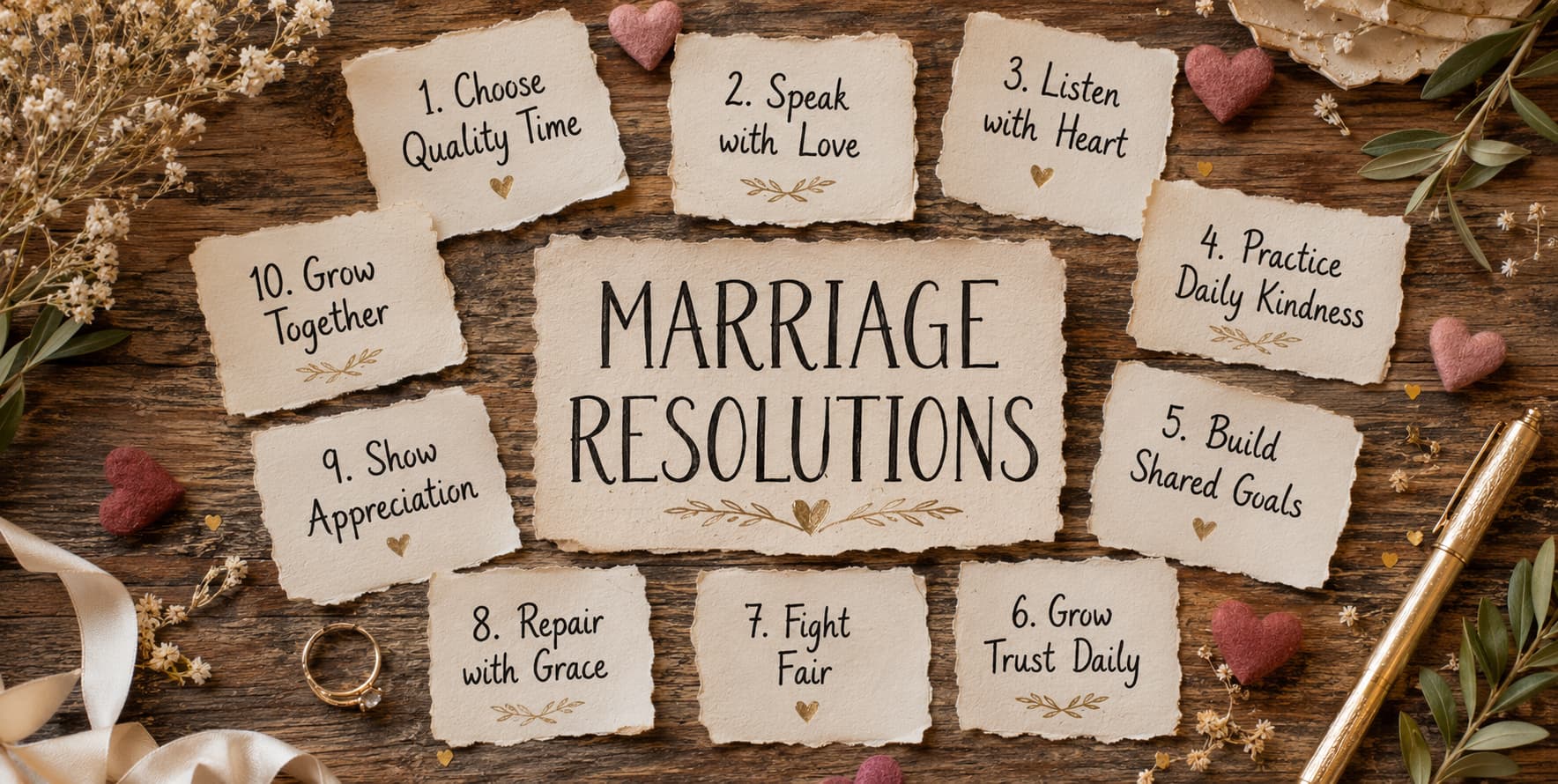



No marriage is free of mistakes. What separates couples who grow closer from those who slowly drift apart isn't whether they hurt each other — it's whether they learn to repair it.
Apology and forgiveness in marriage are how two people turn a painful moment into a turning point, instead of a wound that quietly festers.
Maybe you've hurt your spouse and don't quite know how to make it right. Maybe you're the one carrying the hurt, unsure whether you can forgive.
Either way, what follows isn't a magic fix or a script to recite — just honest, practical ways couples find their way back to each other.
Most of the distance in a marriage doesn't come from one dramatic betrayal. It comes from small hurts that never get repaired, stacking up over months until two people start to feel like strangers under the same roof.
Learning to apologize sincerely and forgive genuinely is how you keep that distance from setting in.
Disclaimer
This article is for educational purposes only and isn't a substitute for professional advice. It's based on general relationship principles, not personalized counseling or therapy.
Please seek professional help right away if you're dealing with abuse, substance issues, depression, or you ever feel unsafe. Every relationship is different — what works for one couple may not work for another, and serious issues deserve qualified support.
Why Repair Skills Matter in Marriage

Every healthy marriage needs tools for handling conflict well. No couple is perfect, but partners who learn how to repair after a rupture tend to feel more connected and more secure with each other.
Think about it: most of us spend years learning practical skills like driving or cooking, yet almost no one teaches us how to mend a relationship after we've hurt someone. These repair skills sit right alongside everyday communication habits — the two reinforce each other — and since conflict in marriage is unavoidable, knowing how to recover from it is quietly one of the most useful things you can learn.
What Research Generally Shows About Forgiveness
Studies tend to point in the same direction: couples who handle conflict constructively report more satisfying, more stable relationships. In broad strokes, the research suggests that:
- Partners who take responsibility for their mistakes usually face less ongoing conflict.
- Working through forgiveness supports emotional healing over time.
- Couples who talk openly about hurts tend to feel more connected.
- Repair skills can genuinely be learned and strengthened with practice.
It's worth remembering that every marriage is its own world — what works beautifully for one couple may land differently for another.
When Repair Skills Are Missing
Without healthy ways to repair, small hurts pile up into bigger problems. Some couples describe walking on eggshells, or feeling like their partner has "changed completely," when really it's the unaddressed hurts that have slowly built a wall between them.
Signs that better repair skills might help include:
- Having the same argument over and over without ever resolving it
- Feeling emotionally distant from your partner
- Avoiding hard conversations altogether
- Holding on to grudges from past hurts
- Feeling like your partner just doesn't get your side
The hopeful part is that these skills can almost always be developed — with a little patience and practice.
How to Give a Sincere Apology: A 4-Step Approach
Not every apology does the same work. A quick "sorry" tossed over your shoulder while you're distracted rarely lands for a partner who's genuinely hurt. A real apology takes intention, presence, and honest remorse.
The 4-Part Apology Framework
A simple framework many counselors and marriage educators use breaks a meaningful apology into four steps:
1. "I was wrong." Take clear responsibility without slipping in excuses. Instead of "I'm sorry, but you also…," try "I was wrong to brush off your concerns about our budget."
2. "I'm sorry." Name the impact, not just the act. "I'm sorry my dismissive tone made you feel unheard and unimportant."
3. "Please forgive me." This shows you're after real reconciliation, not just an end to the discomfort. Remember — forgiveness can be asked for, never demanded.
4. "I love you." Reaffirm your commitment. This says the relationship matters more to you than being right.
What Makes an Apology Land
A few things tend to make an apology feel real rather than rushed:
Timing. It often helps to apologize once the heat has cooled but before the hurt has hardened — sometimes thirty minutes, sometimes a few hours. Read the moment.
Presence. Put the phone down, make eye contact, face your partner. Your body says as much as your words.
Specifics. "I'm sorry I criticized your cooking in front of your mother" lands far better than a vague "sorry for everything."
Proportion. If your partner is deeply hurt, a casual response can feel dismissive. Let the weight of your apology match the weight of the hurt.
Understanding Forgiveness: Types and Process
Forgiveness is one of the most misunderstood words in marriage. It helps to be clear about what it actually involves — and what it doesn't.
Three Kinds of Forgiveness
Researchers who study forgiveness, including psychologist Everett Worthington, describe it as unfolding in more than one way — which is why you can decide to forgive long before you feel like you have:
Decisional forgiveness. You consciously choose to let go of resentment and treat your partner with kindness, even when the feelings haven't caught up yet. You may still ache, but you decide to act with love. This usually comes first.
Emotional forgiveness. This is when your feelings finally line up with your decision — the anger softens, the hurt loosens its grip, and warmth genuinely returns. It tends to take longer, but it's the kind that brings lasting peace.
Behavioral forgiveness. This shows up in what you do: choosing to be open again, lowering the walls you put up, slowly letting trust grow back. It's often the last piece to fall into place.
Knowing these are separate can help you be gentle with yourself and your partner — moving through forgiveness rarely happens all at once.
What Forgiveness Does NOT Mean
- Excusing harmful behavior — you can forgive and still expect things to change.
- Forgetting it happened — memory doesn't work like that.
- Snapping straight back to full trust — trust rebuilds gradually, through consistent action.
- Weakness — real forgiveness usually takes considerable strength.
- Skipping accountability — forgiveness and consequences can live side by side.
A Simple Forgiveness Process
Many people find this gentle, step-by-step approach helpful:
- Name the hurt: "When you broke our agreement, I felt betrayed and let down."
- Acknowledge the impact: "It shook my trust and left me feeling less safe with you."
- Make a conscious choice: "I'm choosing to work toward forgiving you — for my own peace, and for us."
- Look forward: "Let's talk about how we rebuild trust and keep this from happening again."
This works for both major betrayals and the smaller, everyday hurts — though the intensity and the timeline will look very different.
Common Apology Mistakes to Avoid
Even a well-meant apology can backfire. Here are the patterns that tend to add hurt instead of healing it.
The Non-Apology
Sounds like: "I'm sorry you feel that way" or "I'm sorry if I hurt you."
The problem: it apologizes for their feelings, not your actions.
Try instead: "I'm sorry I hurt you by canceling our plans without talking to you first."
The Defensive Apology
Sounds like: "I'm sorry, but I was stressed from work."
The problem: the word "but" quietly cancels the apology.
Try instead: "I'm sorry I snapped at you. Work stress is real, but it doesn't excuse how I treated you."
The Rushed Apology
Sounds like: a quick, distracted "sorry" while you're doing three other things.
The problem: it reads as dismissive, even when you mean it.
Try instead: stop, look up, and give your partner your full attention.
The Complex-Situation Apology
Sometimes you believe your decision was genuinely necessary, yet you can see it hurt your partner. In those moments, an "impact apology" can open a door:
"I can see that working late without calling hurt you, even though I felt I had to handle the emergency. I'm sorry for how that landed on you. Help me understand how to handle something like this better next time."
It honors their pain while keeping the conversation open.
Rebuilding Trust in Marriage: A Gradual Process
Apology and forgiveness open the door to rebuilding trust — but trust itself comes back slowly, through consistent action over time, not a single conversation.
How Trust Tends to Come Back
Trust usually rebuilds in phases, though everyone's experience differs:
The early crisis (days to weeks). Emotions run high and the focus is just on basic communication and feeling safe. That's normal.
Building a foundation (weeks to months). New, steadier behaviors get put in place, the deeper issues get faced, and a sense of security slowly starts to return.
Settling in (months to years). Trust starts to feel more natural again, closeness gradually returns, and the tender spots that remain can be talked through.
A new normal (no fixed timeline). Many couples find that trust eventually feels solid again — sometimes even stronger than it was before.
Practical Steps for Rebuilding Trust
If you're the one who broke trust:
- Follow through on the small promises, every time.
- Share what you're doing and how you're feeling, before you're asked.
- Be patient with your partner's healing.
- Let your changed behavior, not just your words, do the talking.
If your trust was broken:
- Say what you need clearly and specifically.
- Notice the positive changes out loud when you see them.
- Try to weigh today's behavior more than yesterday's mistakes.
- Be patient with your own healing, too.
Why Consistency Is Everything
Trust grows back through trustworthy behavior repeated over time — things like:
- Keeping promises, even the tiny ones.
- Being open about where you are and what you're doing.
- Showing up emotionally when your partner needs you.
- Following through on the changes you committed to.
Practical Repair Tools for Daily Use
Here are a few simple habits couples lean on to keep small hurts from turning into big ones.
The 24-Hour Guideline
Where you can, try to address a hurt within about a day. That's usually enough time for the first sting to settle, but not so long that resentment sets in. Some hurts need more time, and that's fine too.
The Emotional Check-In
Before a sensitive conversation, both of you might pause and notice where you are emotionally. If either of you is too worked up to talk well, taking a little more time to settle is a kindness, not avoidance.
Regular Maintenance
Some couples build in a simple, recurring question: "Is there anything I should apologize for lately?" or "How are you feeling about us?" These small check-ins catch the little things before they grow.
Knowing Your Partner's Repair Style
People repair differently. Some want to talk it out right away; others need time to process first. Some find comfort in closeness, others need a bit of space at first. Learning your partner's style makes every repair smoother.
A 7-Day Repair Practice
If you'd like to put some of this into practice, here's a gentle week-long rhythm:
Day 1. Notice one place where you might owe an apology — or where you're holding something you could forgive. Just notice, no judgment.
Day 2. If an apology feels right, shape it using the four-step framework. If you're ready to forgive, picture what that might look like for you.
Day 3. Have the conversation if you both feel ready. Aim for present and genuine, not perfect.
Day 4. Follow up — ask how you can support the repair from here.
Day 5. Give it room. Healing takes time, and that's completely normal.
Day 6. Look for small, consistent ways to show you mean what you said.
Day 7. Reflect together on what you learned, and how you'd like to handle the next bump differently.
When to Reach for Professional Help
Sometimes repair needs more than the two of you can manage alone. It's worth talking to a qualified marriage counselor or couples therapist if:
- You keep circling the same conflicts without ever resolving them.
- One of you really struggles to apologize, or to forgive.
- Trust has been badly damaged by a major betrayal.
- You feel stuck in a loop of hurt and resentment.
- Conversations regularly collapse into criticism, defensiveness, or stonewalling.
- You're facing abuse, addiction, or another serious issue.
- Or you simply want skilled guidance to help your relationship grow.
A good therapist offers personalized strategies and a safe space for the conversations that feel too hard to have alone.
FAQs — Apology and Forgiveness in Marriage
How long should I wait before apologizing?
It depends on the situation and where you both are emotionally. Often, waiting until the first wave of anger has passed — twenty minutes to a few hours — helps, as long as you don't wait so long that the hurt hardens. Trust your read on the moment.
What if my partner won't accept my apology?
An apology can't be forced to land. Make yours genuine and complete, then give your partner room to process. Sometimes it takes more than one conversation, and sometimes a counselor's help makes the difference.
How do I forgive when I'm not ready?
Forgiveness is usually a process, not a single moment. You can start by deciding to work toward it, even before the feelings follow. Many people find that caring for their own emotional health is what eventually makes room for forgiveness.
Can a marriage recover from a major betrayal?
Many do. It usually takes real commitment from both partners and often the support of a professional. Recovery is possible, though never guaranteed, and it takes time. If betrayal is what you're facing, our step-by-step guide to marriage after betrayal walks through the healing.
What if we both need to apologize?
It's often easier to take apologies one at a time. One person apologizes, lets it be received, and then the other offers theirs. That keeps the conversation from turning into a contest over who was "more wrong."
Moving Forward with Realistic Hope
Apology and forgiveness aren't magic — but offered with sincerity, patience, and realistic expectations, they're two of the most powerful tools a couple has. They turn conflict from something that pulls you apart into something you can actually grow through.
The strongest marriages aren't the ones without conflict. They're the ones where both people have learned to repair the damage with grace. Every honest apology says "you matter to me." Every act of forgiveness says "we're worth it."
Real change comes gradually, through steady, caring action — not a dramatic overnight transformation. Start small, be patient with the process, and learning to repair conflict well becomes, quietly, one of the surest ways to keep a marriage from drifting toward divorce.
And if you're wrestling with something serious, please don't try to carry it alone — a skilled marriage therapist can offer guidance that general advice never can.
A Few Books Couples Come Back To
If you'd like to go deeper, two that couples and counselors return to often:
- When Sorry Isn't Enough by Gary Chapman & Jennifer Thomas — on the art of a real apology — view on Amazon
- Forgiving and Reconciling by Dr. Everett Worthington — on the science and practice of forgiveness — view on Amazon
As an Amazon Associate, EyesMata may earn from qualifying purchases — at no extra cost to you.
Looking for support? A qualified marriage counselor or couples therapist can offer guidance tailored to your situation and help you build repair skills that last.