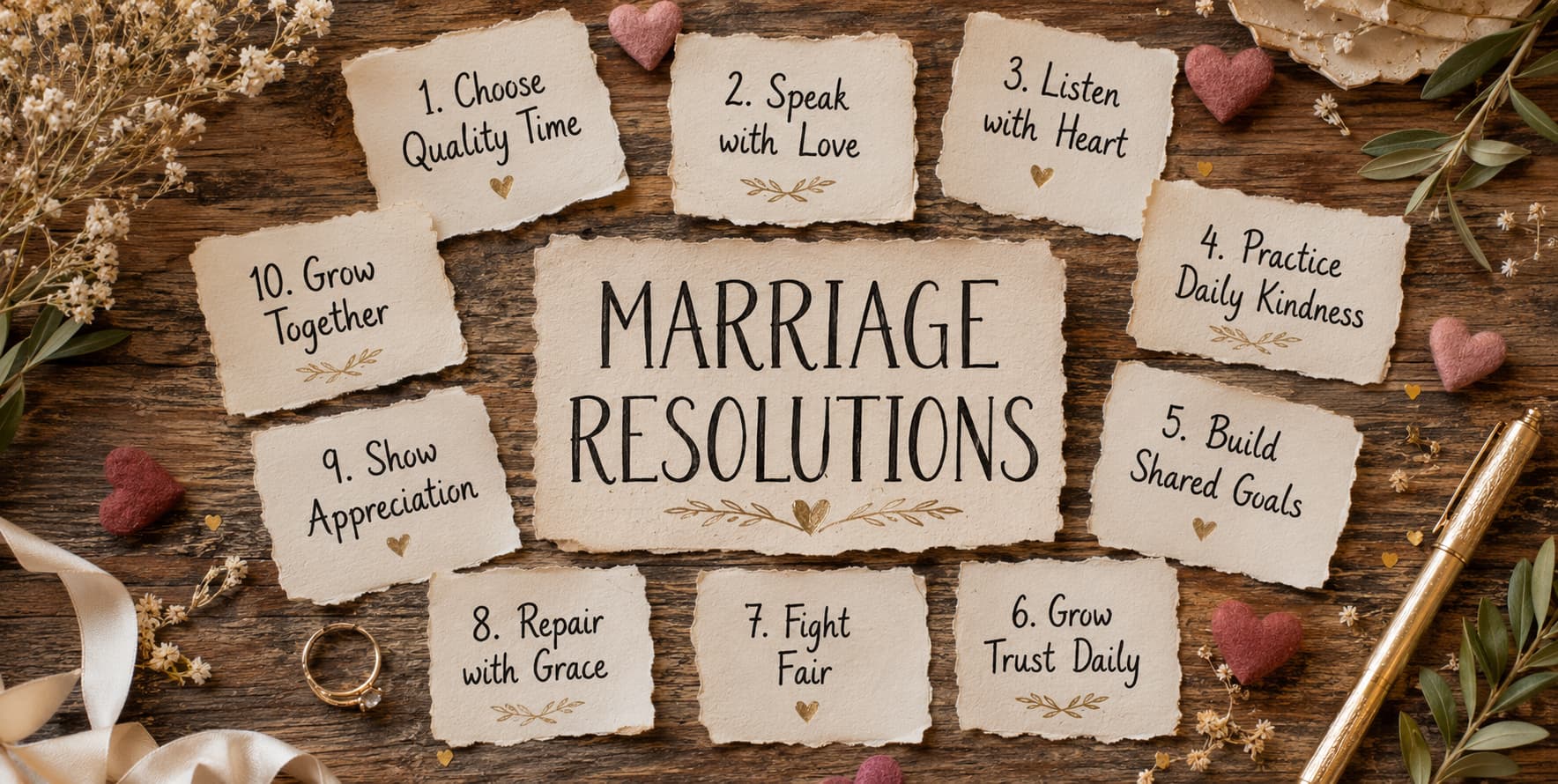




Nobody warns you that the hardest part of marriage isn’t the big dramatic stuff. It’s the Tuesday nights. The ordinary moments where you choose each other again, or quietly don’t.
Most marriage advice skips right past that. You get the pretty quotes, the someday-you’ll-understand smiles, and the cookie-cutter tips that sound lovely until real life shows up at the door.
This isn’t that. What follows is honest. None of it is groundbreaking — some of it you’ve probably heard before. But there’s a wide gap between hearing something and actually living it, and that gap is where most of us get stuck. Love that lasts is built, not found. These are some of the bricks.

1. You’re not trying to win
Somewhere along the way a lot of couples start keeping score, and once you’re keeping score you’ve already lost — both of you. The goal was never to be right. It was to get through the thing together and still like each other on the other side.
Next time you feel the argument tightening, try saying it out loud: we’re on the same team here. It sounds almost too simple. It works anyway.
2. Closeness needs a calendar (yes, really)
This is the unromantic part nobody likes admitting. When you were dating, closeness happened on its own. Married, with jobs and kids and a mortgage, it mostly doesn’t. It waits for an opening that never comes.
So you make the opening. Fifteen minutes before bed with no phones. A standing Friday. Whatever fits your life. Putting connection on the calendar feels clinical right up until the week you skip it and feel the difference. (More on protecting that time in our guide to quality time in marriage.)
3. Say the actual thing
Your partner can’t read your mind, and resentment grows beautifully in the space between what you wanted and what you actually said. “I wish you’d help more” gives them nothing to do with. “Can you take the kids Tuesday and Thursday nights?” gives them something to say yes to.
Counselors teach a small formula for this: name the feeling, name the moment, name the ask. I feel stretched thin when bath time lands on me every night. I need you to take two of them. Awkward at first. Then it just becomes how you talk. (Our guide on how to fix communication in a relationship has more of these.)
4. Sometimes listening is the whole job
Here’s a hard one for the fixers. When your partner comes to you upset, the instinct is to solve it. Often they don’t want it solved. They want to be heard by the one person whose opinion they actually care about.
You can just ask: do you want me to help, or do you want me to listen? It saves a remarkable number of pointless fights.
5. Keep flirting
You flirted your way into this. There’s no rule that says it has to stop at the wedding. A text in the middle of a boring workday. Noticing the shirt. Catching their eye across a crowded room like you still can’t quite believe your luck.
It costs nothing and it keeps something alive that quietly dies in a lot of long marriages — the sense that you still choose this person, not just live with them.
6. You’re both going to keep changing
The person you married at twenty-five is not the person you’ll be married to at forty-five. People grow. Their dreams shift. That’s not a betrayal of the deal — it is the deal.
The trick is to grow toward each other on purpose, and to treat your partner’s changes with curiosity instead of fear. “You’ve changed” can be an accusation. It can also just be true, and even a little wonderful.
7. Separate beds aren’t a failure
If one of you snores like a chainsaw or kicks all night, and you’ve both been quietly exhausted for years, you’re allowed to sleep apart. No marriage was ever saved by lying awake resentful at 3 a.m.
Rest makes you kinder. Kindness makes the marriage. Do the math however works for your bodies, and skip the guilt.
8. Forgiveness is a habit, not an event
The big betrayals get all the attention, but most marriages aren’t undone by one explosion. They’re worn down by a thousand small hurts nobody ever bothered to clear. The forgotten promise. The tone. The thing they always do.
You can’t store those up. You let them go in small batches, regularly, the way you’d empty a trash can before it overflows. Forgiveness in a marriage isn’t one grand gesture — it’s a maintenance habit. (We go deeper on this in apology and forgiveness in marriage.)
9. You can love each other and still feel far apart
Don’t panic the first time the spark dims. It will. It comes back. Distance doesn’t mean the love is gone — usually it just means life got loud and the two of you stopped checking in. (When that drift goes unchecked for too long, it can harden into marriage burnout.)
A simple question, asked now and then: how are we doing, you and me? Not the kids, not the bills. You two. Most couples never ask it until something’s already broken.
10. The fight is almost never about the dishes
When you find yourself genuinely furious about a sink full of plates, it’s worth pausing. The plates are rarely the point. Underneath is usually something quieter: I feel like I’m carrying this alone. I don’t feel seen. You don’t seem to notice what I do.
Get to that, and the dishes more or less sort themselves out.
11. Praise out loud, more than you criticize
The relationship researcher John Gottman spent decades watching couples and found that the ones who lasted shared roughly five positive moments for every negative one — a glance, a thank-you, a small kindness. The ratio holds up because nobody stays soft toward a person who only ever points out what’s wrong.
So say the good things you usually only think. The dinner was great. You handled that call well. I’m glad it’s you.
12. Stop measuring your marriage against other people’s highlight reels
Instagram shows you the anniversary post, not the silence on the drive home. The surprise trip, not the argument that funded the guilt behind it. Every couple you envy is also, somewhere, doing the unglamorous work — or quietly falling apart while smiling for the camera.
Your marriage isn’t behind. It’s just yours, and it’s the only one you actually have to live in.
13. A good date costs attention, not money
You don’t need a sitter and a tasting menu. You need each other’s full attention for an hour, which is harder to come by than money these days. A walk after dinner. Coffee in the car before the day starts. Thirty minutes with both phones in the other room.
The luxury isn’t the venue. It’s being properly looked at by the person you love.
14. Wanting time alone doesn’t make you a bad wife
You’re allowed to want a quiet hour with a book and no one needing anything from you. That’s not selfish and it’s not a sign that something’s wrong with the marriage. It’s how you refill so you have something left to give.
A person who never gets a moment to themselves slowly turns into someone they don’t like. Protect your peace. You’ll come back warmer for it.
15. Resentment is quiet until suddenly it isn’t
This is the one that ends marriages while everyone insists things are fine. Unspoken frustration doesn’t disappear. It hardens, slowly, into distance — and by the time it finally comes out, it’s been collecting interest for years. (It’s one of the quieter forces behind the kind of slow drift our guide on how to avoid divorce is built around.)
Catch it early. Say the small annoyance while it’s still small and reasonable, before it becomes the thing you bring up in every fight for the next decade.
16. Counseling isn’t the ambulance — it’s the gym
A lot of people only think about therapy when the marriage is already on fire, then treat going as an admission of failure. Flip it. Couples counseling is closer to a gym membership: you go to stay strong, not because you’ve collapsed.
Some of the steadiest couples you know have sat on a therapist’s couch on purpose, with nothing dramatic going on. That’s not weakness. That’s maintenance.
17. He can’t heal a hurt he doesn’t know about
Bottling it up feels noble — you’re keeping the peace, not making a fuss. But silence doesn’t protect a marriage. It just quietly starves it, and leaves your partner confused about why you’ve gone cold. (Feeling safe enough to say the hard thing is part of feeling secure in a relationship.)
Give him the chance to show up for you. Say the thing, even when your voice shakes. People can only reach for you if they know where you’re standing.
18. What makes them feel loved will change — so keep asking
Gary Chapman built a whole framework around this: some people feel loved through words, others through time, touch, help, or small gifts. What’s easy to forget is that it shifts. What landed for your partner ten years ago, in a different season of life, might not land now.
So don’t assume. Ask, every so often: what makes you feel most loved these days? The answer is allowed to surprise you.
19. Fair doesn’t always mean fifty-fifty
Some seasons, one of you simply has to carry more — a new baby, an illness, a brutal stretch at work. Insisting on a perfect even split through all of it just turns the marriage into an accounting dispute.
Real partnership means trusting that it evens out over the long run, and being the one who carries more when it’s your turn, without keeping a ledger about it. (Our guide on the division of labor in marriage digs into how to keep it fair without scorekeeping.)
20. Never stop saying thank you
For the coffee. For taking the bins out. For going to work on a grey Monday for the hundredth time. The small thank-yous are easy to drop once you’ve gotten comfortable, and dropping them is exactly how comfort curdles into being taken for granted.
Gratitude, said out loud and often, is one of the cheapest and most powerful things you can do for a marriage.
21. Marriage is a daily yes
No relationship stays strong on autopilot. The vows were one big yes; the marriage is a thousand small ones, said quietly, especially on the days you don’t feel like it. I’m choosing you today — even when today is hard, even when you’re tired, even when they left the cabinet open again.
That daily, unglamorous choice is the whole thing. Everything else is decoration.
22. Build a few small rituals
The couples who feel close usually have little anchors woven through the week — coffee together before the house wakes up, a walk after dinner, Sunday morning with nowhere to be. Nothing fancy. Just yours.
Rituals give a marriage a rhythm to return to when life gets chaotic. They’re the small, repeated proof that you keep coming back to each other on purpose.
23. Protect the marriage from the peanut gallery
Everyone has an opinion about your relationship — your mother, your best friend, the group chat. Some of it is loving. Not all of it deserves a vote. The fastest way to weaken a marriage is to let too many outside voices into the room where you two are supposed to figure things out.
Sort it out privately. Present a united front. What happens between you stays between you, unless you both decide otherwise.
24. Learn to repair fast
You’re going to mess up — both of you, regularly. What separates the couples who last isn’t fewer fights; it’s how quickly they find their way back. A softened tone mid-argument. A hand on a shoulder. A small I’m sorry, let me try that again.
Gottman called these “repair attempts,” and they matter more than the fight itself. A clumsy repair beats a perfect silence every time.
25. Stay curious about the person you married
It’s strange, but you can share a bed with someone for twenty years and slowly stop being curious about them. You assume you already know. Mostly you know the old version.
Keep asking. What are they afraid of now? What do they want that they’ve never said out loud? Curiosity is what kept you up talking at the beginning, and it’s what keeps a marriage feeling alive long after the beginning is over.
The Honest Bottom Line
Marriage was never about getting it perfect. It’s about showing up, owning it when you get it wrong, and choosing the same person again and again with your eyes open.
You don’t need all twenty-five of these at once. Pick the two or three that landed hardest — the ones that made you a little uncomfortable, probably — and live them for the next month. That’s enough. A strong marriage isn’t built in a weekend. It’s built the same way it’s always been built: one ordinary, intentional day at a time.
FAQ — Marriage Advice
What’s the single most important thing for a long marriage?
If it came down to one: stay emotionally safe with each other. Keep choosing connection over being right, and stay curious about who your partner is becoming. Everything else grows out of that.
How do we bring back intimacy when it’s faded?
Gently, and on purpose. Talk honestly about what makes each of you feel close — emotionally and physically — and then actually make room for it instead of waiting for it to happen on its own.
Is it normal to fall out of love sometimes?
Yes, and it usually isn’t the end. Love is partly a feeling and partly a daily decision. When the feeling dims, the decision is what carries you back. Most couples drift and reconnect more than once.
How do we stop fighting about little things?
Look underneath them. The small fight is almost always standing in for a bigger feeling — feeling unseen, unappreciated, or alone. Name the real thing and the little fights lose most of their fuel.
When should we try counseling?
Sooner than you think you need to. Counseling works best as upkeep, before things feel broken — not as a last resort once the damage is deep.
How often should we really talk — properly?
A short, honest check-in once a week does more than most couples expect. You don’t have to wait for a crisis to ask how the two of you are doing.
Two Books, If You Want to Go Deeper
Both of these come up by name in the tips above — and both are worth the shelf space:
- The Seven Principles for Making Marriage Work by Dr. John Gottman — the research-backed classic behind the 5:1 ratio and repair attempts — view on Amazon
- The 5 Love Languages by Gary Chapman — for figuring out how each of you actually feels loved — view on Amazon
As an Amazon Associate, EyesMata may earn from qualifying purchases — at no extra cost to you.