


Marriage resolutions for wives: 10 small promises that quietly build a stronger marriage.
A new year always brings that quiet pull to start fresh — to love a little better, to build something that lasts. If you’re a wife hoping to make this your strongest marriage year yet, you’re in the right place.
Strong marriages don’t happen by accident. They’re built by women making small, intentional choices, day after day, to tend the relationship.
These resolutions aren’t about being a perfect wife — they’re about steady progress and real connection.
Why Marriage Resolutions Are Worth Making
It’s easy to dismiss resolutions as something you’ll forget by February. But marriage resolutions have one big advantage: a built-in partner.
Between digital distraction and packed schedules, real connection has to be chosen on purpose now; more couples want to thrive, not just survive; and the more we learn about wellbeing, the clearer it is that a healthy marriage rests on healthy daily habits.
The point isn’t a dramatic overhaul — it’s small, sustainable changes that actually hold.
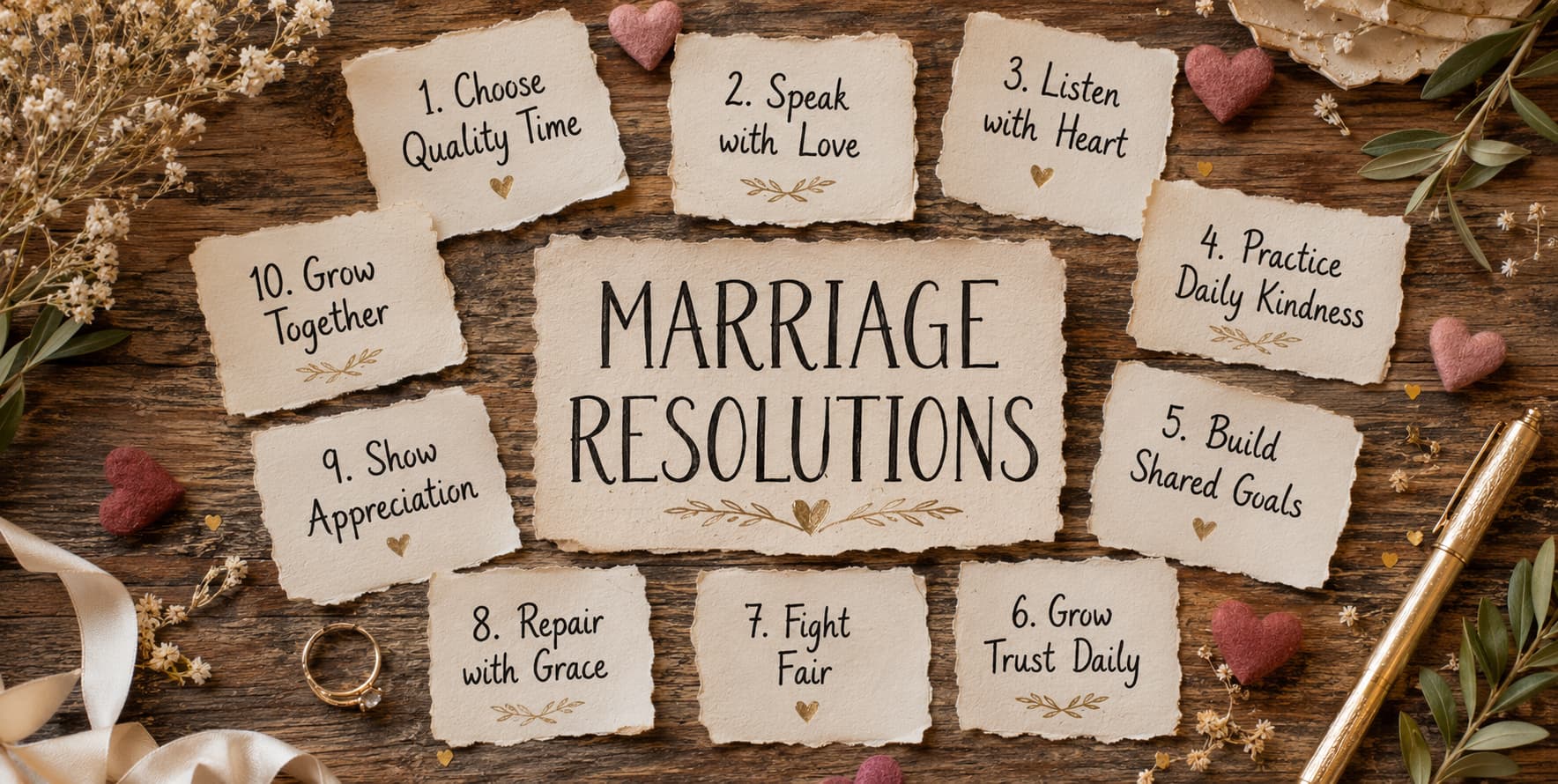
10 Marriage Resolutions Every Wife Can Make (and Keep)
1. Prioritise Sacred Quality Time Together
“I will create intentional moments of connection with my husband, free from distractions.”
In a hyperconnected world, undistracted time has become rare — and it’s exactly what builds emotional closeness. Our guide on quality time in marriage has simple ways to protect it.
- Keep at least three “no-phone dinners” a week
- Plan a monthly, screen-free date
- Build a weekly ritual — maybe Sunday coffee where you share the week ahead
- Spend twenty minutes a day talking about something other than logistics
2. Master Open, Honest Communication
“I will speak my truth with love and listen with my whole heart.”
Communication isn’t only about talking — it’s about a safe space where both of you can be honest. If conversations tend to go sideways, our guide on how to fix communication in a relationship breaks down the patterns.
- A daily check-in: “How are we doing today?”
- The 24-hour rule — sit with big topics for a day before responding
- Swap “you always…” for “I feel… when…”
- Reflect back what you heard before you reply
3. Practise Daily Acts of Kindness
“I will show love through small, meaningful gestures every day.”
The magic isn’t in grand gestures. Dr. John Gottman’s research found that couples who keep up small kindnesses and appreciation tend to have more resilient marriages.
- Leave a note somewhere he’ll find it
- Bring him his coffee without being asked
- Send a midday text naming something specific he did
- Compliment his character, not just his actions
4. Set and Pursue Shared Goals
“I will actively help build our future together.”
Couples who work toward shared goals tend to feel more like a team. It’s not only about money — it’s a shared vision. Our list of long-term goals for married couples is a good place to start the conversation.
- A health goal — a morning walk, cooking better together
- A money goal — a trip, a house, an emergency fund
- A growth goal — a book or a new skill you take on together
- A family goal — a tradition, a project, a way of giving back
5. Build Trust Through Consistency
“I will be reliable in the small things and honest in all things.”
Trust is built in the daily choice to be consistent and to own your mistakes. And when it’s been damaged, it’s rebuilt slowly — through patience and changed actions, not just words. Our guide on marriage after betrayal walks through that road with care.
- Keep your promises, even the small ones
- Admit when you’re wrong without deflecting
- Be where you said you’d be, when you said you’d be there
- Share your struggles instead of hiding them
6. Turn Conflict Into Connection
“I will fight fair and seek understanding, not victory.”
Conflict isn’t the enemy of marriage — poor conflict handling is. Couples who learn to disagree well often come out closer. Repairing quickly is the heart of it, and our guide on apology and forgiveness in marriage goes deeper there.
- Take a break if emotions run high, and come back calmer
- Attack the problem, not the person
- Start hard conversations gently
- Apologise quickly when you cross a line
A simple script when it’s hard: “I feel [emotion] about [situation]. I need [need]. Can we figure this out together?”
7. Nurture Physical and Emotional Intimacy
“I will protect our connection as partners, not just co-parents.”
Intimacy is more than touch — it’s closeness, vulnerability, and staying lovers rather than roommates. Much of it grows from feeling safe with each other, which our guide on feeling secure in a relationship explores.
- Non-sexual touch — a long hug, holding hands, sitting close
- Share your fears and dreams, not just the logistics of the day
- Keep a little romance alive — flirt like you’re dating
- Talk honestly about needs, and be patient when intimacy ebbs and flows
8. Celebrate Each Other’s Wins
“I will be his biggest cheerleader and celebrate his wins as my own.”
How you respond when your partner shares good news turns out to matter a great deal for satisfaction — your warmth in that moment is its own kind of gift. Reading those moments well is part of emotional intelligence in relationships.
- Match his energy when he shares good news
- Ask “What was the best part?”
- Find your own way to celebrate wins together
- Once a month, name out loud what you appreciated
9. Protect Your Marriage from Outside Pressure
“I will set boundaries that keep our connection from being squeezed out.”
Modern life is full of demands, and without boundaries the marriage is often the first thing to get crowded out. That slow squeeze, left unchecked, is also how couples drift toward marriage burnout.
- No phones during meals, or the first hour home
- Kindly but firmly limit unsolicited advice
- Leave work stress at the door when you can
- Choose couple time over some social obligations
10. Track Your Progress and Adjust
“I will check in on our resolutions and adjust as we go.”
The difference between goals that stick and goals that fade is following up — and a built-in partner makes that easier.
- A weekly “how are we doing?”
- A monthly review of what’s working and what isn’t
- A small quarterly celebration of progress
- An annual look back, and a look ahead
Making Them Stick
Most resolutions fade within a few weeks — but a few small habits change the odds. Start with one or two, not all ten. Attach a new habit to an existing routine (gratitude during morning coffee).
Build a system, not just a wish — “a ten-minute check-in after dinner,” rather than “communicate better.” Celebrate small wins weekly, not only once you’ve mastered something.
And most of all, bring your husband in. These are your promises, but a shared effort holds far better than a solo one.
When It Feels Hard
A few honest snags, and what tends to help:
- “He’s not interested.” Start with yourself — change in one partner often draws the other in.
- “We’re too busy.” Begin with five minutes a day and build from there.
- “We’ve tried and failed.” Past tries aren’t predictions — ask what was different, and adjust.
- “Our problems feel too big.” Resolutions help, but they’re not magic. For serious issues — addiction, abuse, infidelity — get professional support alongside.
Frequently Asked Questions
What are the most effective marriage resolutions?
The ones that focus on daily connection, honest communication, small kindnesses, shared goals, and steady trust-building. They compound over time and meet the real needs of a busy marriage.
How do I keep my marriage resolutions all year?
Start small, track gently, lean on a little accountability, and adjust when something isn’t working. Monthly check-ins and celebrating small wins keep the momentum alive.
Should I make resolutions even if my marriage is strong?
Yes. Strong marriages stay strong through ongoing intention. Resolutions help good relationships grow, and catch small issues before they become big ones.
What if my husband thinks they’re silly?
Lead by example. Focus on what you can change yourself, and let the results speak. Reluctant partners often warm up once they feel the difference.
What’s the difference between marriage resolutions and relationship goals?
Resolutions are usually personal commitments you make to improve how you show up. Relationship goals are objectives you set together as a couple. They work best side by side.
Start With One Promise
A stronger marriage doesn’t ask for perfection — it asks for intention. Every day you choose to show up with love, you’re quietly writing a better love story.
So pick the one promise that landed hardest, tell your husband, and start this week. That’s how it begins — one small, intentional yes at a time.
A note: these are suggestions based on common relationship principles, and every marriage is different. If you’re facing serious difficulties — abuse, addiction, or mental-health concerns — please reach out to a qualified professional. Your safety comes first.
Two Books Worth a Look
If you’d like to go deeper, two stand out:
- The Seven Principles for Making Marriage Work by Dr. John Gottman — the research-backed classic behind much of the advice above — view on Amazon
- The 5 Love Languages by Gary Chapman — for showing love in the way your partner actually feels it — view on Amazon
As an Amazon Associate, EyesMata may earn from qualifying purchases — at no extra cost to you.